There are dozens of fiber optic connector designs on the market, but most networks rely on fewer than six. If you are selecting connectors for a data center build, an FTTH rollout, or a campus upgrade, the real question is not "which types exist" but "which one fits this specific environment." This guide covers the connectors that actually matter in current deployments, explains how to match them to your project, and flags the mistakes that cause problems in the field.

Fiber Connector Comparison at a Glance
Before diving into details, this table summarizes the key differences among the most widely deployed connector types. Use it as a quick reference when evaluating options for your project.

| Connector | Ferrule Size | Coupling Mechanism | Typical Fiber Count | Best-Fit Environment | Key Strength | Main Limitation |
|---|---|---|---|---|---|---|
| LC | 1.25 mm | Latch clip (push-pull) | 1–2 (simplex/duplex) | Data centers, high-density panels, transceiver ports | Compact size, high port density | Not ideal for multi-fiber trunk cabling |
| SC | 2.5 mm | Push-pull snap-in | 1–2 | FTTH, PON, telecom access networks | Reliable mating, widely supported in FTTH gear | Larger footprint limits panel density |
| ST | 2.5 mm | Bayonet twist-lock | 1 | Legacy multimode LANs, campus networks | Secure bayonet coupling | Rarely specified in new builds |
| FC | 2.5 mm | Threaded screw-on | 1 | Test labs, measurement equipment, some single-mode links | Very stable, vibration-resistant connection | Slow to mate; low density |
| MPO/MTP | Rectangular ferrule | Push-pull with guide pins | 8, 12, 24, or more | Data center trunks, 40G/100G/400G parallel optics | Multi-fiber in a single mating | Polarity management is complex |
How to Choose the Right Fiber Connector by Environment
Connector selection should start with the deployment environment, not with a product catalog. The same connector that performs well in a data center may be the wrong choice for a field install or an access network. Below are the most common scenarios and the connectors that fit each one.

Data Centers and High-Density Patching
LC is the standard duplex connector for most data center patching. Its 1.25 mm ferrule takes up roughly half the panel space of an SC, which matters when you are filling a 1U or 2U patch panel with dozens of ports. Nearly all current SFP, SFP+, SFP28, and QSFP transceivers use LC interfaces on the line side. If you are building or expanding a structured cabling system with high-density LC fiber solutions, LC duplex assemblies are typically the starting point.
When a single trunk cable needs to carry 8, 12, or 24 fibers between cabinets, MPO/MTP connectors are the practical choice. They are used in 40G QSFP+ and 100G QSFP28 parallel optics, and in breakout assemblies that fan out to individual LC ports. The tradeoff is that TIA-568.3 defines multiple polarity methods (A, B, C, U1, U2) for array connectors, and mixing methods within the same cable plant creates connectivity failures. Choose one polarity method early and stick with it across the entire installation.
FTTH and PON Access Networks
SC-APC is the most widely deployed connector in FTTH networks globally. The angled polish on SC-APC reduces back-reflectance below −60 dB, which matters in passive optical networks where reflected light can degrade signal quality across PLC splitters and short single-mode links. If your project involves residential access, PON distribution, or FTTH passive component procurement, SC-APC is typically the default, not because it is technically superior in every way, but because the installed base, field tools, and ONT equipment overwhelmingly support it.
LC-APC is gaining traction in some next-generation PON deployments, particularly where equipment vendors are designing for higher density. However, the transition is gradual, and SC-APC remains dominant in the access layer for now.
Test Labs and Precision Measurement
FC connectors still appear regularly on optical power meters, OTDRs, and reference-grade test jumpers. The threaded coupling provides a repeatable, vibration-resistant connection that does not shift during measurement. In environments where you are setting a zero reference per FOA test procedures or performing insertion loss testing, the slight inconvenience of threading an FC connector is offset by the stability it provides. That said, many newer test instruments now ship with LC or SC ports, so FC is gradually becoming less common even in lab environments.
Legacy Campus and Building Networks
ST connectors with their bayonet-style twist-lock were widely deployed in multimode campus backbones during the 1990s and 2000s. You will still find them in older building networks, especially in horizontal runs terminated at wall outlets. When maintaining or extending these environments, it often makes more sense to continue with ST for consistency than to reterminate an entire floor, unless a broader upgrade is already planned. For new multimode installations, LC has largely replaced ST.
Outdoor, Industrial, and Harsh Environments
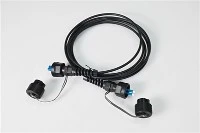
Standard indoor connectors are not designed for sustained exposure to moisture, vibration, UV, or temperature extremes. Outdoor small cell sites, distributed antenna systems (DAS), and industrial control networks typically require ruggedized connector systems with IP67 or IP68 ratings. These connectors use sealed housings and hardened materials to maintain optical performance where standard LC or SC assemblies would fail. If the deployment involves outdoor cable installation, evaluate connectors specifically rated for that environment rather than defaulting to the indoor connector list.
Understanding Each Connector Type in Detail

LC Connector
The LC (Lucent Connector) was developed by Lucent Technologies and later standardized under TIA-604-10 (FOCIS 10). Its defining feature is the 1.25 mm ceramic ferrule, exactly half the diameter of the older SC and FC ferrules. That size reduction is what makes LC the dominant connector in high-density applications: you can fit roughly twice as many LC ports into the same panel space as SC ports.
LC is available in both single-mode and multimode versions, as simplex or duplex assemblies, and with UPC or APC polish. Duplex LC is the standard interface for SFP-family transceivers across 1G, 10G, and 25G Ethernet. For 100G deployments, LC typically appears at the breakout end of MPO-to-LC harness cables.
SC Connector
The SC (Subscriber Connector) was developed by NTT and uses a 2.5 mm ferrule with a push-pull latching mechanism. It was the first connector type specified in the original TIA-568 structured cabling standard. SC connectors are straightforward to mate and unmate, and they do not require the rotational alignment that ST and FC connectors need.
In practice, SC-UPC handles general telecom patching, while SC-APC is the norm in FTTH and PON deployments. The SC connector's larger body means lower port density compared to LC, but in access network environments where a patch panel might hold 12 to 48 ports rather than hundreds, that tradeoff is rarely a problem.
ST Connector
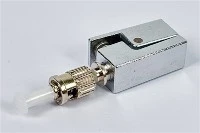
The ST (Straight Tip) connector was created by AT&T and uses a spring-loaded 2.5 mm ceramic ferrule secured by a bayonet twist-lock. It was one of the earliest widely adopted fiber connectors in LAN environments and was common in 10BASE-FL and early 100BASE-FX Ethernet installations. ST is simplex-only, so duplex links require two separate connectors and adapter ports.
Today, ST is primarily a maintenance connector. You are unlikely to specify it for new infrastructure unless you are extending an existing ST-terminated cable plant where retermination is not justified.
FC Connector
The FC (Ferrule Connector) uses a 2.5 mm ferrule with a threaded nickel-plated or stainless steel body. The threaded coupling provides excellent mating stability and resistance to vibration, which is why FC has historically been favored in test and measurement, single-mode long-haul, and certain CATV headend applications.
FC is available in both PC and APC polish styles. While it has been largely displaced by LC and SC in general networking, it remains relevant in precision environments. If you are building a fiber test bench or maintaining legacy headend equipment, FC connectors and FC patch cords are still part of the conversation.
MPO/MTP Connector

MPO (Multi-fiber Push-On) connectors use a rectangular plastic ferrule that holds multiple fibers in a single alignment. Common configurations include 8-fiber, 12-fiber, and 24-fiber variants. MTP is a trademarked, performance-enhanced version of MPO manufactured by US Conec, featuring tighter tolerances and removable housing for field re-polishing.
MPO/MTP is essential in modern data center backbone cabling. It is the physical interface behind 40GBASE-SR4, 100GBASE-SR4, and many 400G parallel optic architectures. The connector supports both multimode (OM3, OM4) and single-mode fiber, though single-mode MPO demands tighter manufacturing tolerances and typically higher cost.
A practical note on polarity: MPO connectors have a key on one side of the housing that determines orientation. Male connectors have guide pins; female connectors have guide pin holes. Mismatching gender or key orientation disrupts polarity across the entire fiber array. For detailed guidance, refer to your structured cabling vendor's polarity documentation or the relevant section of ANSI/TIA-568.3.
Other Connectors You May Encounter
Beyond the five main types above, a few other connectors still appear in specific environments:
- E2000 uses a spring-loaded protective cap over the ferrule end face and is found in some European telecom networks. It offers built-in contamination protection but is less common globally than LC or SC.
- MU is essentially a miniaturized SC with a 1.25 mm ferrule, used in some Japanese telecom deployments and compact equipment. It has not achieved the global adoption of LC.
- MT-RJ is a duplex connector with a single rectangular ferrule and metal guide pins. It saw some adoption in enterprise horizontal cabling but has been largely superseded by LC duplex.
Unless you are maintaining an existing plant that uses one of these connectors, they are unlikely to be your primary selection for new projects.
Connector Classifications Beyond Shape
Simplex vs. Duplex
A simplex connector terminates a single fiber, while a duplex assembly pairs two connectors side by side for bidirectional communication. Most structured cabling links use duplex assemblies because each link needs a transmit and receive path. Duplex LC is the standard for transceiver-based connections; duplex SC is common in FTTH ONT ports. ST and FC are simplex-only, which is one reason they have fallen behind in environments that favor integrated duplex solutions.
Single-Mode vs. Multimode
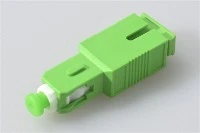
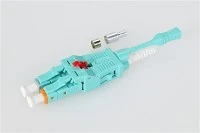
The connector body itself does not change between single-mode and multimode fiber in most cases. An LC connector looks the same on both fiber types. What does change is the ferrule bore diameter (matched to the fiber core), the polish type, and the color coding. Per TIA-598, single-mode connectors and adapters are typically blue (UPC) or green (APC), while multimode connectors are beige (OM1/OM2) or aqua (OM3/OM4). Mismatching single-mode connectors onto multimode fiber, or vice versa, introduces excess loss and unreliable performance.
UPC vs. APC Polish

This is one of the most consequential choices in connector selection, and one of the most common sources of field errors. UPC (Ultra Physical Contact) connectors have a slightly curved, flat-polished end face. APC (Angled Physical Contact) connectors have an 8-degree angle on the end face, which directs reflected light away from the fiber core and into the cladding.
The practical result: APC connectors achieve return loss better than −60 dB, while UPC typically achieves around −50 dB. In applications where back-reflectance degrades performance, such as analog CATV, PON networks, and coherent optical systems, APC is the better choice. In digital data links where moderate return loss is acceptable, UPC works fine and is generally less expensive.
The critical rule: never mate an APC connector to a UPC adapter or vice versa. The angled and flat end faces do not align properly, resulting in high loss, high reflectance, and potential damage to both ferrules. In the field, the simplest safeguard is color: green means APC, blue means UPC on single-mode connectors. If you see green mating to blue, stop and verify before proceeding.
Common Mistakes in Fiber Connector Selection

These are the errors that come up most often in procurement, installation, and network design:
Defaulting to LC everywhere.
LC is the right answer for most data center and enterprise patching, but specifying LC for an FTTH access network ignores the fact that the ONT, splitter, and field termination ecosystem is built around SC-APC. Using LC where SC is the standard means incompatible field tools, adapters, and replacement parts.
Mixing APC and UPC.
This happens when patch cords from different vendors or projects get mixed in the same patch panel. The result is connection loss well above specification, intermittent link failures, and potential ferrule damage. Label your patch panels clearly, and maintain separate inventory for APC and UPC assemblies.
Ignoring fiber mode when ordering assemblies.
Ordering a connector assembly without specifying fiber type (OS2, OM3, OM4, etc.) can result in mismatched core sizes. A single-mode pigtail terminated onto multimode fiber creates a core mismatch that degrades signal quality, even if the connector seats properly.
Overlooking MPO polarity in structured cabling.
Each MPO trunk, cassette, and harness cable must follow the same polarity method. Mixing Method A and Method B trunks in the same zone creates crossed fiber paths that are difficult to troubleshoot without pulling cables.
Specifying indoor connectors for outdoor use.
Standard LC and SC assemblies lack environmental sealing. Deploying them in outdoor cabinets, manholes, or industrial settings leads to contamination, moisture ingress, and accelerated connector degradation.
Are VSFF Connectors Replacing LC?

Very Small Form Factor (VSFF) connectors, including CS (from SENKO), SN (from SENKO), and MDC (from US Conec), are designed to push port density beyond what LC can achieve. They use ferrules smaller than 1.25 mm and connector housings that allow significantly more ports per rack unit.
In practice, VSFF adoption is still in its early stages. These connectors appear mainly in next-generation 400G and 800G switch and transceiver designs from certain vendors. They are not yet a mainstream replacement for LC in general-purpose structured cabling. If you are designing a new data center with a 3- to 5-year horizon and planning for 400G or 800G per port, VSFF connectors are worth evaluating during the design phase. For most current deployments, LC and MPO/MTP remain the practical choices.
A Simple Decision Framework
When selecting a fiber connector for a specific project, answer these four questions in order:
1. What is the deployment environment? Indoor data center, outdoor plant, FTTH access, test lab, or legacy campus? This narrows the field immediately. Data centers typically mean LC or MPO/MTP. FTTH access means SC-APC. Test labs may still need FC. Outdoor environments need ruggedized options.
2. How many fibers per connection? If each link is one or two fibers, a simplex or duplex patch cord with LC or SC will work. If you need 8, 12, or 24 fibers per mating, MPO/MTP is the answer.
3. Is the fiber single-mode or multimode? This determines polish options, color coding, and compatible transceiver types. Single-mode links use OS2 fiber and support longer distances. Multimode links use OM3, OM4, or OM5 fiber and are common in short-reach data center interconnects.
4. Do you need UPC or APC? For FTTH, PON, CATV, and any link sensitive to back-reflectance, choose APC. For standard digital data links in enterprise and data center environments, UPC is typically sufficient.
Answering these four questions will point you to the right connector in nearly every case. When it does not, the issue is usually an unusual environmental constraint or a legacy compatibility requirement that calls for a more specific evaluation.
Frequently Asked Questions
What are the most common fiber optic connector types?
The five connectors used in the vast majority of current deployments are LC, SC, ST, FC, and MPO/MTP. Among these, LC and SC account for the largest share of new installations. VSFF connectors (CS, SN, MDC) are emerging for very high-density data center applications but are not yet widely deployed.
Is LC better than SC?
It depends on the application. LC offers higher port density and is the standard interface for most modern transceivers, making it the default in data centers and enterprise networks. SC remains the practical choice in FTTH and PON access networks, where SC-APC is deeply integrated into the equipment and tooling ecosystem. Neither is universally better; the environment determines which one fits.
What is the difference between UPC and APC connectors?
UPC connectors have a flat, curved end face polish and typically achieve return loss around −50 dB. APC connectors have an 8-degree angled polish that achieves return loss better than −60 dB by directing reflected light into the cladding. APC is required in reflectance-sensitive applications like PON and CATV. The two types must never be mated together. For a deeper comparison, see our PC vs. UPC vs. APC polish guide.
When should I use MPO/MTP instead of duplex connectors?
Use MPO/MTP when a link needs to carry more than two fibers in a single connection. This is typical in data center backbone trunks, 40G/100G/400G parallel optic links, and structured cabling systems that use cassette-based breakout from MPO to LC. For standard two-fiber links, duplex LC or SC is simpler and more cost-effective.
Are ST and FC connectors obsolete?
They are no longer specified in most new network designs, but "obsolete" overstates it. ST is still present in many legacy multimode campus networks that are in active service. FC continues to be used on test equipment and in some specialized single-mode applications. Both connectors remain commercially available and will be for the foreseeable future. The question is whether to specify them for new builds, and in most cases the answer is no.
Can you connect SC to LC fiber cables?
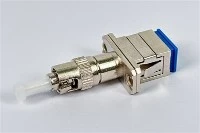
Not directly. SC and LC connectors use different ferrule sizes and housing designs, so they cannot mate to each other. To connect an SC port to an LC port, you need a hybrid patch cord with an SC connector on one end and an LC connector on the other, or you can use a hybrid adapter. Make sure both ends use the same fiber type and polish style.
What fiber connector is best for FTTH?
SC-APC is the industry default for FTTH access networks. The angled polish controls back-reflectance in splitter-based PON architectures, and the vast majority of ONT ports, OLT line cards, and FTTH passive components are designed around SC-APC interfaces.
Do single-mode and multimode fiber use different connectors?
They use the same connector types (LC, SC, etc.) but with different internal specifications. The ferrule bore is matched to the fiber core diameter, and color coding follows TIA-598: blue or green for single-mode, beige or aqua for multimode. While you can physically mate a single-mode connector to a multimode adapter in some cases, doing so creates a core mismatch that causes signal degradation. Always verify fiber type compatibility before connecting.
What is the difference between MPO and MTP connectors?
MPO is a generic standard (defined by IEC 61754-7 and TIA-604-5/FOCIS 5) for multi-fiber push-on connectors. MTP is a specific brand manufactured by US Conec that meets the MPO standard while adding tighter tolerances, a removable housing for easier re-polishing, and improved guide pin design. MTP connectors are fully compatible with standard MPO connectors and adapters. For more detail, see our MPO/MTP practical guide.
Are VSFF fiber connectors replacing LC in data centers?
Not yet at scale. VSFF connectors like CS, SN, and MDC offer higher density than LC and are designed for 400G and 800G transceiver interfaces. However, the installed base of LC-compatible equipment is enormous, and most data centers currently being built or upgraded continue to use LC for duplex connections and MPO/MTP for trunk cabling. VSFF is a technology to watch and plan for, particularly in hyperscale environments, but it has not displaced LC in mainstream deployments.