One fiber strand or two - that's the core difference between simplex and duplex fiber optic cables. But the choice between them shapes more than just material cost. It determines your patch panel density, the spec of every patch cord in the run, and - most critically - whether the physical architecture of your entire link actually matches what the network demands. Here's a quick-reference comparison, and if you need the full picture, keep reading.

Simplex Fiber Optic Cable: One Strand, One Direction
A simplex fiber optic cable has a single strand of glass or plastic fiber inside one protective jacket. It carries data in one direction - from source to receiver, full stop. No return path, no two-way conversation.
That one-way design fits a specific set of jobs. CCTV surveillance is the classic example: the camera captures video and pushes the stream to a recording unit. The recorder never needs to send data back to the camera over that same fiber. Industrial sensor networks operate the same way - a temperature probe in a factory sends readings to a control dashboard, and the dashboard has no reason to talk back.
Simplex cables also run broadcast infrastructure. In television production, a camera transmits its feed to a central broadcast unit through a simplex fiber link. Medical imaging equipment - endoscopy systems, certain X-ray machines - relies on the same unidirectional approach. The imaging device fires high-resolution data to a processing station, and that's the entire data path.
On the physical side, simplex fiber is lighter and takes up less tray space. A single strand terminated with an SC fiber optic connector or FC connector is fast to install and easy to troubleshoot. One fiber, one alignment, one potential failure point - and that simplicity has real value in large-scale sensor deployments where you're running hundreds of individual links.
Duplex Fiber Optic Cable: Two-Way Communication
A duplex fiber optic cable bundles two fiber strands together in a zipcord configuration - two strands side by side, joined by a thin strip of jacket material. One strand handles transmit (TX), the other handles receive (RX), so a single cable delivers full bidirectional communication.
Think about what happens inside a data center. A server talks to a switch - requests go out, responses come back, and both directions stay busy at the same time. Floor switches feed into a core backbone, and every one of those uplinks carries traffic both ways. That's not a coincidence; it's how the protocols work. Ethernet, Fibre Channel, SONET - they all assume a simultaneous send-and-receive path. Duplex fiber exists because modern networking doesn't take turns.
Full-duplex operation means both strands stay active simultaneously. A workstation fires a request to a server on one strand while the server pushes a response back on the other. No waiting, no turn-taking, no wasted bandwidth. That's different from half-duplex, where data travels both directions but only one way at a time - the walkie-talkie model, where you hold the talk button and the other person waits.
Duplex patch cords are terminated with paired connectors. An LC-to-LC duplex patch cord is the most widely deployed cable assembly in data centers today, thanks to the LC connector's compact 1.25mm ferrule and direct compatibility with SFP and SFP+ transceivers.
Single-Mode vs Multimode
Both simplex and duplex fiber optic cables come in single-mode and multimode versions. This choice determines distance and bandwidth, so it's worth understanding clearly.
Single-mode fiber has a core diameter of 8 to 10 microns and carries one ray of light. That tight core eliminates modal dispersion, which keeps the signal clean over long distances - we're talking kilometers, not meters. Single-mode simplex and duplex cables are the standard for telecom backbones, metro area networks, and any link over a few kilometers. The cost sits higher because single-mode transceivers use laser light sources rather than the cheaper LEDs in multimode systems.
Multimode fiber runs a larger core - 50 or 62.5 microns - and lets multiple light modes travel simultaneously. That delivers strong bandwidth over short runs, but the signal degrades faster because those multiple light paths hit the receiver at slightly different times. Modal dispersion caps effective multimode distances at 300 to 550 meters for 10G links, depending on OM3 or OM4 cable grade. For campus networks, intra-building links, and short data center runs, multimode duplex fiber is the cost-effective choice.

Where these cables terminate at distribution points, a well-specified fiber optic terminal box keeps splice points organized and protected. That detail saves hours of troubleshooting when you're chasing a problematic link months after installation.
Simplex vs Duplex Fiber Optic Cables
Cost is the first thing we ask about. Simplex cable uses one fiber strand and one connector per end - less material, lower price per run. When we're pulling hundreds of sensor feeds through an industrial facility or wiring a building-wide CCTV network, the per-run savings stack up fast. Duplex cable costs more because of the second strand and additional connectors, but it delivers bidirectional capability that simplex cannot replicate.
Installation is the second question. Simplex cables are thinner, more flexible, and easier to route through tight conduit. Duplex cables run wider because of the zipcord construction, which creates constraints in high-density patch panels. But here's the tradeoff: duplex cables eliminate the need to manage two separate simplex runs when project need bidirectional communication. In networking environments, one duplex cable is cleaner than two simplex cables routed to the same destination.

Bandwidth capacity favors duplex in any networking context. Simultaneous two-way data flow means your link's full capacity works in both directions at once. A simplex link dedicates all bandwidth to one direction - efficient for sensor feeds and broadcast, but it doesn't support the send-and-receive cycle that IP networking requires.
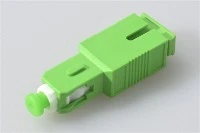
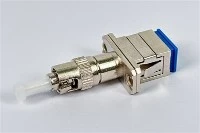
Connector compatibility is identical across both types. The same fiber optic adapters that mate SC-to-SC or LC-to-LC connections work with simplex and duplex assemblies interchangeably. Two simplex cables can substitute for one duplex cable, and the reverse holds true. In practice, duplex is preferred for network connections because it keeps cable management cleaner.
Where to Use Simplex Fiber Optic Cables
Simplex fiber belongs in every application where data flows in one direction from source to receiver: CCTV and video surveillance systems, industrial automation sensors and IoT monitoring networks, broadcast signal distribution (such as camera-to-production facility feeds), medical imaging data transmission (such as endoscope-to-processing station links), and highway sensor relays and stadium perimeter detection systems.
In all of these scenarios, the source device generates data and the receiving device consumes it. No return channel exists in the application design, so running duplex cable adds cost without adding function.
Where to Use Duplex Fiber Optic Cables
Duplex fiber goes everywhere that bidirectional communication happens - which covers the overwhelming majority of network infrastructure. LAN backbone connections between switches and routers, server-to-switch links in data centers, WAN connections between buildings, fiber-to-the-desk deployments for high-bandwidth workstations, and connections to fiber modems and media converters all run on duplex fiber. If the device on each end both sends and receives data - and that describes every piece of networking equipment built in the last twenty years - duplex is the cable to specify.
One development worth knowing about: BiDi (bidirectional) transceivers achieve two-way communication over a single fiber strand by using different wavelengths for transmit and receive. BiDi transceivers paired with simplex cables reduce fiber count in metro and access networks where duct space is tight. The approach requires wavelength-specific transceivers at both ends, so it's a targeted solution rather than a general replacement for duplex.
How to Choose the Right Fiber Optic Cable for Your Application
The decision comes down to one question: does the link carry data in one direction, or two? One direction - a sensor feeding a dashboard, a camera feeding a recorder - means simplex. Two directions - any network connection - means duplex.
Beyond that, don't overlook termination quality. A clean, properly polished fiber optic fast connector on either cable type outperforms a poorly terminated premium cable every time. The best cable on the market won't save a link with a dirty or misaligned end face.
For most network builds, a combination of both cable types makes sense. Run duplex for active network connections. Use simplex for dedicated monitoring, sensor, and broadcast feeds. Matching cable type to the actual data flow - instead of defaulting to duplex on every run - keeps material costs controlled and cable pathways manageable without giving up any performance where it counts.