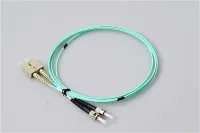
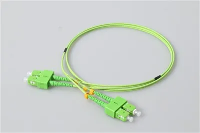
Choosing between OM1, OM2, OM3, OM4, and OM5 multimode fiber is not about picking the newest cable on the shelf. It is about matching fiber performance to the transceivers you plan to use, the distances your links must cover, and whether your cabling plant is an existing asset or a fresh installation. This guide compares all five multimode fiber types with real distance data, standards references, and scenario-based selection advice so you can make a confident procurement or design decision.

Quick Answer: Which Multimode Fiber Should You Use?
If you need a fast decision before reading the full comparison, here is the short version. OM1 and OM2 are legacy fiber grades that do not support 10G Ethernet at practical distances. OM3 is the entry-level laser-optimized fiber for 10G links up to 300 m and 40G/100G parallel-optic links up to 70–100 m. OM4 extends those distances - 400 m at 10G and 100–150 m at 40G/100G - and is the most widely deployed multimode fiber in current data center and campus builds. OM5 shares OM4's performance at 850 nm but adds a guaranteed bandwidth specification at 953 nm, which only matters when you use short-wavelength division multiplexing (SWDM) transceivers to reduce fiber count for 100G or 400G applications.
OM1 vs OM2 vs OM3 vs OM4 vs OM5 Comparison Table
The table below summarizes key specifications from the ANSI/TIA-568.3-E and ISO/IEC 11801 standards, along with IEEE 802.3 Ethernet distance references. Distances shown are maximum standards-based values for each application; real-world reach also depends on connector loss, splice count, and total channel attenuation.

| Specification | OM1 | OM2 | OM3 | OM4 | OM5 |
|---|---|---|---|---|---|
| Core / Cladding | 62.5/125 µm | 50/125 µm | 50/125 µm | 50/125 µm | 50/125 µm |
| Jacket Color (TIA) | Orange | Orange | Aqua | Aqua (or Erika Violet) | Lime Green |
| Designed Light Source | LED | LED | VCSEL (850 nm) | VCSEL (850 nm) | VCSEL (850–953 nm) |
| Modal Bandwidth (EMB at 850 nm) | Not specified (OFL: 200 MHz·km) | Not specified (OFL: 500 MHz·km) | 2000 MHz·km | 4700 MHz·km | 4700 MHz·km |
| Modal Bandwidth (EMB at 953 nm) | - | - | - | Not specified | 2470 MHz·km |
| 1000BASE-SX (1G) Distance | 275 m | 550 m | 550 m | 550 m | 550 m |
| 10GBASE-SR (10G) Distance | 33 m | 82 m | 300 m | 400 m | 400 m |
| 40GBASE-SR4 (40G, 8-fiber MPO) Distance | Not supported | Not supported | 100 m | 150 m | 150 m |
| 100GBASE-SR4 (100G, 8-fiber MPO) Distance | Not supported | Not supported | 70 m | 100 m | 100 m |
| Typical Use Case | Legacy low-speed links | Legacy / 1G installed base | Modern 10G baseline; short 40G/100G | Data center 10G/40G/100G with extra margin | SWDM-based 100G/400G where fiber count is constrained |
Reading this table: At 10GBASE-SR, OM3 reaches 300 m and OM4 reaches 400 m. At 100GBASE-SR4 with parallel optics over an MPO connector, OM3 drops to 70 m while OM4 holds at 100 m. Those numbers come from IEEE 802.3 and are validated by transceiver vendors including Cisco's 10G SFP+ data sheets and Cisco's 100G QSFP data sheets. If your links are in the 70–100 m range and you plan 100G parallel-optic migration, the difference between OM3 and OM4 becomes a real design constraint, not a theoretical one.
OM1 and OM2: When Legacy Fiber Still Has a Role
OM1 (62.5/125 µm) and OM2 (50/125 µm) were developed for LED-based transmission and low-speed Ethernet. Both use an orange jacket under TIA standards, so cable print-legend identification is essential - jacket color alone cannot distinguish them. In fact, the latest revision of the TIA standard (ANSI/TIA-568.3-E) has moved OM1 and OM2 color designations to a grandfathered annex, signaling that these grades are no longer recommended for new installations.

OM1 can technically carry 10G Ethernet, but only for about 33 m - too short for most structured cabling runs. OM2 extends 10G reach to roughly 82 m, which is still well below the 300–400 m range available with OM3 or OM4. For 1000BASE-SX at 1G, OM1 supports 275 m and OM2 supports 550 m, so both remain functional for Gigabit Ethernet in existing buildings.
Practical scenario: You manage a campus with OM1 or OM2 cabling installed in the late 1990s. Some links still carry 1G traffic and function within specification. Before upgrading, verify the cable print legend to confirm the actual fiber grade, test channel loss with an optical loss test set, and check whether the transceivers you plan to deploy still list support for 62.5 µm (OM1) or legacy 50 µm (OM2) fiber. If the next upgrade target is 10G, the cost-effective path is usually to re-cable with OM3 or OM4 rather than to patch around a 33 m or 82 m distance ceiling.
OM3: The Entry Point for Modern Laser-Optimized Multimode
OM3 was the first multimode fiber grade built specifically for 850 nm VCSEL transmission, standardized in 2002. It offers an effective modal bandwidth (EMB) of 2000 MHz·km at 850 nm, which is a major step up from the LED-era bandwidth of OM1 and OM2. In practical Ethernet terms, OM3 supports 10GBASE-SR up to 300 m, 40GBASE-SR4 up to 100 m, and 100GBASE-SR4 up to 70 m.
For many enterprise and campus networks, OM3 is a solid, cost-effective starting point for 10G deployments using duplex LC fiber connectors. It also supports 40G and 100G over parallel optics with MPO/MTP patch cords, though at shorter distances than OM4.
Where OM3 starts to feel tight: At 100GBASE-SR4, OM3's 70 m limit can be restrictive in larger data halls or campus cross-connects. If your link distances frequently fall in the 70–150 m range and 100G migration is on the roadmap, OM4 gives meaningfully more headroom for the same connector and transceiver infrastructure.

OM4: The Current Standard for High-Speed Data Center and Campus Links
OM4 was ratified by TIA in 2009 (TIA-492AAAD) and recognized by IEEE 802.3ba in 2010. It raises the effective modal bandwidth to 4700 MHz·km at 850 nm - more than double OM3's 2000 MHz·km. That bandwidth improvement translates directly into longer supported distances: 400 m at 10GBASE-SR, 150 m at 40GBASE-SR4, and 100 m at 100GBASE-SR4.
OM4 is currently the most widely deployed multimode fiber grade in new data center and campus installations. The TIA recommends OM3 and OM4 laser-optimized multimode fiber as preferred media for data center connectivity, and most 10G/40G/100G transceiver modules are validated against OM4 reach specifications.
OM3 vs OM4 at 100G - a concrete example: A 100GBASE-SR4 link using an 8-fiber MPO patch cord reaches 70 m on OM3 but 100 m on OM4. In a mid-size data center with row-to-row distances around 80–90 m, OM3 would fail while OM4 passes. That 30 m difference is the practical reason many organizations default to OM4 for any new high-speed cabling plant. For a deeper technical breakdown, see our OM3 vs OM4 multimode fiber comparison.
OM5: Wideband Multimode for SWDM and Fiber-Count Reduction

OM5 was standardized in 2016 (TIA-492AAAE) and is formally described as wideband multimode fiber (WBMMF). It shares the same 50/125 µm core and 4700 MHz·km EMB at 850 nm as OM4, but it adds a second bandwidth specification: 2470 MHz·km at 953 nm. This dual-wavelength specification is the defining technical feature of OM5, and it exists for one specific purpose - to guarantee performance across the 850–953 nm wavelength window used by SWDM transceivers.
SWDM technology transmits four channels on four different wavelengths over a single fiber pair. A 100G SWDM4 transceiver, for example, sends 4 × 25 Gb/s on wavelengths from 850 nm to approximately 940 nm over duplex fiber optic patch cords rather than requiring an 8-fiber MPO assembly. This reduces fiber count and can lower cabling density in constrained rack environments.
The key misconception about OM5: Cisco's white paper on OM4 vs OM5 makes the point clearly. At 850 nm, OM5 and OM4 have identical EMB specifications. For the large majority of current multimode transceivers - 10GBASE-SR, 40GBASE-SR4, 100GBASE-SR4 - all operating at 850 nm only, OM5 provides no reach advantage over OM4. OM5's added value emerges only when the transceiver uses wavelengths above 850 nm, as SWDM optics do.
If your current and near-term optical architecture is based entirely on standard 850 nm transceivers, paying a premium for OM5 does not buy additional distance or bandwidth. If you are actively planning for SWDM-based 100G or 400G over duplex fiber and fiber-count reduction is a design goal, OM5 is the right investment.
How to Choose: A Scenario-Based Selection Guide
Scenario 1: Maintaining or Extending a Legacy OM1/OM2 Network
Start by confirming what you have. Check the cable print legend - not just the jacket color - because both OM1 and OM2 can have orange jackets. Then test channel loss and verify that your current transceivers still support the installed fiber grade. If the existing cabling meets 1G application requirements and no 10G upgrade is imminent, continue using it. If you are planning a 10G rollout, re-cabling with OM3 or OM4 is almost always more practical than attempting to run 10GBASE-SR over OM1's 33 m limit or OM2's 82 m limit.
One important compatibility note: OM1's 62.5 µm core is physically different from the 50 µm core used by OM2 through OM5. You cannot simply patch OM1 into a 50 µm trunk line without core-size mismatch loss. If your plant has a mix of 62.5 µm and 50 µm fiber, treat them as separate channel types and plan accordingly.
Scenario 2: New 10G Enterprise or Campus Deployment
For new 10G links using 10GBASE-SR SFP+ transceivers and duplex LC or MTP/MPO connections, both OM3 and OM4 are viable. OM3 covers up to 300 m and costs less per meter. OM4 covers up to 400 m and provides a better margin for future 40G/100G migration. If your longest intra-building runs stay well under 200 m and the budget is tight, OM3 is a reasonable choice. If runs approach or exceed 300 m, or if you expect to upgrade to 40G/100G within the cabling plant's 15–20 year lifecycle, OM4 is the safer bet.
Scenario 3: Data Center 40G/100G Parallel-Optic Deployment
At 40GBASE-SR4 and 100GBASE-SR4, OM4 becomes the practical default. The 100 m reach at 100G on OM4 versus 70 m on OM3 is often the difference between a clean design and one that requires intermediate patching or shorter cable runs. In high-density data center environments, pair OM4 trunk cables with pre-terminated MPO assemblies for the fastest, most reliable deployment.
Scenario 4: Planning for SWDM 100G/400G over Duplex Fiber
If your architecture specifically plans to use SWDM transceivers - for instance, 100G SWDM4 running four wavelengths over a single duplex pair - OM5 is the appropriate fiber. The guaranteed 2470 MHz·km bandwidth at 953 nm ensures consistent performance across all four SWDM channels. Without OM5, the bandwidth at longer wavelengths is unspecified and varies by manufacturer, which creates an unpredictable link budget.
Scenario 5: When to Evaluate Singlemode Instead
Multimode fiber is engineered for short-reach links - typically under 400–550 m. If your project involves inter-building backbone runs exceeding 500 m, long campus paths, or any link where future distance requirements are uncertain, singlemode fiber is the more appropriate medium. Singlemode optics cost more per port, but the fiber itself is not significantly more expensive, and singlemode eliminates the distance ceiling entirely - typical 10G singlemode links run to 10 km. The right question is not always "which OM grade?" - sometimes it is "should this link be multimode at all?"
Common Mistakes When Selecting OM Fiber Types
Assuming the newest OM type is always the best choice
OM5's added bandwidth specification at 953 nm only matters if your transceivers use wavelengths above 850 nm. For standard 850 nm optics (10GBASE-SR, 40GBASE-SR4, 100GBASE-SR4), OM5 performs identically to OM4. Buying OM5 for a deployment that exclusively uses 850 nm transceivers is paying for a capability you will not use.
Ignoring the transceiver side of the equation
Fiber type sets the bandwidth ceiling, but link performance depends on the complete channel: cable grade, connector polish quality, splice loss, and transceiver specifications. Two identical OM4 links with different connector counts or loss budgets will reach different distances. Always evaluate the whole channel, not just the cable label.
Using jacket color as the sole identification method
OM1 and OM2 both use orange jackets. OM3 and OM4 both use aqua jackets (though some vendors use erika violet for OM4). The only reliable identification method is the cable print legend - the text printed on the outer jacket that states the fiber specification. During installation, documentation, and termination, always verify by print legend.
Mixing fiber core sizes without testing
OM2, OM3, OM4, and OM5 all share a 50 µm core and can be physically interconnected. However, mixing different OM grades in the same link (for example, patching an OM3 trunk cable with an OM4 patch cord) means the link performance is limited by the weakest segment. This can work, but it should be verified against the total channel loss budget rather than assumed to be fine. Mixing 62.5 µm (OM1) with 50 µm (OM2–OM5) fiber introduces a core-size mismatch that causes significant signal loss and should be avoided entirely.
Frequently Asked Questions
OM3 vs OM4 for 100G: which is the safer choice?
OM4. At 100GBASE-SR4, OM4 supports 100 m versus OM3's 70 m. That extra margin matters in practice - especially once you account for connector losses, cable routing detours, and the reality that "70 m" can become "not enough" after a patch panel is added mid-path. If you are deploying 100G multimode, OM4 is the widely recommended default per both IEEE 802.3 application tables and major vendor guidance.
Does OM5 replace singlemode fiber?
No. OM5 is still a multimode fiber with a maximum practical reach in the hundreds of meters. Singlemode fiber supports distances of 10 km and beyond at the same data rates. OM5 reduces fiber count for short-reach SWDM links, but it does not extend multimode into singlemode distance territory. If your links exceed approximately 400–500 m, singlemode remains the appropriate choice.
What color is OM5 fiber and why does it matter?
OM5 uses a lime green jacket, as specified in TIA-568.3-E. The distinct color helps installers and technicians identify wideband multimode fiber visually, preventing it from being confused with OM3 or OM4 (aqua) or with legacy OM1/OM2 (orange). However, always confirm the fiber type from the cable print legend, not just the jacket color.
Can OM3 patch cords be used in an OM4 link?
Physically, yes - both are 50/125 µm fiber with compatible connectors. But the OM3 segment will have lower bandwidth than the OM4 trunk, so the overall link performance is constrained by the OM3 section. For short patch cord lengths (1–5 m), the impact is often negligible. For longer mixed segments, test the total channel to confirm it meets your application's loss and bandwidth requirements.
Is OM1 still acceptable for new enterprise installations?
Generally, no. OM1 cannot support 10G Ethernet beyond approximately 33 m, and TIA-568.3-E has moved OM1 specifications to a grandfathered annex. For any new cabling project, OM3 is the minimum recommended grade. The cost difference between OM1 and OM3 is small relative to total installation labor, and OM3 provides a dramatically longer upgrade path.
What matters more: cable type or transceiver type?
Both matter - they form an interdependent system. The transceiver determines the wavelength, modulation scheme, and number of fiber lanes required. The cable determines the bandwidth, attenuation, and distance the signal can travel. Choosing OM4 cable does not compensate for the wrong transceiver, and choosing the right transceiver does not fix a bandwidth-limited cable. Start with the target application (10G, 40G, 100G), identify the transceiver standard (SR, SR4, SWDM4), and then select the fiber grade that supports the required reach under those conditions.
When should you stop upgrading multimode and move to singlemode?
Consider singlemode when link distances exceed 300–500 m, when future bandwidth requirements point toward 200G/400G over longer runs, or when the cost of repeatedly upgrading multimode fiber approaches the one-time cost of a singlemode plant. Many organizations adopt a "singlemode for backbone, multimode for intra-row" strategy that optimizes both cost and distance flexibility. Our singlemode vs multimode fiber guide covers the decision framework in more detail.
Can you mix different OM fiber types in the same link?
Mixing grades with the same 50 µm core (OM2, OM3, OM4, OM5) is physically possible, but the link's effective bandwidth and distance capability will be limited by the lowest-grade segment. Mixing 62.5 µm (OM1) with 50 µm fiber causes high insertion loss at the core-size mismatch point and is not recommended. If you must incorporate mixed fiber, calculate the total channel loss budget and verify against the IEEE application's maximum attenuation allowance before going live.
Conclusion
The OM1 vs OM2 vs OM3 vs OM4 vs OM5 decision comes down to four factors: what data rate you need, how far your links must reach, what transceivers you plan to use, and whether you are working with existing cabling or starting fresh. OM1 and OM2 belong to legacy environments - functional for Gigabit Ethernet over existing plants but impractical for new 10G or higher deployments. OM3 is a capable and economical choice for 10G links within 300 m. OM4 is the current mainstream recommendation for data center and campus builds targeting 10G, 40G, and 100G with meaningful distance margin. OM5 is a specialized option that earns its premium only when SWDM transceivers are part of the design.
Before selecting a fiber grade, map your link distances, confirm the transceiver standard for each application, review the total channel loss budget including adapters and connectors, and plan for at least one speed upgrade within the cabling plant's lifecycle. That approach produces a more durable and cost-effective result than simply choosing the newest or cheapest fiber available.