What is single mode fiber?
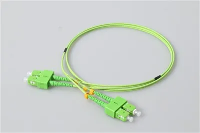
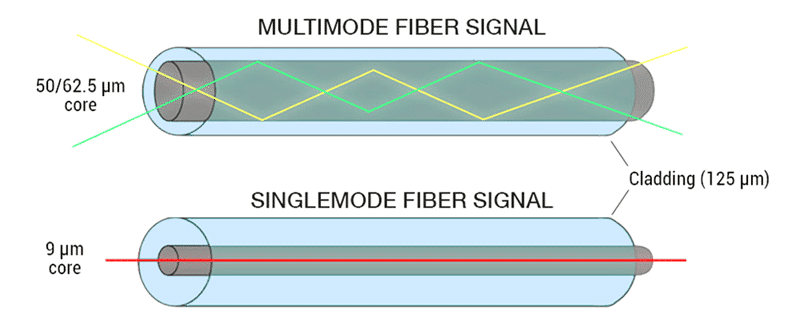
Single mode fiber, short as SMF, is a fiber cable that only allows one mode of light to transmit. Typically, this fiber includes a small light-carrying core of about 9µm diameter. These feature a small modal dispersion for vast-distance signal transmission.
In contrast with multimode fiber, single mode enables the concentration of light to travel quicker and farther, which is crucial for high-speed networks over a long distance.
What is multimode fiber?
Unlike single mode, multimode fiber (MMF) allows multiple light modes to transmit and pass through. Typically, this fiber includes a large light-carrying core of about 50µm or 62.5µm diameter. That makes manufacturing easier and offers a lower cost ratio on the same length.
However, modal dispersion limits the most significant length of transmission connections. So, these fibers are mainly for the short-distance transmission of signals.
Commonly, multimode fiber can be divided into five types:
OM1: it has a diameter of 62.5µm and an orange jacket. With 200/500 MHz*km overfilled launch (OFL) bandwidth at 850/1300nm, it is suitable for 100 Megabit and 1G Ethernet applications.
OM2: it has a diameter of 50µm and an orange jacket. With 200/500 MHz*km overfilled launch (OFL) bandwidth at 850/1300nm, it is suitable for 100 Megabit, 1G, and 10G Ethernet applications.
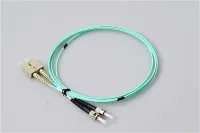
OM3: The laser-optimized MMF fiber supports 2000 MHz*km effective modal bandwidth. With a diameter of 50µm and an aqua jacket.
OM4: A further laser-optimized fiber supports 4700 MHz*km EMB bandwidth. Sutitable for 10 Gb/s, 40 Gb/s, and 100 Gb/s transmissions.
OM5: also known as WBMMF (wideband multimode fiber), uses two fibers to transfer data at speeds ranging from 40 GB/s, 100 GB/s and 400 GB/s.