Last November, I got a call from a customer in Phoenix. They'd just wrapped a 100G spine-leaf buildout-six months of planning, beautiful cable management, color-coded everything. Half the uplinks wouldn't negotiate.
Turned out someone grabbed a box of Type B trunks for a Type A design. The boxes looked identical. The part numbers differed by one digit.
Four hours of troubleshooting. A 6 AM flight for their lead engineer. Final damage: $14,200 in emergency labor, plus $1,847 for that last-minute plane ticket. I still have the invoice screenshot somewhere.
That's why I'm writing this. MPO/MTP fiber isn't rocket science, but the details will wreck you if you're not paying attention. And the penalty scales with your port count-mess up one LC patch, you lose one link. Mess up one MTP trunk, you lose twelve.
MPO vs MTP: Let's Kill This Confusion
I get this question constantly. "Is MTP just expensive MPO?"
Sort of. But that's like asking if a Lexus is just an expensive Toyota. Technically yes, practically no.
MPO is a connector standard. IEC 61754-7, TIA-604-5-the usual alphabet soup. Any factory with a ferrule mold can stamp out MPO connectors.
MTP is US Conec's brand. They invented the multi-fiber push-on format, then spent decades refining it. Same footprint, tighter tolerances, better materials.
Here's the thing most comparison charts miss: forget the plastic-versus-metal clamp debate. That's a distraction.
The elliptical guide pin is the whole ballgame.
Standard MPO uses round guide pins. When you mate two connectors, round pins can wobble slightly in the alignment sleeve-maybe a micron here, a micron there. Doesn't sound like much. But do that 200 times, and the wear pattern gets uneven. The outer fiber positions start drifting. Your insertion loss creeps up.
MTP's elliptical pins? They self-center. Every single time. You can feel the difference when you plug them in-there's this definite click when the pin seats, versus that vague mushiness you get with cheap MPO.
We ran a torture test last year: 437 mating cycles on six different connector samples. By cycle 300, two of the generic MPOs were showing 0.15 dB degradation on positions 1 and 12. The MTPs? Flat line through cycle 400.
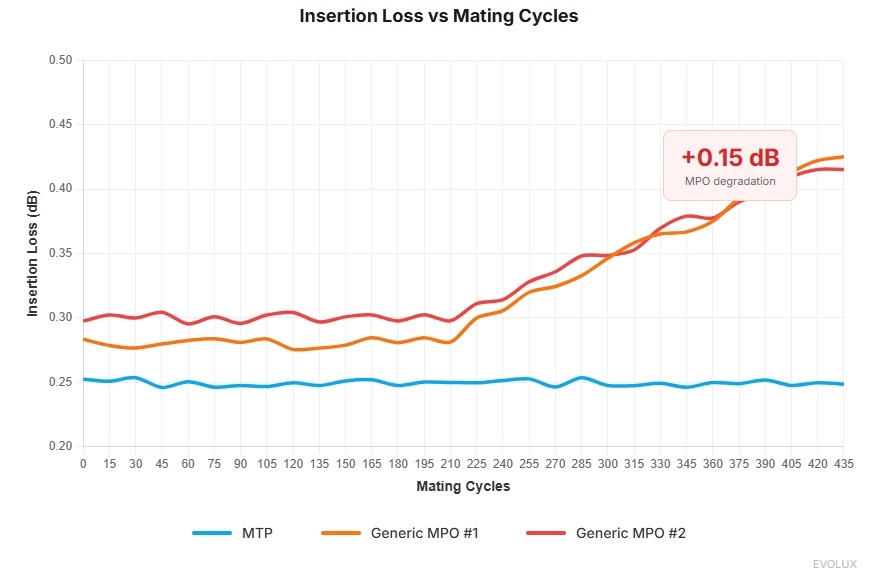
That 0.15 dB doesn't sound scary until you're stacking three mating points in a 400G link with zero margin to spare.
What's Inside These Things
Quick anatomy lesson, because understanding the guts helps when stuff breaks.
The Ferrule
Picture a tiny ceramic brick with 12 holes drilled in positions accurate to about 1 micron. A human hair is 70 microns wide. We're talking 1/70th of a hair.
In MTP connectors, the ferrule floats on springs. Why? Because when you jam two connectors together, they're never perfectly aligned. The float lets the ferrule micro-adjust so the contact pressure spreads evenly instead of grinding one corner into oblivion.
That spring mechanism is also why you shouldn't death-grip MTP connectors when mating them. I've seen techs muscle them together like they're tightening lug nuts. The whole point of the float is to let the connector find its own alignment. Just push until it clicks. Done.
The Guide Pins
Already ranted about the elliptical design. The pins themselves are hardened alloy-they survive thousands of insertions without mushrooming.
Male connectors have the pins. Female connectors have the holes. Sounds obvious, but I've watched people try to mate male-to-male at 2 AM in a dark cabinet. Doesn't work. Ask me how I know.
The Housing
Standard MTP housings are one-piece-polarity and gender are set at the factory. You order wrong, you're either returning cables or buying adapter panels.
Here's something the datasheets won't tell you: in non-climate-controlled edge sites or industrial environments, cheap MPO plastic housings get brittle after a few years. In our stress testing lab, we've compared genuine MTP housings against generic knockoffs under extreme thermal cycling. Many manufacturers cut costs by mixing excessive recycled material into their housing molds-this causes molecular chain degradation that's invisible to the naked eye. But after thermal cycling tests (-40°C to +75°C), latch fatigue resistance drops by over 40%. We've received "disintegrated" connectors returned from customers, and teardown analysis consistently shows classic material embrittlement. That's why we insist on using only high-spec virgin polyetherimide (PEI) resin. It costs more on paper, but it ensures your connectors still mate with that same crisp click after ten years in the data center.
MTP PRO fixes the configurability problem (more on that later), but for now, just know: triple-check your specs before ordering. The RMA process for a $400 trunk cable takes three weeks.
Polarity. Pay Attention Here.
I'm going to spend way too much time on this section because polarity errors account for maybe 60% of the MPO troubleshooting calls I've been on. It's boring. It's tedious. And it will absolutely destroy your Thursday night if you ignore it.
Duplex fiber is simple. Tx to Rx, Rx to Tx. A toddler could figure it out.
Twelve fibers in one connector? Every position matters. And there are three-THREE-different ways manufacturers wire these cables.
Type A
Key up on one end, key down on the other. The cable internally mirrors the fiber array. Position 1 goes to position 1, but the physical flip means the pairs line up correctly for duplex breakouts.
Type B
Both ends key up. The cable swaps adjacent pairs: 1↔2, 3↔4, 5↔6, and so on. Common for SR4 transceivers.
Type C
I personally hate Type C. The standard includes it, sure. But in practice? It's a trap.
Type C does a pair flip on top of the Type A flip. The only time I've seen it used correctly was in a very specific legacy Cisco config, and even then, the tech who installed it left no documentation. We spent two days reverse-engineering the polarity map.
My advice: unless you're matching existing Type C infrastructure, pretend it doesn't exist. You'll sleep better.
Why This Matters in Real Life
Here's a typical spine-leaf path:
Spine switch → Type B trunk → MTP patch panel → Type A patch → Leaf switch
Everything works. Now imagine someone-maybe a contractor, maybe a rushed night-shift tech-swaps that Type B trunk for a Type A. The boxes looked similar. The labels were small.
What happens? Partial connectivity. Fibers 1-2 work. Fibers 3-4 don't. Fibers 5-6 work. And so on.
The symptom looks exactly like a bad transceiver. Or a dirty connector. Or a fiber break. You'll waste hours chasing ghosts before someone finally breaks out the polarity mapper and discovers the real problem.
As a manufacturer, the scariest thing isn't complex wiring schemes-it's "hidden production errors." In our decade-plus of manufacturing experience, we've seen what happens when assembly processes lack proper controls. The most common failure mode? Polarity errors from fiber ribbon rotation during termination. Without automated verification, fatigued workers can inadvertently rotate the ribbon 180 degrees-a mistake that's invisible to the naked eye but devastating to the link. Industry failure analysis reports suggest this accounts for roughly 1% of cables from facilities without foolproofing measures. On our production line, we enforce fully automated polarity testing-every cable generates a unique polarity fingerprint before it ships. Polarity management shouldn't depend on installer luck; it needs to be locked down at the factory through physical foolproofing and automated inspection.
After that nightmare, we made a hard rule: on any large deployment, we randomly pull-test 5% of the cables before they go in the tray. Verify the actual fiber mapping, not the sticker. Never trust the label.

The Fix
Document. Everything.
Before you run a single cable, create a polarity map. Spreadsheet, Visio diagram, napkin sketch-I don't care. Just write down:
What cable type goes where
Which direction the key faces at each end
What the expected fiber-to-fiber mapping is
Label both ends of every cable with the polarity type. Not just the part number-the actual polarity. I use colored tape: blue for A, yellow for B. Low-tech, but it works.
One customer I work with prints QR codes that link to their documentation database. Overkill? Maybe. But they haven't had a polarity incident in three years.
|
Segment |
Cable PN |
Type |
End A (Key) |
End B (Key) |
Fiber 1 Maps To |
|---|---|---|---|---|---|
|
Spine→Panel |
TR-OM4-50M-B |
B |
Up |
Up |
Position 2 |
|
Panel→Leaf |
PA-OM4-3M-A |
A |
Up |
Down |
Position 12 |
Note: This two-segment path maintains correct polarity for 4×25G breakout. Change either cable without recalculating, and you're troubleshooting at midnight.
Loss Budget Math
Every optical link has a power budget. Transmitter puts out X dBm. Receiver needs at least Y dBm. The difference is your loss budget-that's what you spend on fiber attenuation, connector losses, and splices.
At 10G, loss budgets were generous. You could use garbage connectors and still have margin.
At 100G, the math gets tighter.
At 400G, you're counting tenths of a dB like a miser counting pennies.
100GBASE-SR4 Example
IEEE gives you 1.9 dB total channel loss for 100G SR4 over OM4 at 100 meters.
Let's build a realistic link:
100m OM4: 3.5 dB/km × 0.1 km = 0.35 dB
Two MTP matings (switch→panel, panel→patch)
If you use generic MPO at 0.75 dB each:
|
Component |
Loss |
|---|---|
|
100m OM4 fiber |
0.35 dB |
|
Mating #1 |
0.75 dB |
|
Mating #2 |
0.75 dB |
|
Total |
1.85 dB |
|
Budget |
1.9 dB |
|
Margin |
0.05 dB |
That's not margin. That's the error bar on your test equipment.
One speck of dust on one end-face, and you're over budget. One slightly longer cable run, over budget. One connector that came from a Friday afternoon shift at the factory, over budget.
Same link with MTP Elite at 0.35 dB each:
|
Component |
Loss |
|---|---|
|
100m OM4 fiber |
0.35 dB |
|
Mating #1 |
0.35 dB |
|
Mating #2 |
0.35 dB |
|
Total |
1.05 dB |
|
Budget |
1.9 dB |
|
Margin |
0.85 dB |
Now you can breathe. Dust happens. Temperatures drift. Fibers age. That 0.85 dB margin absorbs the real world.
The Road Trip Analogy
Think of loss budget like driving cross-country with a gas tank you can't refill.
Generic MPO starts you at half a tank. Short trips? Fine. But try to make it from Phoenix to Denver, and you're sweating every mile, coasting into the gas station on fumes.
MTP Elite starts you at full. Same destination, but now you can take a detour, run the AC, not panic when you hit construction traffic.
The destination (your data rate) doesn't change. Your margin for surprises does.

MTP Elite vs Standard: When to Pay the Premium
US Conec sells two grades:
Standard MTP: Max 0.50 dB insertion loss. Typical is around 0.35 dB.
MTP Elite: Max 0.35 dB. Typical is 0.15-0.25 dB.
Elite costs 15-30% more depending on fiber count and vendor. Worth it?
Here's how I think about it.
Go Elite when:
Your loss math leaves less than 0.5 dB margin after everything's added up
You have three or more mating points in the path
You're doing 400G now, or will be within 3 years
The cable is backbone infrastructure that'll be in the walls for a decade
Standard is fine when:
Links under 50m with just 1-2 matings
Comfortable margin at 40G or 100G
Patch cords you'll replace every year anyway-why pay premium for consumables?
Genuinely tight budget and you've done the math to prove it works
My general rule: Elite for trunks, Standard for patches.
Here's the logic. Trunks go in the ceiling, under the floor, through the walls. They stay there for 7-10 years. That's your network's foundation-you absolutely cannot cheap out on loss margins for infrastructure you won't touch for a decade.
From a manufacturing precision standpoint, the difference between Elite and Standard grades isn't just that 0.1 dB on paper. Producing Elite-grade connectors requires extended super-polishing of the end-face and rejection of any ferrules with borderline geometry parameters like apex offset. My bottom-line recommendation to customers: trunks must be Elite. Once trunk connectors are buried in cable trays, their mating points are fixed. Patch cords are fluid and get swapped constantly. If your trunk ferrule geometry isn't perfect, it doesn't matter how good your patch cords are-physical contact pressure will always be uneven. Spend money on the precision components that don't move. That's the cost philosophy that actually makes sense in manufacturing.
Patches? They're consumables. Ops techs yank them, reroute them, step on them, accidentally roll chairs over them. Average lifespan is maybe six months to a year before they get swapped. Spending premium dollars on Elite patches while running marginal trunks is backwards-you're polishing the doorknob while the foundation cracks.
One exception: if you're cross-connecting through a meet-me room in a colo, go Elite everywhere. You can't control the cable quality on the other side of that handoff panel.
MTP PRO: Field Repairs That Actually Work
Traditional MTP locks in polarity and gender at the factory. Order wrong? Return it, wait three weeks, explain to your project manager why the schedule slipped.
MTP PRO lets you change polarity (Type A ↔ Type B) and gender (male ↔ female) in the field. No special tools for polarity-just pop the housing. Gender swap needs a pin extraction tool, but it's still a 30-second job.

The premium is 20-40% over standard MTP. Sounds steep.
But let's do the math on a screw-up:
|
Cost Factor |
Standard MTP |
MTP PRO |
|---|---|---|
|
Wrong polarity discovered on-site |
RMA + 3 weeks |
Fix in 30 seconds |
|
Overnight replacement shipping |
$150-400 |
$0 |
|
Technician downtime (4 hrs @ $85/hr) |
$340 |
$0 |
|
Project delay penalty (if applicable) |
??? |
$0 |
If you're doing a big deployment with any ambiguity about what's already installed, MTP PRO pays for itself the first time something doesn't match the drawing.
For colocation or third-party managed environments, we typically recommend customers spec MTP PRO directly. In those "black box" scenarios where you can't predict the other end's polarity or gender, the field-changeable capability of PRO isn't just convenient-it's insurance. We've seen customers shut down entire ten-thousand-fiber projects for a week because both ends turned out to be male. As a manufacturer, we produce PRO-series connectors to hand configuration authority back to the field-eliminating supply chain risks caused by early-stage communication gaps.
For small, well-documented builds where you control every variable? Standard is fine.
MTP-16: Stop Wasting Fiber
Dirty secret about 12-fiber MTP: it wastes a third of your fiber for 8-lane applications.
40G uses 4 lanes (8 fibers). 100G uses 4 lanes (8 fibers). 400G uses 8 lanes (16 fibers). 800G uses 8 lanes (16 fibers).
|
Speed |
Lanes |
Fibers Used |
MTP-12 Has |
Wasted |
|
40G |
4 |
8 |
12 |
4 (33%) |
|
100G |
4 |
8 |
12 |
4 (33%) |
|
400G |
8 |
16 |
12 |
Need two connectors |
|
800G |
8 |
16 |
12 |
Need two connectors |
MTP-16 fixes this. Sixteen fibers, eight duplex pairs, zero waste.
For 400G-SR8 and the upcoming 800G wave, MTP-16 is the native form factor. If you're building new AI training infrastructure-those GPU clusters that need 400G or 800G between every node-standardize on MTP-16 now. The cost delta is negligible, and you won't be ripping out 12-fiber trunks in two years.
Heard from a hyperscaler contact last month: they've already committed to MTP-16 for all new builds. The fiber utilization improvement alone justified the tooling change.

End-Face Inspection: The Boring Part That Saves You
I'll keep this short because it's the least interesting topic. But skipping it is why people burn $2,000 transceivers.
MTP connectors have 12, 16, or 24 fibers in one ferrule. One contamination particle on one fiber tanks the whole connector. The odds of contamination scale with fiber count.
IEC 61300-3-35 defines clean. Here's the summary:
|
Zone |
Distance from Center |
Allowed Defects |
|---|---|---|
|
Core |
0-25 μm |
Zero |
|
Cladding |
25-120 μm |
≤5 defects, each <3 μm |
|
Contact |
Beyond 130 μm |
No scratches >10 μm |
That core zone-25 microns-is brutal. One dust particle. One. And your 400G link starts throwing CRC errors.
You can't manually inspect 12+ fibers per connector per end for every cable. Get an automated MTP probe ($4,000-8,000). It pays for itself the first time you catch contamination before mating instead of after replacing a transceiver.
Cleaning protocol:
- Inspect first. Always.
- If dirty: dry wipe. Works 80% of the time.
- Still dirty: IPA wet clean.
- Re-inspect before mating.
- Failing after wet clean? Connector may be damaged. Don't force it.
One thing rookies get wrong: they assume wet cleaning is always more thorough than dry. On MTP connectors, that's a disaster waiting to happen. IPA residue that doesn't fully evaporate creates sticky micro-traps in the guide pin holes-and those traps attract more dust than you started with.
Under a 400x factory microscope, we often see the invisible killer left behind by "wet cleaning": IPA residue films. Many customers use board cleaner or high-concentration alcohol, but if the mixture ratio is wrong or evaporation is incomplete, liquid surface tension literally "locks" fine particles right into MTP guide pin holes. That's why some cables test fine fresh out of the box but show spiking loss after just a few mating cycles. Our shop floor recommendation: dry cleaning handles ninety percent of cases. If wet cleaning is absolutely necessary, use specialized residue-free cleaning solvents followed by high-pressure nitrogen purge. The goal is preserving "virgin integrity" of the fiber end-face-not chemically degrading it with excessive treatment.
Our rule: dry wipe first, always. Save the wet cleaning for stubborn contamination-skin oils from a tech's fingers, adhesive residue, that kind of thing. And if you do wet clean, follow it immediately with two dry wipe passes. Think of MTP like precision optics: the drier, the safer.
One detail that often gets overlooked: dust cap design matters more than people realize. Caps that grip too tightly force technicians to yank on the boot during removal, potentially stressing the ferrule assembly. When we designed our dust caps, we specifically engineered the grip tension to balance contamination protection against ease of removal-firm enough to stay put during handling, loose enough that you're not wrestling with it at 2 AM in a dark cabinet.Little stuff like that isn't in any datasheet.
Decision Framework
Here's the cheat sheet. But read the asterisks-that's where the real guidance is.
|
Speed |
Distance |
Matings |
Recommendation |
|
40G |
<100m |
1-2 |
Generic MPO or Standard MTP |
|
40G |
<100m |
3+ |
Standard MTP |
|
100G |
<100m |
1-2 |
Standard MTP |
|
100G |
<100m |
3+ |
MTP Elite |
|
400G |
Any |
Any |
MTP Elite |
|
800G |
Any |
Any |
MTP Elite + MTP-16 |
The asterisks:
⚠️ Near HVAC equipment or compressors? Vibration loosens connections over time. Go MTP (metal clamps) even if the loss math says generic is fine.
⚠️ Lab environment with constant reconfiguration? MTP PRO, even if polarity is "known." Plans change. Save yourself the headache.
⚠️ Connecting to existing generic MPO trunks? Don't waste money on Elite patches-upgrade the trunks first. A chain is only as strong as the weakest link.
⚠️ Colo meet-me room? Elite everywhere. Here's the thing about colocation: you can't inspect what's on the other side of that demarcation panel. You have no idea if they're using quality jumpers or the cheapest thing their procurement department could find. What you can control is your side of the connection. Going Elite on your end builds in an extra 0.3 dB of margin-and in a "black box" environment where you're blind to half the link, that margin is often the difference between a solid green light and a flapping yellow alarm.
For MPO/MTP fiber trunks, cassettes, and breakout modules that cover this whole range, you can find detailed specs and stock availability in the EVOLUX catalog. Our fiber optic connector section includes MTP-12, MTP-16, and PRO variants-all manufactured with the quality controls and inspection protocols discussed throughout this guide.
MPO/MTP fiber isn't complicated once you internalize three things:
Connector quality scales with speed. 40G forgives sloppiness. 400G doesn't.
Polarity errors look like everything except polarity errors. Document before you install.
Loss budgets are smaller than you think. Do the math. If it's close, upgrade the connector spec.
And one personal opinion: MTP Elite on backbone trunks is almost always worth the premium. The total cost difference on a data center build is a rounding error compared to one night of emergency troubleshooting.
References
- US Conec MTP Specifications: https://www.usconec.com/
- FS.com MTP Connector Guide: https://www.fs.com/blog/a-comprehensive-guide-to-mtp-connector-958.html
- TIA-568.3-D: Optical Fiber Cabling Components Standard
- IEC 61754-7: MPO Connector Family Specifications
- IEC 61300-3-35: End-face Inspection Criteria
- IEEE 802.3bm/cm: 100G and 400G Optical Standards