"Why is my 10G campus network still lagging when I used the best single mode fiber?"
That was the panicked message from a system integrator three days before a university Full Optical Campus handover. In the lab, Single Mode vs Multimode looks like a simple spec sheet comparison. On a real job site? Different story. We've seen projects derail because someone mated a UPC blue connector to an APC green adapter. Or underestimated the ONT link budget. Or blew the budget on single mode transceivers for 100-meter runs that could have used cheaper multimode optics.
With FTTO becoming the new standard, fiber selection has moved far beyond "single mode for long, multimode for short." If your cabling approach is stuck in textbook territory-honestly, you might be planting landmines for future upgrades.
Picture this: a 50-building campus that won't need a single cable replacement for 20 years. That's the promise of a well-designed POL cabling guide implementation. But the path there? Filled with traps. LC or SC/APC? Full single mode in horizontal runs, or keep multimode to save on optical modules? One wrong connector spec doesn't just delay your timeline. It multiplies maintenance headaches for years.
Let's skip the physics definitions you've seen a hundred times. The goal here: helping you make that "get it right the first time" decision.
The Numbers That Actually Matter
You've seen the standard comparison chart. Core diameter, wavelength, distance. Got it. But those charts don't tell you the real story: the single mode vs multimode decision is about money. Not physics.
Think of it this way. Single mode is a sports car-one beam of light down a core so thin (9 micrometers) that a human hair looks fat in comparison. Clean signal, travels 10, 20, 100 kilometers without needing a boost. Multimode is the pickup truck. Wider core (50 micrometers-still thinner than hair, but 6x bigger), multiple light beams bouncing through simultaneously. Easier to work with, cheaper to connect. But those bouncing beams start interfering after a few hundred meters. Signal gets muddy.

|
What You're Comparing |
Single Mode (OS2) |
Multimode (OM4/OM5) |
|
Core Size |
9 µm (thinner than spider silk) |
50 µm (6x larger, still tiny) |
|
Distance @ 10G |
10+ km (across a small city) |
400m (about 4 football fields) |
|
Distance @ 100G |
10 km |
100-150m (one large building) |
|
10G Transceiver |
$80-150 each |
$25-50 each |
|
Cable Cost |
Actually 10-20% cheaper |
Slightly more expensive |
|
Installation |
Needs precision alignment |
More forgiving |
See the trap? Single mode cable is cheaper. But transceivers cost 3-5x more. For a 500-port campus, that difference hits $30,000-50,000 in optics alone. In our 2023-2024 projects across Southeast Asia, we've seen procurement teams get burned by this exact calculation-picking single mode "for future-proofing" on short runs, then scrambling when transceiver costs blow the budget.
Now-POL architecture changes everything. Full Optical Campus deployments using POL require single mode. No choice involved. The technology uses GPON wavelength-division multiplexing-two wavelengths traveling opposite directions on one fiber strand. Only works with single mode's clean transmission.
So if you're building POL, skip the multimode debate. But traditional Ethernet? That's where Fiber selection for Optical LAN gets complicated.
Why SC/APC Dominates POL (And What Happens When You Mix Colors)
Traditional campus networks look like a tree. Core switch at the root, distribution switches at branches, access switches on every floor. Lots of equipment, lots of power, lots of things that break.
POL flattens that. One central OLT connects through passive splitters to ONTs at each desk or room. No intermediate switches. No IDF closets on every floor. Just fiber, splitters, endpoints.
[Data Center] → OLT → Single Fiber → 1:32 Splitter → 32 ONTs
Downstream: 1490nm | Upstream: 1310nm | Both on ONE fiber strand
The splitters are completely passive. No power, no electronics, nothing to fail. Light from the OLT hits a 1:32 splitter and divides to 32 locations. Like a garden hose with a 32-way sprinkler-except you're splitting laser light, not water pressure.
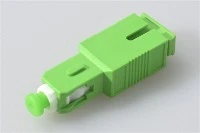
The critical detail most guides skip: POL uses SC/APC connectors almost universally. The "APC" means Angled Physical Contact-ferrule polished at 8 degrees instead of flat. When light hits a flat surface (UPC), some bounces straight back toward the source. In bidirectional POL, those reflections create noise. Over dozens of connection points, noise accumulates.
The angled APC face bounces reflections away from the core. Return loss drops from ~-50 dB (UPC) to -65 dB or better (APC). Roughly 30x less reflected light making it back. In POL terms? Difference between clean signal and degraded one.
TIA Fiber Optic Training Council puts it simply: SC/APC is standard for passive optical networks because return loss characteristics matter in bidirectional systems. Don't second-guess this-go SC/APC.
What happens when you mix green and blue:
We saw this on a smart hotel GPON project last year. The contractor used SC/APC (green) at the floor-level splitter outputs-correct. But then gave the rooms SC/UPC (blue) patch cords for the ONT connections. Physically, it plugs in. Electrically? Disaster.

The angled face meeting a flat face creates a tiny air gap. Contact area shrinks to almost nothing. Return loss plummets. Reflected optical power triggered high-reflection alarms at the OLT. Worse-when the 1550nm CATV signal came through at higher power, the air gap reflections caused ONTs in edge rooms to drop offline repeatedly. Guests complained. Management panicked. The fix required re-pulling patch cords for 200+ rooms.
In an all-optical network, green-into-blue isn't "a little slower." It's a signal black hole. That 1dB insertion loss increase looks small-but on a 1:64 split link, it's the straw that breaks the system.
Real Deployment Decisions
The backbone from data center to first splitter. This is your highway. Everything flows through it. POL means single mode OS2 with SC/APC-no discussion. But cable grade, pre-terminated vs field-terminated, spare fiber count? Still decisions to make.
For runs under 2km (most campus backbones), standard OS2 handles the job. Premium low-loss fiber? Overkill unless you're pushing extremely long splitter chains or planning 25G-PON upgrades. Insertion loss per connector should stay under 0.3 dB-specify this in your RFQ, require test reports.
Pre-terminated trunk cables cost more but save installation time. For hospitals or universities where minimizing disruption matters? Worth it. New construction with time to spare? Field termination works fine. For high-density termination at the OLT, fiber optic connectors designed for rack-mount applications make port identification and access easier during maintenance.
Distribution cables from splitters to ONTs.

This is where FTTO fiber connectors get interesting. Not one cable-32 cables from each splitter to 32 locations. Multiply by splitter count. Mid-size campus might have 50+ splitters serving 1,500+ endpoints. Lots of connectors.
SC/APC remains default. But check your ONT specs first-some newer models use LC/APC ports. If so, you can run LC-terminated cables throughout (cleaner) or use SC-LC hybrid adapters at the splitter (adds connection points). We generally recommend the first option. Every adapter is a potential failure point.
Why connector quality matters at scale:
|
Connector Quality |
Loss/Connector |
× 1,500 Connectors |
Result |
|
Premium (≤0.15 dB) |
0.15 dB |
225 dB total |
Tight budgets work |
|
Standard (≤0.25 dB) |
0.25 dB |
375 dB total |
Usually fine |
|
Economy (≤0.35 dB) |
0.35 dB |
525 dB total |
Marginal links fail |
A 0.1 dB difference per connector sounds trivial. Multiply across hundreds of connections-it's not. Typical 1:32 POL architecture has ~28 dB total loss budget. Splitter eats 15-17 dB. Cable attenuation takes a few more. That leaves maybe 8-10 dB for all connector losses. Cheap connectors push you over budget on longer runs.
Traditional Ethernet backbone (when you're not doing POL). Not everyone is ready for POL. Renovating existing infrastructure? Budget constraints? Traditional switched Ethernet still works. Different fiber decisions though.
Under 300 meters-floor-to-floor, adjacent buildings-OM4 multimode with LC duplex makes economic sense. Transceiver savings (SR vs LR modules) add up when connecting dozens of switches. The calculus flips at 300+ meters. Multimode struggles, especially at higher speeds. Single mode usage in Campus Network inter-building links gives unlimited bandwidth headroom. Install once, support 10G, 100G, 400G-whatever comes next.
LC/UPC (not APC) works fine for point-to-point Ethernet. No bidirectional WDM, so extra APC cost and handling care isn't necessary.
Desktop Connections and the Zone Enclosure Solution
FTTO means fiber reaches the desk. Different environment than a data center. Cables get kicked. Chairs roll over them. Cleaning staff bumps things. The Fiber Connector Selection Guide for desktop prioritizes durability.
Bend-insensitive fiber (BIF) is non-negotiable. Standard fiber loses signal at tight bends. BIF handles bend radii down to 7.5mm-tighter than your pinky finger. Pre-cut patch cords (2m, 3m, 5m) save time versus field termination at each desk. Cost difference minimal, avoids variability from awkward installation positions.
The open office challenge:
On a project for a large internet company-completely open office layout-the designer refused to mount any visible cable trays on the support columns. Direct routing from backbone to every desk meant fiber everywhere. Nightmare to maintain.
Our solution: Zone Enclosures in the ceiling plenum or under the raised floor. Run multi-fiber MPO trunks from the backbone to each zone box. Inside the box, break out to LC Uniboot patch cords serving 6-8 nearby workstations.
The payoff? When workstations move (and they always do), you don't touch the backbone fiber in the ceiling. Just swap the 3-meter patch cord at the zone box. Our client's estimate: 70% reduction in MACs (moves/adds/changes) labor cost. Over 3 years of office reorganizations, that adds up.
Critical detail: in tight zone boxes, LC Uniboot or Push-Pull Tab connectors are mandatory. When 12 patch cords are plugged in, standard LC connectors don't leave enough finger room to remove anything. We learned this the hard way on a retrofit project-had to unplug half the box just to access one cable.
The Money Question
Everyone asks about cost. Answer depends on your timeframe. POL costs more upfront (OLTs and ONTs aren't cheap) but saves dramatically on everything else-especially over 10 years.
Rough breakdown for 500 endpoints. These are industry estimates, not guaranteed quotes-your mileage varies by vendor, region, specifics.
|
Cost Category |
POL Architecture |
Traditional Ethernet |
|
Network Equipment |
$45K-60K |
$120K-180K |
|
Cabling |
$35K-45K |
$50K-70K |
|
Connectors & Patches |
$8K-12K |
$15K-25K |
|
Installation Labor |
$25K-35K |
$40K-60K |
|
Floor Space (10yr) |
$15K-20K |
$40K-60K |
|
Power & Cooling (10yr) |
$12K-18K |
$45K-70K |
|
10-Year Total |
$140K-190K |
$310K-465K |
Where POL saves most: floor space and power. Traditional networks need IDF closets every floor-switches, UPS, air conditioning. POL replaces all that with passive splitters needing no power, no cooling, fitting in a wall-mounted box the size of a textbook. Huawei's FTTO docs claim 50-70% power reduction-that's a marketing figure, take it appropriately skeptically-but the direction is real. Fewer active devices means less electricity and less heat to remove.
Dirt Is Your Enemy (The $500 Lesson)
Something sales brochures don't emphasize: contamination is the leading cause of fiber network failures. Not equipment failure. Not cable damage. Dirt.
Single mode fiber has a 9-micrometer core. A dust spec invisible to your eye blocks 10%+ of light transmission. Fingerprint oil creates enough loss to drop a connection. In POL systems with tight link budgets, contamination at a few points cascades into network-wide issues.
The $500 that turned into $5,000:
Southeast Asia campus project. Client cut approximately $500 in professional cleaning kits from the budget. "Just use dust caps and be careful." Allowed workers to install without proper inspection equipment.
One week after handover, roughly 15% of links showed unexplained packet loss. Engineering team had to return with OTDR equipment, pull connectors one by one, inspect every end face. Finding: most contaminated ferrules had been scratched by dust particles during installation. Irreversible damage.
Final bill: ~100 patch cords replaced ($2,000 materials), three days of labor for two technicians ($3,000+), plus the reputation damage of a failed handover. The $500 "savings" cost them 10x.
A fiber connector end face is more fragile than an eyeball. Under 400x magnification, a dust particle looks like a crater on the moon. If you're not buying cleaning tools, budget triple for repairs.
Inspection before mating is mandatory. A 400x fiber microscope costs a few hundred dollars and prevents thousands in troubleshooting. Every connector inspected before plugging-during installation and any maintenance. Cleaning protocol: dry wipe first (lint-free), wet clean with 99%+ isopropyl alcohol if needed, dry again, re-inspect. Takes 30 seconds. Skipping takes hours to diagnose later.
Planning for What Comes Next
Campus fiber lasts 15-25 years. The cable you install today will still be there when technologies we haven't invented become standard.
Good news for POL: the physical layer supports the entire roadmap. Current GPON runs 2.5 Gbps downstream. 10G-PON (XGS-PON) already available. 25G-PON in trials. 50G-PON in standards development. All use the same fiber and connectors-only OLT and ONT equipment changes.
OFS Optics notes that while multimode handles most enterprise distances adequately, single mode's bandwidth advantages become more pronounced as data rates increase. They acknowledge the trend toward single mode as transceiver premiums narrow.
A Full Optical Campus built on single mode handles Wi-Fi 7 backhaul (multi-gigabit per AP), 8K video surveillance, IoT densities we can't predict-without touching cabling. That's the value of getting infrastructure right first time.
What to Put in Your RFQ
When sourcing connectors for a POL cabling guide-compliant deployment, specify these minimums:
Insertion loss: ≤0.25 dB typical, ≤0.35 dB max
Return loss (APC): ≥65 dB
Ferrule: Zirconia ceramic
Mating cycles: ≥500 with ≤0.2 dB change
Documentation: Individual test results or batch certificates
For mission-critical deployments, suppliers with in-house manufacturing (not trading companies sourcing multiple factories) provide more consistent quality. Evolux Fiber offers factory-direct products with testing documentation enterprise POL projects require.
Spare ratios worth budgeting: 5-10% for pre-terminated assemblies, 15-20% for field-installable connectors (accounts for termination failures), 10-15% for patch cords to handle first-year MACs.
Quick Reference
|
Where |
Fiber |
Connector |
Why |
|
POL backbone |
Single Mode OS2 |
SC/APC |
WDM needs low return loss |
|
POL to ONT |
Single Mode OS2 |
SC/APC or LC/APC |
Match your ONT port |
|
Desktop FTTO |
Single Mode BIF |
SC/APC |
Handles tight bends |
|
Ethernet <300m |
Multimode OM4 |
LC duplex |
Cheaper transceivers |
|
Ethernet >300m |
Single Mode OS2 |
LC/UPC |
Distance + future-proof |
The shift toward Full Optical Campus architecture is accelerating as enterprises discover operational and energy savings. Whether you're deploying POL for a new building or upgrading traditional infrastructure, connector decisions you make during installation determine reliability for the next decade or two. Get them right first time.
References:
1. TIA Fiber Optic Training Council (tiafotc.org) - Passive Optical LANs
2. OFS Optics (ofsoptics.com) - Single mode vs multimode fiber selection
3. Huawei Enterprise (e.huawei.com) - FTTO Solution documentation
4. FS.com Community - Return loss discussions in PON applications