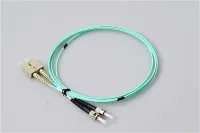
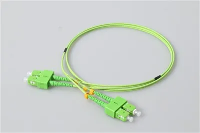
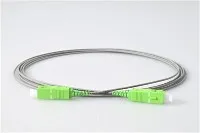
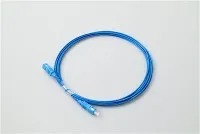
Last month, our sales team at Evolux received an urgent call from a logistics company in New Jersey. They'd just completed a painful-and expensive-lesson in fiber selection. They'd installed OM3 multimode patch cords and pigtails throughout their new 50,000 sq ft warehouse, only to discover six months later that their WMS vendor required 10km links to the corporate data center. The fix? Ripping out $47,000 worth of cabling-including hundreds of LC connectors, SC adapters, and pre-terminated patch cords-and starting over with single mode.
This guide exists so you don't make the same mistake.
At Evolux Fiber, with 12+ years manufacturing fiber optic connectors, patch cords, and connectivity solutions for 50+ countries, we've seen this scenario play out countless times. The truth is, choosing between single mode and multimode fiber isn't just about the cable-it's about understanding how your choice impacts every component in the optical link: connectors, adapters, pigtails, patch cords, and splitters.
The 30-Second Answer (For Those in a Hurry)
|
If Your Situation Is... |
Choose This |
Why |
|
Data center interconnects <500m |
Multimode OM4/OM5 |
Lower transceiver cost, simpler alignment |
|
Campus backbone >500m |
Single Mode OS2 |
Only viable option for distance |
|
Enterprise LAN, budget-conscious |
Multimode OM3 |
Best price/performance ratio |
|
Future-proofing for 400G+ |
Single Mode OS2 |
Industry direction, 25+ year lifespan |
|
Outdoor/harsh environments |
Single Mode OS2 |
Better temperature tolerance |
Still reading? Good. Let's go deeper.
Understanding the Fundamental Difference
Here's an analogy that actually works:
Single mode fiber is like a sniper rifle-one precise beam, travels far, requires precision optics. The 9µm core (about 1/10th the width of a human hair) allows only one light pathway, eliminating the "echoes" that degrade signals over distance.
Multimode fiber is like a shotgun-multiple pellets (light modes) spread out, effective at close range, easier to aim. The 50µm or 62.5µm core lets light bounce around in hundreds of different paths, which is fine for short distances but creates timing issues (modal dispersion) as distance increases.

This isn't just academic-it directly impacts how far your signal can travel and at what speed.
How Fiber Type Affects Your Connector Choice
Here's what most guides don't tell you: single mode and multimode fibers use physically identical connectors-but the performance requirements are completely different.
The Connector Compatibility Matrix
|
Connector Type |
Single Mode Compatible |
Multimode Compatible |
Best Application |
|
LC (Lucent) |
Yes |
Yes |
High-density data centers, SFP/SFP+ transceivers |
|
SC (Subscriber) |
Yes |
Yes |
FTTH, telecom, general networking |
|
FC (Ferrule) |
Yes |
Yes |
Test equipment, high-vibration environments |
|
ST (Straight Tip) |
Yes |
Yes |
Legacy networks, multimode LANs |
|
MPO/MTP |
Yes |
Yes |
40G/100G/400G parallel optics |
|
E2000 |
Yes |
Yes |
High-security, dust-protected applications |
Critical insight: While the connectors look identical, single mode connectors demand tighter tolerances. A connector with 0.3dB insertion loss is acceptable for multimode but may cause link failures in long-haul single mode applications.
Polish Types: APC vs UPC
|
Polish Type |
Return Loss |
Best For |
Color Code |
|
UPC (Ultra Physical Contact) |
>50dB |
Multimode, general single mode |
Blue (SM) or Beige (MM) |
|
APC (Angled Physical Contact) |
>60dB |
CATV, PON, analog video, long-haul SM |
Green |
Evolux Tip: Never mate APC connectors with UPC connectors-the angled ferrule will damage both ends and cause severe signal loss. Our LC APC connectors feature precision 8° angle polish for maximum return loss.
Patch Cord Selection by Fiber Type
When ordering fiber optic patch cords, the fiber type dictates everything:
|
Specification |
Single Mode Patch Cord |
Multimode Patch Cord |
|
Fiber Core |
9/125 µm (OS2) |
50/125 µm (OM3/OM4/OM5) or 62.5/125 µm (OM1/OM2) |
|
Jacket Color |
Yellow |
Orange (OM1/OM2), Aqua (OM3/OM4), Lime Green (OM5) |
|
Typical Insertion Loss |
<0.2 dB |
<0.3 dB |
|
Wavelength |
1310nm, 1550nm |
850nm, 1300nm |
|
Bend Radius |
30mm (standard), 15mm (bend-insensitive) |
25mm (standard) |
Evolux Product Spotlight: Our single mode and multimode patch cords are available in lengths from 0.3m to 500m, with duplex, simplex, armored, and uniboot configurations. All patch cords undergo 100% optical testing before shipment.
The Specifications That Actually Matter
Core & Cladding: The Physical Foundation
|
Parameter |
Single Mode |
Multimode |
|
Core Diameter |
9 µm (8.3µm in some specs) |
50 µm (OM3/4/5) or 62.5 µm (OM1/2) |
|
Cladding Diameter |
125 µm |
125 µm |
|
Numerical Aperture |
0.12-0.14 |
0.200 ± 0.015 (OM3/4) |
|
Mode Field Diameter |
9.2 µm @ 1310nm |
N/A |
Why this matters: That tiny 9µm single mode core is both a blessing and a curse. It requires laser-precision alignment during splicing and connection (driving up installation costs), but it virtually eliminates modal dispersion.
Attenuation: Signal Loss Per Kilometer
|
Fiber Type |
@ 850nm |
@ 1300nm |
@ 1310nm |
@ 1550nm |
|
Single Mode OS2 |
N/A |
N/A |
0.35 dB/km |
0.22 dB/km |
|
Multimode OM3 |
3.0 dB/km |
1.0 dB/km |
N/A |
N/A |
|
Multimode OM4 |
3.0 dB/km |
1.0 dB/km |
N/A |
N/A |
|
Multimode OM5 |
3.0 dB/km |
1.0 dB/km |
N/A |
N/A |
The takeaway: Single mode at 1550nm loses only 0.22 dB per kilometer-that's roughly 14x less than multimode at 850nm. Over a 10km run, that's the difference between a usable signal and static.
Bandwidth: The Speed Ceiling
|
Fiber Type |
Bandwidth (MHz·km) |
Practical Meaning |
|
OM1 |
200 @ 850nm |
Legacy, avoid for new installs |
|
OM2 |
500 @ 850nm |
Legacy, avoid for new installs |
|
OM3 |
2000 @ 850nm |
10G up to 300m, 40G up to 100m |
|
OM4 |
4700 @ 850nm |
10G up to 400m, 100G up to 150m |
|
OM5 |
28000 @ 953nm |
SWDM4 optimized, 400G-ready |
|
OS2 |
Theoretically unlimited |
Limited only by transceiver technology |
Here's what vendors don't tell you: OM5's "28000 MHz·km" sounds impressive, but it only matters for SWDM (Short Wavelength Division Multiplexing) applications. For standard SR4 optics, OM5 performs identically to OM4.
MPO/MTP: The High-Density Game Changer
For data centers running 40G, 100G, or 400G, the connector choice often matters more than the fiber type. MPO/MTP connectors enable parallel optics that simply aren't possible with traditional LC/SC connections.
Single Mode vs Multimode in MPO/MTP Applications
|
Speed |
Single Mode Solution |
Multimode Solution |
Fiber Count |
|
40G |
40GBASE-LR4 (LC Duplex, WDM) |
40GBASE-SR4 (MPO-12) |
2 vs 8 |
|
100G |
100GBASE-LR4 (LC Duplex, WDM) |
100GBASE-SR4 (MPO-12) |
2 vs 8 |
|
400G |
400GBASE-DR4 (MPO-8) |
400GBASE-SR8 (MPO-16) |
8 vs 16 |
The trade-off is clear:
Single mode uses fewer fibers but more expensive transceivers
Multimode uses more fibers but cheaper VCSEL-based transceivers
MPO/MTP Polarity and Gender
This is where many installations go wrong:
|
Term |
Meaning |
When to Use |
|
Type A (Straight) |
Key up to key down |
Standard method, odd number of connections |
|
Type B (Reversed) |
Key up to key up |
Most common, even number of connections |
|
Type C (Pairs Flipped) |
Adjacent pairs swapped |
Duplex breakout applications |
|
Male (Pins) |
Has guide pins |
Typically on equipment side |
|
Female (No Pins) |
No guide pins |
Typically on patch cord/trunk side |
Evolux Expertise: Our MTP/MPO patch cords are available in 8, 12, and 24-fiber configurations with Type A, B, or C polarity. We also offer MTP-to-LC breakout cables for transitioning between parallel and duplex connections.
The Real-World Matrix
This is where rubber meets road. I've compiled actual tested distances, not just spec sheet numbers:
Ethernet Standards Distance Comparison
|
Speed |
Standard |
Single Mode OS2 |
OM3 |
OM4 |
OM5 |
|
1 Gbps |
1000BASE-LX |
10 km |
550m* |
550m* |
550m* |
|
1 Gbps |
1000BASE-SX |
N/A |
550m |
550m |
550m |
|
10 Gbps |
10GBASE-LR |
10 km |
N/A |
N/A |
N/A |
|
10 Gbps |
10GBASE-SR |
N/A |
300m |
400m |
400m |
|
25 Gbps |
25GBASE-LR |
10 km |
N/A |
N/A |
N/A |
|
25 Gbps |
25GBASE-SR |
N/A |
70m |
100m |
100m |
|
40 Gbps |
40GBASE-LR4 |
10 km |
N/A |
N/A |
N/A |
|
40 Gbps |
40GBASE-SR4 |
N/A |
100m |
150m |
150m |
|
100 Gbps |
100GBASE-LR4 |
10 km |
N/A |
N/A |
N/A |
|
100 Gbps |
100GBASE-SR4 |
N/A |
70m |
100m |
100m |
|
400 Gbps |
400GBASE-DR4 |
500m |
N/A |
N/A |
N/A |
|
400 Gbps |
400GBASE-SR8 |
N/A |
70m |
100m |
100m |
*Requires mode conditioning patch cable
Critical insight: Notice how multimode distances shrink dramatically as speeds increase. At 25G, OM3 maxes out at just 70 meters-barely enough for a single row of racks in a large data center.
The Cost Equation: It's More Complex Than You Think
Transceiver Pricing (Q1 2025, Compatible Modules)
|
Speed |
Single Mode |
Multimode |
Price Delta |
|
1G SFP |
$10 |
$9 |
+$1 (11%) |
|
10G SFP+ |
$27 |
$20 |
+$7 (35%) |
|
25G SFP28 |
$59 |
$39 |
+$20 (51%) |
|
40G QSFP+ |
$309 |
$39 |
+$270 (692%) |
|
100G QSFP28 |
$499 |
$99 |
+$400 (404%) |
|
400G QSFP-DD |
$1,200 |
$450 |
+$750 (167%) |
The 40G anomaly: Why is 40G single mode 8x more expensive? It uses four laser wavelengths (LR4 = 4 x 1310nm CWDM), while multimode SR4 uses four parallel fibers with cheap VCSELs. This is the sweet spot where multimode absolutely wins on cost.
Total Cost of Ownership: A 10-Year View
Let me share a real calculation from a 2024 project:
Scenario: 500-node data center, average link distance 150m, planning for 10G today, 100G in 5 years
|
Cost Factor |
Multimode (OM4) |
Single Mode (OS2) |
|
Fiber cable (installed) |
$89,000 |
$67,000 |
|
Initial transceivers (10G x 1000) |
$20,000 |
$27,000 |
|
Upgrade transceivers (100G x 500) |
$49,500 |
$249,500 |
|
10-Year Total |
$158,500 |
$343,500 |
"Wait, multimode wins by $185K?"
Not so fast. Here's what happens when we extend to 15 years and add 400G:
|
Cost Factor |
Multimode Path |
Single Mode Path |
|
Previous total |
$158,500 |
$343,500 |
|
400G upgrade (250 links) |
$112,500 |
$300,000 |
|
But wait... |
OM4 maxes at 100m for 400G |
OS2 supports 500m+ |
|
Recabling for 400G |
+$45,000 (30% of links) |
$0 |
|
15-Year Total |
$316,000 |
$643,500 |
Plot twist: Even with recabling, multimode still wins in this scenario. But-and this is crucial-the moment your 400G links exceed 100m, single mode becomes mandatory regardless of previous investment.
My Honest Recommendation on Cost
"If you're building infrastructure that needs to last beyond 2030, the single mode premium is insurance, not expense."
The networking industry is clearly moving toward single mode. Intel's Silicon Photonics, Broadcom's 800G roadmap, and hyperscaler architectures all favor single mode. OM5 was supposed to extend multimode's relevance, but adoption has been lukewarm.
The Decision Framework: A Practical Flowchart

Real-World Case Studies
Case: E-Commerce Fulfillment Center (Phoenix, AZ)
Challenge: 200,000 sq ft facility, 3,000+ IoT devices, 40G backbone, extreme temperature variations (warehouse sections range from -20°C freezer to 45°C loading docks)
Initial Plan: OM4 multimode throughout
What Happened: Summer temperatures in the non-climate-controlled sections caused unexpected signal degradation. Multimode's higher attenuation combined with heat-induced connector expansion created intermittent failures.
Solution: Hybrid deployment-OM4 for climate-controlled data room interconnects, single mode for all links passing through temperature-variable zones.
Lesson: Temperature tolerance matters. Single mode's lower attenuation provides more margin for environmental stress.
FTTH & PON Networks: Where Single Mode Dominates
In Fiber-to-the-Home (FTTH) deployments, single mode fiber is the only practical choice. Here's why, and how PLC splitters make it economical:
Why FTTH Must Be Single Mode
|
Requirement |
Single Mode Advantage |
|
Distance |
Serves subscribers 20km+ from central office |
|
Splitter Loss |
Tolerates 1:64 split ratios (17dB loss) |
|
Wavelength |
Supports triple-play (1310nm up, 1490nm down, 1550nm video) |
|
Future-Proof |
Same fiber supports GPON → XGS-PON → 50G-PON |
PLC Splitter Selection Guide
PLC (Planar Lightwave Circuit) splitters divide optical signals to serve multiple subscribers from a single fiber:
|
Split Ratio |
Insertion Loss |
Typical Use Case |
|
1:2 |
3.8 dB |
Building entry points |
|
1:4 |
7.2 dB |
Small MDUs (8-16 units) |
|
1:8 |
10.5 dB |
Medium buildings |
|
1:16 |
13.5 dB |
Large MDUs, campuses |
|
1:32 |
16.5 dB |
Standard FTTH distribution |
|
1:64 |
19.5 dB |
High-density urban deployments |
Form Factor Options:
Bare fiber - For splice trays in street cabinets
Mini module - Compact, for terminal boxes
ABS box - Rugged, for outdoor distribution
LGX cassette - Rack-mount, for central offices
Rack mount (1U/2U) - High-density ODF integration
Evolux Solution: Our PLC splitters support ratios from 1:2 to 1:64 with excellent uniformity (<1.5dB). Available with SC, LC, or FC connectors pre-terminated, or as bare fiber for field splicing. All units are Telcordia GR-1209/1221 compliant.
Case: Hospital Campus Network (Boston, MA)
Challenge: Main hospital + 4 satellite buildings, distances from 200m to 2.3km, HIPAA compliance requiring network segmentation, 10G today with 100G planned for PACS imaging
Decision: Single mode OS2 for all inter-building links, OM4 within buildings
Key Insight: The CTO told me, "We priced multimode for the longest building link at 400m. It worked. Then legal reminded us that patient data links require redundant paths. Our backup route through the parking structure was 600m. Single mode was the only answer."
Lesson: Always map your redundant paths, not just primary routes.
Case: Financial Trading Floor (Chicago, IL)
Challenge: Ultra-low latency requirements (<5 microseconds switch-to-switch), 100G fabric, 50m average link length
Surprising Choice: OM4 multimode
Reasoning: At 50m distances, multimode transceivers' VCSEL lasers actually have faster rise times than single mode DFB lasers. The latency difference is nanoseconds, but in high-frequency trading, nanoseconds are money.
Lesson: Latency optimization sometimes favors multimode for very short, very fast links.
2026 Technology Trends You Should Know
The Rise of 800G and Beyond
The IEEE 802.3df standard (ratified 2024) introduces:
800GBASE-SR8: Multimode, 8 lanes x 100G, max 50m on OM4
800GBASE-DR8: Single mode, 8 x 100G, 500m reach
Notice the distance penalty multimode pays at 800G-just 50 meters. For hyperscale data centers with row lengths exceeding 30m, this leaves almost no margin.
Co-Packaged Optics (CPO) and Silicon Photonics
Intel, Broadcom, and AMD are all betting on silicon photonics-which is inherently single mode technology. CPO integrates optical transceivers directly onto switch ASICs, and early implementations (expected 2026-2027) are exclusively single mode.
What this means: The next generation of networking hardware will be optimized for single mode. Multimode isn't going away, but investment in advancing it has slowed significantly.
Bend-Insensitive Fiber
Both fiber types now have bend-insensitive variants (ITU-T G.657 for single mode, OM4-BI for multimode). These tolerate tighter bend radii without signal loss-crucial for high-density patching environments.
Recommendation: Always specify bend-insensitive fiber for new installs. The cost premium is negligible (<5%), and it dramatically simplifies cable management.
Common Mistakes to Avoid
Mistake 1: Mixing Fiber Types Without Mode Conditioning
The Problem: Someone connects a single mode transceiver to multimode fiber (or vice versa), expecting it to "just work."
What Actually Happens: At 1G with 1000BASE-LX optics and a mode conditioning patch cable, this can work for up to 550m. At 10G and above, it doesn't work at all. The modal mismatch causes severe signal degradation.
Rule: Never mix fiber types without explicit engineering justification and the correct conditioning cables.
Mistake 2: Ignoring Connector Quality
The Problem: Using cheap connectors or improper cleaning practices.
The Math: A single dirty connector can introduce 1-3 dB of loss. On a 300m OM4 link at 100G, your total loss budget is only about 2.6 dB. One bad connector and you're over budget.
Rule: Invest in quality connectors, clean before every connection, inspect with a fiber scope.
The Role of Pigtails in Fiber Termination
When installing permanent fiber infrastructure, pigtails are the bridge between raw cable and connectorized equipment:
|
Pigtail Type |
Application |
Evolux Recommendation |
|
Single Mode LC/UPC |
Data center patch panels, ODF |
Yellow jacket, 0.9mm tight buffer |
|
Single Mode LC/APC |
PON networks, CATV |
Green connector, 0.9mm or ribbon |
|
Single Mode SC/APC |
FTTH terminal boxes |
Pre-connectorized for fast install |
|
Multimode LC OM4 |
Server-to-switch connections |
Aqua jacket, laser-optimized |
|
MPO/MTP 12-fiber |
Trunk cable termination |
Fan-out to LC for breakout |
Why pigtails matter: Factory-terminated pigtails have guaranteed optical performance (typically <0.2dB insertion loss). Field-terminated connectors often exceed 0.3dB and have higher failure rates.
Evolux Product Line: Our fiber optic pigtails come in LC, SC, FC, and ST configurations with OS2 single mode or OM1-OM5 multimode fiber. Available in 0.9mm tight-buffered or 12/24-fiber ribbon formats, lengths from 0.5m to 5m.
Industry-Specific Fiber Selection
Different industries have unique requirements that influence single mode vs multimode decisions:
Telecommunications & ISPs
|
Deployment |
Recommended Fiber |
Key Components |
|
FTTH/FTTP |
Single mode OS2 |
PLC splitters, SC/APC pigtails, terminal boxes |
|
Central Office |
Single mode OS2 |
High-density ODF, LC connectors |
|
Last Mile |
Single mode OS2 |
Outdoor-rated patch cords, IP68 enclosures |
Evolux Telecom Solutions: We serve 50+ telecom operators worldwide with end-to-end FTTH components including pre-connectorized drop cables, 1:32 LGX splitters, and wall-mount terminal boxes.
Data Centers
|
Tier |
Connection Type |
Recommended Solution |
|
Spine-Leaf (<100m) |
100G/400G SR |
OM4 MPO trunk cables |
|
Building Interconnect |
100G/400G DR |
Single mode MPO-8 |
|
DCI (Campus) |
400G LR |
Single mode LC duplex |
Evolux Data Center Solutions: Our MTP/MPO trunk cables and breakout assemblies are designed for 40G/100G/400G parallel optics with ultra-low insertion loss (<0.35dB per connector).
5G Networks
|
Segment |
Distance |
Fiber Type |
Components |
|
Fronthaul |
100m-10km |
Single mode |
Armored patch cords, weatherproof adapters |
|
Midhaul |
10-40km |
Single mode |
Low-loss LC connectors, splice enclosures |
|
Backhaul |
40-80km |
Single mode |
APC connectors, high-isolation splitters |
Evolux 5G Solutions: Our industrial-grade outdoor patch cables feature IP67/IP68 waterproofing, UV-resistant jackets, and operating temperatures from -40°C to +85°C.
Healthcare & Medical Imaging
Special consideration: Hospitals require EMI-immune cabling for MRI suites and surgical robotics.
|
Application |
Requirement |
Solution |
|
PACS Imaging |
10G+ bandwidth, <5ms latency |
Single mode backbone, OM4 access |
|
Remote Surgery |
Zero packet loss, redundant paths |
Dual single mode rings |
|
Patient Monitoring |
IoT scale, easy maintenance |
Pre-terminated multimode |
Smart Cities & Industrial IoT
|
Environment |
Challenge |
Recommended Fiber |
|
Outdoor sensors |
Temperature extremes, moisture |
Single mode, IP68 connectors |
|
Factory floor |
EMI, vibration, oil exposure |
Multimode armored, industrial adapters |
|
Traffic systems |
Long distances between intersections |
Single mode, splice enclosures |
Mistake 3: Forgetting About Patch Panel Density
The Problem: Planning fiber runs without considering patch panel limitations.
The Reality: Single mode LC connectors and multimode LC connectors are physically identical. But single mode's smaller core demands tighter tolerances in high-density patch panels. Budget 15-20% more for single mode panel infrastructure.
Mistake 4: Over-Specifying Multimode
The Problem: Installing OM5 "just in case" when OM4 would suffice.
The Reality: OM5's benefits only materialize with SWDM4 transceivers. If you're using standard SR4/SR8 optics, OM5 and OM4 perform identically. Save the 25% cost premium unless you have specific SWDM plans.
Frequently Asked Questions
Q: Can I future-proof by installing both fiber types?
A: Yes, and many enterprises do exactly this-it's called a "hybrid" or "parallel" infrastructure. Run single mode for backbone/uplinks and multimode for access layer. Just maintain strict documentation and color coding.
Q: My vendor says multimode is "good enough" for 400G. Are they right?
A: Technically yes, but with caveats. 400GBASE-SR8 works on OM4 up to 100m. However, it requires 16 fibers (8 TX + 8 RX) compared to single mode's 2 fibers for 400GBASE-DR4. Factor in the cost of MTP-16 vs LC duplex infrastructure before deciding.
Q: What about fiber to the desktop? Which type?
A: For most office environments under 100m, multimode OM3 offers the best economics. Exception: If you're in a campus environment where desktop links might be aggregated over longer distances, single mode simplifies the architecture.
Q: Is single mode harder to terminate in the field?
A: It was, historically. Modern pre-polished connectors and fusion splicers have largely eliminated this gap. Field termination adds about 10-15% time/cost premium for single mode versus multimode. For permanent infrastructure, this is negligible.
Q: We're a small business with a 5-person server room. Does any of this matter?
A: Honestly? Probably not. At small scale, use whatever your switches came with for transceivers, buy matching fiber, and don't overthink it. This guide is for infrastructure that needs to last a decade and scale significantly.
My Personal Recommendations for 2026
After everything above, here's my honest take:
For Data Centers (Any Size)
Go single mode for spine/leaf interconnects. The 400G/800G roadmap is single mode dominant. Pay the transceiver premium now or pay the recabling premium later.
For Enterprise Campus
Single mode for building-to-building, multimode OM4 inside buildings. This hybrid approach balances cost and future-proofing.
For Industrial/Harsh Environments
Single mode, always. The lower attenuation provides margin for temperature swings, vibration, and connector contamination.
For Home Labs and Small Business
Whatever's cheapest and matches your gear. At this scale, the technical differences don't justify optimization effort.
It's Not About the Fiber, It's About the Complete Solution
The single mode vs multimode debate often gets framed as "which is better"-but that's the wrong question. The right question is "what complete fiber connectivity solution does my application require?"
At Evolux Fiber, we've learned that successful deployments depend on:
Choosing the right fiber type for your distance and bandwidth needs
Matching connectors and adapters to your equipment and environment
Specifying proper polish types (APC vs UPC) for your application
Selecting appropriate patch cords and pigtails with verified optical performance
Planning for future upgrades without expensive re-cabling
Single mode has physics on its side: lower loss, unlimited bandwidth potential, and industry momentum. Multimode has economics on its side: cheaper transceivers, simpler installation, and decades of proven reliability at short distances.
The best network architects don't choose sides-they choose appropriately for each segment of their infrastructure, with quality components that won't become the weak link.
Get Expert Guidance for Your Project
Not sure which fiber solution is right for your deployment? Our technical team at Evolux Fiber has helped design connectivity solutions for data centers, telecom networks, and enterprise campuses in 50+ countries.
We offer:
- Free technical consultation
- Custom patch cord and pigtail configurations
- Low MOQ for prototyping and pilot projects
- 24/7 engineering support
- Competitive OEM/ODM pricing