OM3 and OM4 are both 50/125µm laser-optimized multimode fibers. OM4 offers higher modal bandwidth (4700 MHz·km vs 2000 MHz·km) and longer reach. If your 10GbE runs stay under 300 meters, OM3 works fine. Planning 40G or 100G links that stretch beyond 100 meters? OM4 is worth the modest premium.
The Real Decision Framework
Before diving into specs, here's the logic we walk customers through when they ask "OM3 or OM4?"
- 10GbE, runs under 300m, budget matters: OM3. No performance difference at this speed and distance.
- 10GbE, runs between 300-550m: OM4. This is the only speed tier where OM4's extended reach actually matters for 10G.
- 40GbE or 100GbE, runs under 100m: Either works. OM3 saves cost; OM4 adds margin.
- 40GbE or 100GbE, runs 100-150m: OM4. OM3 won't make it reliably.
- Any multimode application over 500m: Stop comparing OM3 and OM4. You need single-mode fiber.
That covers probably 90% of the decisions. The rest of this article explains why these cutoffs exist and where the edge cases get tricky.
What Actually Differs Between OM3 and OM4
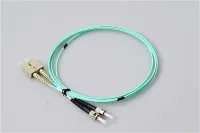
Both fibers share the same 50µm core, same 125µm cladding, same aqua jacket (usually), and same connector compatibility. They're manufactured to ISO 11801 standards and optimized for 850nm VCSEL lasers. From the outside, they're identical.
The difference is inside: how tightly the refractive index gradient is controlled during manufacturing. OM4's tighter tolerances reduce modal dispersion-the timing spread between different light paths traveling through the fiber. Less dispersion means higher effective modal bandwidth (EMB): 4700 MHz·km for OM4 versus 2000 MHz·km for OM3.
That bandwidth number translates directly into supported distance at a given speed. Higher bandwidth = longer reach before signal quality degrades.
Distance Limits by Speed: The Numbers That Matter
Here's where most articles get sloppy. They'll tell you "OM3 does 100m at 100G, OM4 does 150m" and leave it there. But 100 Gigabit Ethernet isn't one thing-it's multiple physical layer standards with different fiber requirements.
1 Gigabit and 10 Gigabit Ethernet
At 1GbE (1000BASE-SX), both OM3 and OM4 reach 1000 meters. No meaningful difference.
At 10GbE (10GBASE-SR), the gap opens up:
- OM3: 300 meters
- OM4: 400 meters (standard spec), up to 550 meters with high-quality fiber and clean connections
Most enterprise 10GbE runs fall well under 300 meters, so OM3 handles them without issue. The 300-400m zone is where OM4 actually earns its keep at this speed.
40 Gigabit Ethernet (40GBASE-SR4)
40GbE uses parallel optics: four 10G lanes transmitted over four fibers in each direction, requiring an 8-fiber MTP/MPO connection.
- OM3: 100 meters
- OM4: 150 meters
100 Gigabit Ethernet: Two Different Animals
This is where confusion happens. "100G multimode" can mean two very different things:
100GBASE-SR4 uses four lanes at 25Gbps each, requiring an 8-fiber MPO connector (same physical interface as 40GBASE-SR4). Distance limits:
- OM3: 70 meters
- OM4: 100 meters
100GBASE-SR10 uses ten lanes at 10Gbps each, requiring a 24-fiber MPO connector. Distance limits:
- OM3: 100 meters
- OM4: 150 meters
SR4 is far more common in current deployments because it uses less fiber and aligns with QSFP28 transceiver form factors. SR10 exists but sees limited adoption. When someone says "100G over multimode," they almost always mean SR4-which means OM3 maxes out at 70 meters, not 100.
We've seen customers spec OM3 for 100G links assuming 100-meter reach, then discover their 85-meter run won't certify. If you're deploying 100GBASE-SR4, treat 70 meters as the OM3 ceiling and plan accordingly.
The Mistake We See Most Often
Customers agonize over OM3 vs OM4 when the real issue is something else entirely.
In our experience, the fiber grade rarely causes deployment problems. What causes problems:
- MPO polarity mismatches. Method A, B, or C? Wrong polarity kills the link regardless of fiber type.
- Dirty connectors. A speck of dust on an MPO ferrule causes more loss than the difference between OM3 and OM4 attenuation specs.
- Mixing fiber types accidentally. Someone patches an OM3 cord into an OM4 trunk, or worse, connects 50µm fiber to legacy 62.5µm OM1 infrastructure. The core mismatch (not the grade) causes 3-4 dB loss.
- Transceiver/fiber speed mismatch. Plugging a 10G-only transceiver into a link designed for 40G parallel optics, then wondering why it doesn't work.
If you're doing a new build, pick one fiber grade and standardize. OM4 costs slightly more but removes any distance anxiety for 40G/100G upgrades. If you're adding to existing OM3 infrastructure, stick with OM3 unless you're certain you need the extra reach-mixing degrades the whole path to OM3 performance anyway.
When to Skip Multimode Entirely
Here's advice we give that might seem counterintuitive for a fiber supplier: sometimes the answer isn't OM3 or OM4. It's single-mode.
Multimode fiber exists because it's cheaper to terminate and historically required less expensive transceivers. But that cost gap has narrowed. 10G single-mode SFP+ modules now cost only marginally more than multimode equivalents. And single-mode gives you:
- Distances measured in kilometers, not meters
- A clear upgrade path to 25G, 40G, 100G, 400G without distance constraints
- No OM3/OM4/OM5 confusion-OS2 single-mode just works
If your building-to-building runs exceed 300 meters, or if you're installing new campus backbone that needs to last 15+ years, single-mode often makes more sense than trying to stretch multimode to its limits. The slightly higher transceiver cost buys you flexibility that multimode can't match.
That said, for data center leaf-spine connections, server-to-switch links, and most intra-building runs, multimode remains cost-effective and practical. Just don't force it where it doesn't fit.

Attenuation: A Secondary Concern
OM3 fiber specifies maximum attenuation of 3.5 dB/km at 850nm. OM4 improves this to 3.0 dB/km. The 0.5 dB/km difference sounds meaningful, but at typical multimode distances (under 300 meters), it translates to fractions of a decibel-less than the variation you'll see between connector matings.
Attenuation matters more for link budget calculations in marginal installations. If you're pushing OM3 close to its 300-meter limit at 10GbE with multiple patch points, every fraction of dB counts. But for most standard deployments, the bandwidth/distance difference between OM3 and OM4 is more decision-relevant than attenuation.
Identifying Fiber in Existing Installations
Quick version: OM3 and OM4 both traditionally use aqua jackets. Some manufacturers now use "Erika Violet" (a purple-magenta shade) specifically for OM4, but adoption is inconsistent-especially in North America where plenty of OM4 still ships in aqua.
If you need to identify unlabeled cable: check the printed markings on the jacket (manufacturers print fiber type at regular intervals), or pull documentation. Visual color alone isn't reliable unless you know the installer followed the violet convention.

What About OM5?
OM5 (wideband multimode fiber) supports shortwave wavelength division multiplexing across 850-953nm. It enables higher aggregate bandwidth by running multiple wavelengths over the same fiber pair-useful for 100G and 400G applications using SWDM optics.
For most current deployments, OM5 is overkill. It's backward compatible with OM3/OM4 at standard 850nm, so it works as a future-proofing choice if SWDM adoption grows. But today, the practical decision remains OM3 vs OM4. We don't push OM5 unless a customer has specific SWDM requirements.
Cost Reality
OM4 commands a price premium over OM3, but the gap isn't dramatic for patch cords and short assemblies-sometimes just a few percent difference. The premium is more noticeable on long trunk cables and large-quantity orders.
Where cost calculation gets interesting: if OM4's extended reach eliminates the need for an intermediate distribution frame or allows consolidating two equipment rooms into one, the cable premium pays for itself many times over. Conversely, if all your runs fit comfortably within OM3 limits, paying extra for unused capability doesn't make sense.
We typically recommend: new data center builds standardize on OM4; existing OM3 infrastructure stays OM3 unless a specific link needs longer reach; budget-constrained projects with sub-100m runs can safely choose OM3.
Real Project Scenarios We've Worked Through
A few examples from actual customer conversations that illustrate how this plays out:
Scenario 1: Warehouse network upgrade. A logistics company needed to connect new 10GbE switches across a 180,000 sq ft distribution center. Longest run: 140 meters. Their contractor quoted OM4 "for future-proofing." Our take: OM3 handles 10GbE at 300 meters comfortably. Unless they're planning 40G/100G in the next 5 years (they weren't), OM4 adds cost without benefit. They went with OM3 and saved 12% on cabling.
Scenario 2: Data center leaf-spine fabric. A colocation provider building out new pods with 100GBASE-SR4 between spine and leaf switches. Average run: 65 meters, longest: 95 meters. They initially spec'd OM3 assuming the "100 meter" limit they'd seen in various articles. Problem: 100GBASE-SR4 on OM3 maxes out at 70 meters. Their 95-meter runs wouldn't certify. Switched to OM4 (100-meter limit for SR4), problem solved.
Scenario 3: Campus backbone replacement. A university replacing aging OM1 infrastructure between buildings. Some runs exceeded 400 meters. They asked about OM4 to maximize multimode distance. Our advice: at 400+ meters, you're fighting multimode physics. Single-mode OS2 fiber costs slightly more for transceivers but gives them kilometer-scale reach and a 20-year upgrade path. They went single-mode for inter-building links, kept multimode for intra-building distribution.
These examples share a common thread: the right answer depends on actual distance requirements and realistic upgrade timelines, not theoretical "what if" scenarios.
Connector and Termination Notes
Both OM3 and OM4 use identical termination hardware. LC connectors dominate modern installations for duplex connections; MTP/MPO connectors handle parallel optics for 40G and 100G. Factory-terminated assemblies deliver more consistent loss performance than field termination-if you're deploying high-speed links, pre-terminated OM4 MTP trunk and breakout cables reduce installation variables.
One practical note: for 40G/100G parallel optics, verify MPO polarity type (Method A, B, or C) matches between trunk cables and equipment. Polarity errors cause link failures that have nothing to do with fiber grade.

Frequently Asked Questions
Q: Can I Mix OM3 And OM4 In The Same Link?
A: Yes, they're physically compatible (same 50µm core). But the link performs at OM3 specifications-you get OM3 distance limits regardless of how much OM4 is in the path. One OM3 patch cord in an otherwise all-OM4 run limits the whole thing.
Q: My 100G Link Is 90 Meters. OM3 Or OM4?
A: If it's 100GBASE-SR4 (the common one), OM3 only supports 70 meters. You need OM4. If somehow you're using 100GBASE-SR10, OM3 reaches 100 meters-but SR10 is rare. Assume SR4 unless you know otherwise.
Q: Should I Replace Working OM3 Infrastructure With OM4?
A: Usually no. If OM3 meets your current speed and distance needs, replacement adds cost without benefit. Consider OM4 for new additions or when upgrading to speeds where OM3 limits become constraining.
Q: What's The Actual Price Difference?
A: For patch cords: minimal, often under 10%. For trunk cables: OM4 runs roughly 15-30% higher depending on length and fiber count. The percentage matters less than whether the extra reach capability has practical value for your deployment.
Q: Does OM4 Require Different Transceivers?
A: No. Transceivers don't know or care about fiber grade-they transmit and receive 850nm light regardless. The fiber type determines how far that light travels reliably, not which transceiver you use.
Bottom Line
OM3 remains a solid choice for 10GbE deployments within 300 meters-which covers most enterprise LAN scenarios. OM4 justifies its premium when you're deploying 40G/100G links, when runs exceed OM3's distance limits, or when you want headroom for future speed upgrades without recabling.
The bigger mistakes aren't picking the wrong grade. They're forcing multimode where single-mode makes more sense, mixing incompatible fiber types, or overlooking MPO polarity in parallel optics deployments. Get those right, and the OM3/OM4 decision becomes straightforward.
Need help speccing fiber for a specific project? Our technical team can review your distance requirements and recommend the right combination of multimode fiber types, connector configurations, and trunk/patch assemblies.