Product Introduction
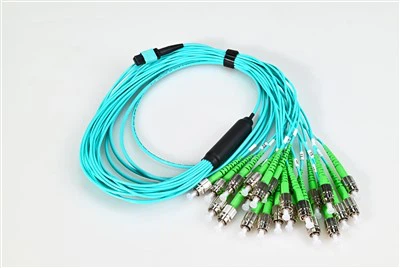
MPO/ multi-fiber cabling system is ideally suited for a high density environment that demands space saving and innovative cable management solutions. MPO fan-out supports various connections from multi-fiber to single-fiber out.
Specification
|
Specification |
MM low loss |
Standard |
SM low loss |
Standard |
|
Insertion Loss |
Typitcal<0.30dB |
Typitcal<0.50dB |
Typitcal<0.30dB |
Typitcal<0.50dB |
|
Return Loss |
≥20dB |
≥20dB |
≥PC45dB |
≥PC45dB |
Feature


Push-pull latching
Easy assembly , no tool needed
Alignment achieved with high precious guide pins
Designed for low loss and standard loss SM and MM applications
Ruggedized round cable, oval cable and bare ribbon options available
Color coded housing available to different fiber type, polish type and connector grade
Application

Data Center High-Density Cabling
- 40G QSFP+ SR4 and 100G QSFP28 SR4 parallel optics interconnects between spine and leaf switches - each 12-fiber MPO connector replaces six individual duplex LC jumpers
- High-density fiber optic patch cord cross-connects on MDF and IDF patch panels, cutting panel space requirements by up to 70%
- MPO trunk cable backbone runs between cabinets, consolidating 12–72 multimode fibers into a single cable pathway for cleaner cable management
- Migration-ready infrastructure: the same OM4 MPO cabling supports future upgrades to 200G and 400G parallel optics without re-pulling cable

Array Fiber to Single Fiber Fanouts & Cassettes
- MPO-to-LC breakout assemblies distributing multi-fiber connections from SAN directors to individual storage array ports - one cable replaces a dozen patch cords
- Pre-loaded MPO cassette modules enabling rapid add/move/change operations in structured cabling systems
- Fibre Channel 16G/32G switch-to-switch ISL trunking over multimode OM3/OM4 fiber for storage area networks
- Quick-deploy fanout cables for connecting QSFP+ transceivers to individual SFP+ ports during 10G-to-40G network migration

Array Trunk Cables & Campus Backbone
- Building-to-building multimode fiber backbone runs within campus networks - MPO trunk cables simplify riser and horizontal pathways
- Plenum-rated (OFNP) and LSZH MPO assemblies for vertical backbone in multi-floor office and industrial buildings
- 10G aggregation layer connections from access switches to distribution switches, with pre-terminated MPO reducing on-site installation time by up to 75% versus field termination
- Large-scale array trunk cables supporting 24–144 fibers between telecom rooms and main equipment rooms

Optical Switching & High-Density Interconnect
- Optical switching interframe connections where space constraints demand multi-fiber push-on connectors - one MPO interface delivers 12× the density of standard SC connectors
- High fiber density card-edge access on routers, optical switches, and line cards in telecom central offices
- Test lab and R&D environments requiring rapid reconfiguration of multi-fiber links between prototype equipment
- Broadcast and media production facilities using parallel optics for uncompressed video transport and studio-to-control room connectivity
FAQ
Q: What's the actual difference between MTP and MPO on these patch cords?
A: We get this one on almost every inquiry call. Short answer: every MTP connector is an MPO, but not every MPO is an MTP. MPO is the generic connector type defined by IEC 61754-7 and TIA-604-5 (FOCIS 5). MTP is a registered trademark from US Conec - think of it as the premium version with tighter ferrule tolerances, a stainless steel elliptical guide pin, and a metal pin-clamp spring. Where it really shows up is insertion loss: our low-loss MTP-grade assemblies typically come in at 0.15–0.25 dB per mated pair, whereas a standard MPO sits around 0.35–0.50 dB. They're 100% cross-compatible - plug an MTP into a generic MPO adapter and it works fine. For a deeper comparison, we put together a full MPO/MTP deep-dive guide that walks through the mechanical differences in detail.
Q: Should I go with OM3 or OM4 multimode fiber for these MPO cables?
A: Depends on your distances and speeds. OM3 gives you 300 m at 10G and about 100 m at 40G SR4 - which covers most rack-to-rack runs inside a data center just fine. OM4 pushes that to 400 m at 10G and 150 m at 40G, plus it has nearly double the modal bandwidth (4700 MHz·km vs 2000 MHz·km at 850 nm). Here's what I always tell buyers: if you're building new infrastructure, spend the extra 15–20% for OM4. We've seen too many customers outgrow OM3 reach limits within two years when they add cabinet rows or go from 10G to 40G. The cable cost difference is small; the re-pull labor cost is not. Our single mode vs multimode 2026 guide has a detailed comparison table if you want the numbers side-by-side.
Q: What does polarity Type A, Type B, and Type C mean, and which do I need?
A: Polarity is honestly the #1 source of confusion in MPO cabling - and getting it wrong means your transmit and receive won't line up, so no link lights. Quick breakdown: Type A (straight-through) maps fiber 1 to fiber 1 with the key flipped (key-up to key-down). Type B (reversed) maps fiber 1 to fiber 12 with both keys facing the same way - this is by far the most common for 40G QSFP+ SR4 direct switch-to-switch connections and what TIA-568.3-D generally recommends for parallel optics. Type C (pair-flipped) swaps adjacent pairs - it's less common and mainly shows up in some legacy duplex-to-MPO migration setups. If you're doing direct 40G/100G connections between two transceivers, go with Type B. If you're routing through cassette modules, the cassette vendor's spec sheet will tell you what trunk polarity to match. Not sure? Send us your transceiver and panel models and we'll spec the right polarity for you - that's a free service we do on every quote.
Q: Can these multimode MPO patch cords handle 40G and 100G Ethernet?
A: That's exactly what they're built for. For 40GBASE-SR4, you need 8 fibers over OM3 (up to 100 m) or OM4 (up to 150 m) - our 12-fiber MPO connector handles this because the outer 4 fibers simply go unused. For 100GBASE-SR4, it's 8 fibers on OM4 out to 100 m. And if you're looking at 100GBASE-SR10, that uses all 24 fibers in a 24-fiber MPO assembly. We test every single cable before it ships - insertion loss, return loss, end-face geometry under 3D interferometry - and the individual test data ships with your order. Planning a 10G-to-40G-to-100G migration? Talk to us about fiber count selection now so you won't have to re-cable later.
Q: What's the difference between an MPO trunk cable and a breakout (fanout) cable?
A: Think of a trunk cable as the highway and a breakout cable as the exit ramp. An MPO trunk cable has MPO connectors on both ends - 12, 24, up to 144 fibers in one jacket. It connects patch panels to patch panels, cassettes to cassettes, or any equipment that both use MPO interfaces. A breakout cable (also called a harness or fanout) has an MPO connector on one end and splits into individual duplex LC or SC connectors on the other. You'd use it when connecting a multi-fiber QSFP+ port on a switch down to separate SFP+ transceivers on individual servers. We manufacture both - and the matching fiber optic adapters and cassette panels that tie the system together.
Q: Male (pinned) or female (unpinned) MPO connector - which side do I need?
A: Getting the gender wrong is one of the most common ordering mistakes we see - and it'll stop your link dead on install day. Male connectors have two precision guide pins sticking out of the ferrule face; female connectors have the corresponding alignment holes. When they mate, the pins slide into the holes to align all 12 or 24 fiber cores. The general rule: trunk cables (MPO to MPO) use female on both ends because the adapter panel or bulkhead coupler in between provides the pins. Breakout cables and direct equipment jumpers typically have one male end to plug straight into a transceiver or cassette module's female port. If you're not sure, just tell us the equipment model on your purchase order - we'll match the correct gender and it's one less thing to worry about at the job site.
Q: How do I properly clean an MPO/MTP multi-fiber connector?
A: Cleaning MPO connectors is more involved than a standard LC or SC connector because you've got 12 or 24 fiber end-faces on a single ferrule instead of just one. Use a dedicated MPO one-click cleaning pen - they're designed specifically for the rectangular MPO ferrule geometry. Never use a standard simplex cleaner; the contact area doesn't match and you'll just push debris around. Clean both the plug and the adapter before every mating. We see a lot of field problems that come down to a single contaminated ferrule adding 1–2 dB of excess loss across the whole 12-fiber assembly. Keep the dust caps on whenever the connector isn't plugged in - especially in active construction environments. A 10-second clean can save you hours of OTDR troubleshooting.
Q: What cable jacket rating do I need - LSZH, Plenum, or Riser?
A: It comes down to where the cable is physically installed. OFNP (plenum) is required by U.S. building codes for any cable running through air-handling spaces - ceiling plenums, raised-floor voids, HVAC return air paths. It carries the highest fire safety rating and won't produce toxic halogenated fumes. OFNR (riser) is for vertical runs between floors that don't pass through air-handling spaces. LSZH (Low Smoke Zero Halogen) is the default in Europe, the Middle East, and much of Asia - it's required under IEC 60332 and EN 50575 CPR regulations. We stock all three jacket types in standard lengths and can do custom lengths on any of them. Not sure which code applies to your project? Send us the building location and we'll match the right jacket - we do this dozens of times a week so it's a quick answer.
Hot Tags: mtp mpo fiber patch cords mm sx, China mtp mpo fiber patch cords mm sx manufacturers, suppliers, factory, fiber optic patch cord with mtp connector, fiber optic patch cord for cloud computing, fiber optic patch cord for virtual reality, fiber optic patch cord for media photographers, fiber optic patch cord manufacturer, fiber optic cable