
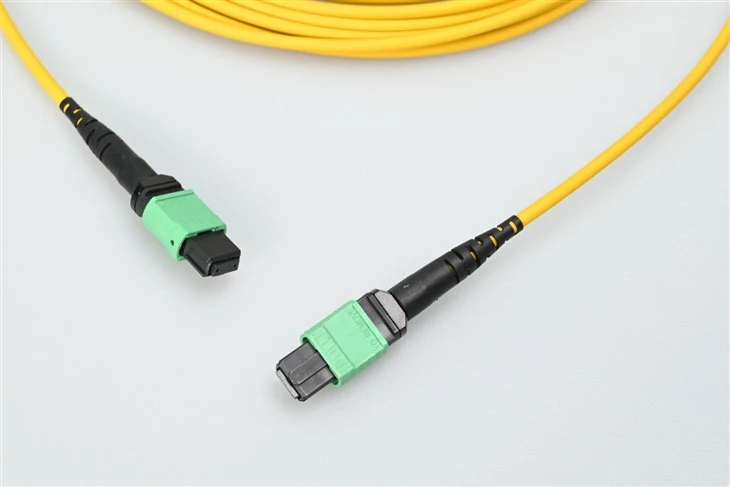
Product Introduction
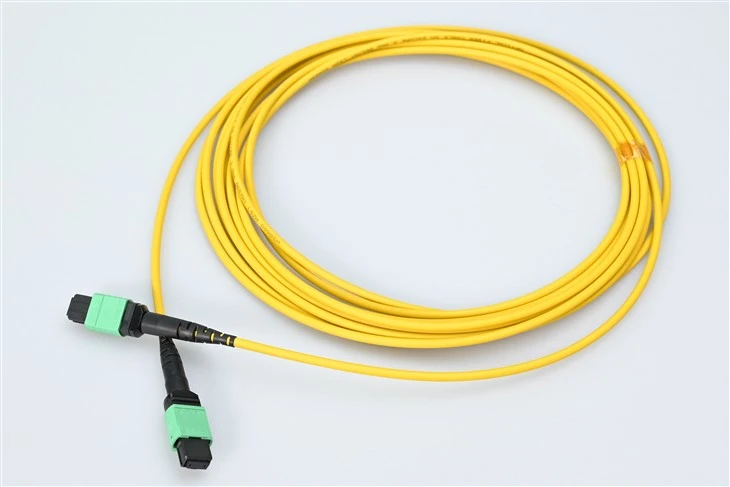
MPO/ multi-fiber cabling system is ideally suited for a high density environment that demands space saving and innovative cable management solutions. MPO fan-out supports various connections from multi-fiber to single-fiber out.
Specification
|
Specification |
MM low loss |
Standard |
SM low loss |
Standard |
|
Insertion Loss |
Typitcal<0.30dB |
Typitcal<0.50dB |
Typitcal<0.30dB |
Typitcal<0.50dB |
|
Return Loss |
≥20dB |
≥20dB |
≥PC45dB |
≥PC45dB |
Feature
Push-pull latching
Easy assembly , no tool needed
Alignment achieved with high precious guide pins
Designed for low loss and standard loss SM and MM applications
Ruggedized round cable, oval cable and bare ribbon options available
Color coded housing available to different fiber type, polish type and connector grade
Application

Array Trunk Cables
Pre-terminated singlemode MTP/MPO trunk cables pack 8, 12, or 24 OS2 fibers into one connector, replacing dozens of individual duplex patch cords for backbone runs. Ideal for MDF-to-IDF links, inter-building risers, and 40G PLR4 / 100G PSM4 / 400G DR4 parallel optics trunk connections between MTP/MPO patch panels. Yellow LSZH jacket follows TIA-598 color coding for instant singlemode identification.

Array Fiber To Single Fiber Fanouts & Cassettes
Transition from multi-fiber OS2 trunks to individual duplex ports using MTP/MPO-to-LC breakout cables (8F to 4×LC or 12F to 6×LC) or panel-mount cassette modules. Essential for connecting QSFP28 PSM4 / QSFP-DD DR4 parallel optic transceivers to LC-based SFP+/SFP28 equipment, enabling smooth 10G to 100G/400G migration without replacing your existing LC-based infrastructure.

High Fiber Density Card Edge Access
A single MTP/MPO connector carries 12 fibers in the footprint of one SC - delivering 12× density per card edge slot. Perfect for optical line cards, DWDM/CWDM mux-demux units, and ROADM systems where faceplate space is limited. Our OS2 assemblies provide the precision alignment and low insertion loss (<0.30dB typical) these sensitive singlemode systems demand, with push-pull latching for tool-free mating in tight equipment bays.

Optical Switching Interframe Connections
Replace 12 or 24 individual singlemode patch cords between equipment frames with one MTP/MPO trunk cable - dramatically simplifying cable management in optical cross-connect (OXC) and carrier-grade telecom environments. Our APC-polished OS2 assemblies (≥60dB return loss) meet the stringent back-reflection requirements of optical switching equipment. See our MTP/MPO polarity and cable type guide for interframe cabling best practices.
Datacenter Cabling
OS2 singlemode MTP/MPO assemblies fit spine-leaf and cross-connect architectures, supporting 400G DR4 / 800G DR8 direct transceiver connections, backbone trunking, and fan-out to LC cassettes via MPO adapter panels. The yellow jacket provides instant visual separation from multimode cables in hybrid SM/MM environments - critical for avoiding costly misconnections at scale.
FAQ
Q: Why choose a singlemode MTP/MPO patch cord over multimode?
A: It comes down to distance and future-proofing. Our singlemode OS2 MTP/MPO cables carry signals 10km+ at 1310nm - multimode maxes out at 100-550m. Singlemode supports 10G through 400G and beyond without distance penalties. The transceivers cost more, but the infrastructure you install today won't need replacing when you upgrade speeds. See our singlemode vs. multimode guide for the full breakdown.
Q: What's the difference between APC and UPC polish on singlemode MPO connectors?
A: UPC has a flat dome polish with return loss ≥45dB - standard for most datacenter singlemode links. APC has an 8-degree angled polish pushing return loss to ≥60dB, which is critical for DWDM, PON, coherent optics, and long-haul telecom that are extremely sensitive to back reflections. Green housing = APC, blue = UPC. Never mix them - the mismatched angles cause massive signal loss and ferrule damage. We cover this in our end-face polish guide.
Q: What speeds and transceiver types do these cables support?
A: They work with all major singlemode parallel optic transceivers: 40GBASE-PLR4 (4×10G, 10km reach), 100GBASE-PSM4 (4×25G, 500m), and 400GBASE-DR4 (4×100G, 500m). Use 8-fiber or 12-fiber MTP/MPO for 40G/100G modules; 8-fiber for 400G DR4. Also backward compatible with 10G/25G SFP+/SFP28 singlemode transceivers via MTP-to-LC breakout cables.
Q: Why is the cable jacket yellow?
A: Yellow is the TIA-598 standard color for singlemode fiber - it's functional, not cosmetic. In a datacenter with hundreds of patch cords, color coding lets technicians instantly tell fiber types apart: yellow = singlemode OS2, aqua = OM3, magenta = OM4, lime = OM5. Plugging the wrong fiber type into equipment means nothing works. We follow this standard across all our products, from singlemode pigtails to trunk cables.
Q: What insertion loss and return loss should I expect?
A: Low-loss grade: typical <0.30dB, max <0.70dB per connector. Standard grade: typical <0.50dB, max <0.70dB. Return loss ≥45dB (UPC) or ≥60dB (APC). Singlemode parallel optic links like PSM4 have very tight power budgets - every tenth of a dB counts. We 100% test every assembly before shipping. Our article on insertion loss testing walks through link budget calculations.
Q: Do I need male (pinned) or female (unpinned) connectors?
A: Transceiver ports (QSFP+ PLR4, QSFP28 PSM4, QSFP-DD DR4) are always male - so patch cords plugging into transceivers need female ends. Panel-to-panel trunk cables are typically female-to-female. For APC singlemode, also double-check key orientation (key-up vs. key-down) - getting it wrong flips polarity, which is painful to troubleshoot on multi-fiber links. Tell us your transceiver model and we'll spec the right configuration.
Q: What polarity type - Type A, B, or C?
A: We make all three TIA-568 polarity types. Type B (reversed) is our most popular for singlemode datacenter deployments - it works for both duplex and parallel optics (PSM4, DR4) and lets you use the same patch cords on both ends. Type A suits some telecom layouts; Type C is rare but available. The key rule: be consistent across your infrastructure. Our MPO/MTP polarity guide has wiring diagrams for each method.
Q: Can these cables support 400G or 800G?
A: Absolutely - this is where singlemode MTP/MPO shines over multimode. Our 8/12-fiber assemblies directly support 400GBASE-DR4 (8 fibers, 500m). For 800G-DR8, we offer 16-fiber configurations. Even 1.6T standards will continue using singlemode MTP/MPO interfaces. Investing in this infrastructure now means you're building for the next decade of speed upgrades. More detail in our LC vs. MTP/MPO cabling guide.
Q: How should I clean singlemode MTP/MPO connectors?
A: Singlemode's 9µm core is 6× smaller than multimode's 50µm - so contamination that costs 0.3dB on multimode can cause 1dB+ loss or total signal blockage on singlemode. Use a dedicated MPO one-click cleaner (not LC/SC cleaners). Clean both connector and adapter port before every mating. Keep dust caps on when disconnected. Never use canned air - it deposits residue. Our cleaning and maintenance guide covers the full process.
Q: What jacket and cable options are available?
A: Standard: 3.0mm round cable with yellow LSZH jacket for indoor datacenter and telecom installations. Also available: OFNP plenum-rated for North American air-handling spaces, oval cable for higher fiber counts in tight pathways, and bare ribbon for ultra-compact applications. For harsh environments, our armored MTP/MPO patch cords add stainless steel crush protection. All options use OS2 9/125µm fiber with custom lengths from 0.5m to 100m+.
Hot Tags: mtp mpo fiber patch cords sm sx yellow, China mtp mpo fiber patch cords sm sx yellow manufacturers, suppliers, factory, fiber optic patch cord for convention center optical network, fiber optic patch cord for passive optical network pon , optical connecting cord, fiber optic patch cord for enterprise network, fc fiber optic patch cord, fiber optic patch cord retail