


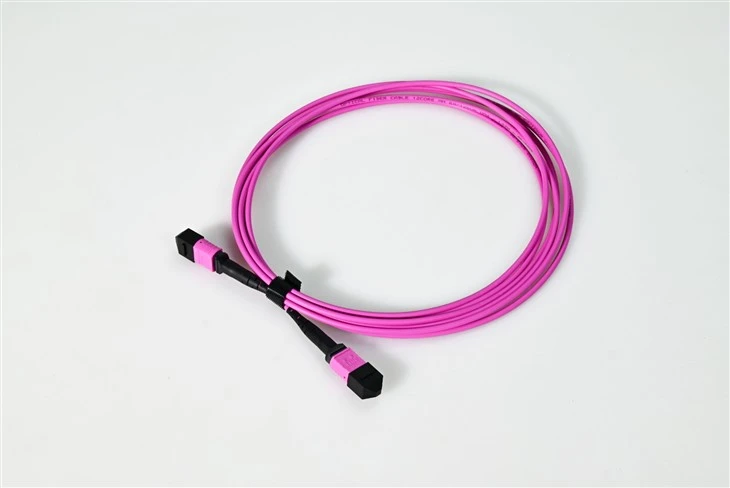
A Low-Loss MTP/MPO Patch Cable Built for Tight 40G and 100G Link Budgets
In a parallel-optic channel, connector loss decides how many patch points you can afford before the link fails certification. This 12-fiber OM4 jumper is designed around that limit.
OM4 fiber delivers 4700 MHz·km modal bandwidth, stretching 40GBASE-SR4 to 150 m, while the low-loss MT ferrule keeps typical insertion loss below 0.30 dB per mated pair. You get longer runs and more room for cassettes and panels within the same budget.
It plugs straight into QSFP+ and QSFP28 SR4 transceivers, feeds MTP-to-LC breakout cassettes, and links panels across spine-leaf rows. Every cord ships with its end-face verified, so acceptance testing starts from a known baseline instead of a guess.

MTP MPO 12 Core OM4 Fiber Patch Cord Specifications and Loss Grades
Every value below applies to the multimode MT version on this page. Use the reach table to check your longest channel before choosing a loss grade.
| Fiber count | 12 fibers (MTP-12 / MPO-12) |
|---|---|
| Fiber type | OM4 multimode, 50/125 µm |
| Modal bandwidth | 4700 MHz·km |
| Attenuation | ≤3.0 dB/km |
| Wavelength | 850 nm, VCSEL transceivers |
| Ferrule | Multimode MT ferrule |
| Insertion loss, low-loss grade | Typical <0.30 dB, maximum <0.50 dB per mated pair |
| Insertion loss, standard grade | Typical <0.50 dB, maximum <0.70 dB per mated pair |
| Return loss | ≥20 dB, both grades |
| Latching | Push-pull, no tools required |
| Alignment | Precision guide pins (male) and guide holes (female) |
| Connector gender | Male or female, set independently at each end |
| Polarity | Female-to-female Type B as the common data center build; other polarity to your design |
| Cable construction | Ruggedized round, oval, or bare ribbon |
| Jacket color | Violet (Erika Violet) per TIA-598 |
| Boot color | Black, identifying a 12-fiber connector |
| Housing | Color-coded by fiber type, polish type and connector grade |
| Testing | 3D interferometry on every cable; individual reports on request |
Maximum Reach by Application at 850 nm
| Application | This OM4 cord | OM3 for comparison |
|---|---|---|
| 10GBASE-SR | 400–550 m | 300 m |
| 40GBASE-SR4 | 150 m | 100 m |
| 100GBASE-SR4 | 100 m | n/a |
| 40GBASE-eSR4 | 400 m | n/a |
| 100GBASE-eSR4 | 300 m | n/a |
Distances exclude connector loss. Single-mode MT versions (return loss ≥45 dB PC, ≥30 dB APC) are also available. Ask Evolux for a spec sheet and sample test report.
Why Data Center Buyers Order These Wholesale OM4 MPO Patch Cords
Four practical reasons network integrators and colocation operators standardize on this cord for volume projects.
Racks Can Sit Further From the MDA
At 40G SR4 the reach rises from 100 m on OM3 to 150 m, and at 10G from 300 m to as much as 550 m. Attenuation also drops to ≤3.0 dB/km.
That extra 50 m often removes an intermediate distribution point, along with the connectors, panels and labor that come with it.
Loss Grades That Match the Channel
Worst case across three mated pairs is 1.50 dB on the low-loss grade and 2.10 dB on standard grade.
On a 100G SR4 channel close to 100 m, that 0.60 dB is frequently the margin between pass and fail. Order low-loss for long, multi-hop links and standard grade for short in-rack patching.
One Part Number Across Speed Migrations
40G QSFP+ SR4 runs on fibers 1–4 (transmit) and 9–12 (receive). The same MTP-12 cable breaks out to six LC duplex links and supports 40G to 4×10G and 100G to 4×25G migration.
Your team stocks fewer SKUs and keeps spares useful when the network moves to the next speed.
Fewer Mis-Patches in Mixed Halls
The violet jacket marks the fiber grade at a glance, and the black boot marks 12 fibers (grey is 8, red is 24).
Technicians working moves, adds and changes in OM3/OM4 environments can identify cords without reading labels.
Planning a 40G or 100G rollout? Send your channel lengths and Evolux will quote bulk MTP MPO patch cords with the loss grade each link actually needs.
How to Specify the Right Gender, Polarity and Loss Grade for Your MPO Jumpers
Most ordering mistakes with multi-fiber patch cords come down to gender or polarity. Use this guide before you send a purchase order.
| Your connection | Order this | Reason |
|---|---|---|
| Direct to a QSFP+ or QSFP28 port | Female end at the transceiver | The transceiver interface is male |
| Panel to panel through adapters | Female to female | Panel adapters supply the alignment pins |
| Standard data center channel, unsure of design | Female to female, Type B | Covers most common layouts |
| Long run or several mated pairs | Low-loss grade | Keeps total connector loss inside budget |
| Linking into existing OM3 | Keep critical 40G/100G links OM4 end to end | A mixed link performs at OM3 limits |

Still unsure? Attach your cabling drawing to the quote form and our engineers will check the configuration before production.
Push-Pull MT Ferrule Construction That Holds Each Patch Cable Within Grade
Loss figures only matter if they stay stable after repeated mating. These build details are what keep them there.
Guide-Pin Alignment
Precision guide pins register all 12 end-faces in one mating, with pins on male connectors and matching holes on female.
Consistent alignment keeps insertion loss inside grade through repeated re-patching.
Tool-Free Push-Pull Latch
Connectors mate and release with a simple push-pull action, with no assembly tools.
In dense panels, installers work one-handed without disturbing neighboring cords.
Three Cable Builds
Ruggedized round cable for exposed routing, oval cable to cut pathway bulk, bare ribbon for protected cassette interiors.
You avoid paying for jacket protection the enclosure already provides.
Project-Ready MTP Patch Cables for Data Center, SAN and Campus Networks
Typical projects where our OM4 multi-fiber cords are specified.

40G/100G Spine-Leaf and Top-of-Rack
- Direct QSFP+ SR4 and QSFP28 SR4 transceiver links
- Spine-leaf and ToR channels up to 150 m at 40G
- High-bandwidth SAN interconnects

Array Trunks and Backbone Cabling
- Extended-reach backbone transmission
- Cabinet-to-cabinet and cross-floor connections
- MDA deployments and high-density card-edge access

Fan-Out, Cassette and Breakout Systems
- MTP-12 to 6×LC duplex breakout
- 40G to 4×10G and 100G to 4×25G migration
- Modular cassette-based structured cabling

Optical Switching and Enterprise Networks
- Optical switching interframe connections
- Low-latency financial trading infrastructure
- Campus backbones at 10G up to 550 m, cloud and virtualization platforms
Custom OM4 MTP MPO Patch Cords Made to Your Cut List
If you resell under your own label or cable a specific hall layout, Evolux builds each OEM MPO patch cord order to your parameters instead of forcing a catalog length.
| Option | Choices | What it solves |
|---|---|---|
| Connector gender | Female-female, male-female, male-male | Correct mating with transceivers and panel adapters |
| Polarity | Type B default, or to your channel design | No Tx/Rx mismatch at turn-up |
| Loss grade | Low-loss or standard | Budget spent only where the link needs it |
| Fiber count | 8, 12 or 24 fibers | One supplier for SR4 and higher-density links |
| Cable build | Round, oval, bare ribbon | Protection matched to the pathway |
| Length | To your cut list | No slack coils in crowded cabinets |
| Housing color code | By fiber type, polish, grade | Fits your site identification scheme |
Send Your Spec to the Evolux OEM Team
Factory-Tested Multi-Fiber Patch Cords With Individual Test Reports
Twelve end-faces share one ferrule, so a single flaw can pull an entire 40G/100G link out of spec. That is why testing here is per cable, not per batch.
- 3D interferometry on every cable to verify MT ferrule end-face geometry before shipment.
- Loss checked against the ordered grade: maximum <0.50 dB for low-loss, <0.70 dB for standard, return loss ≥20 dB.
- Individual reports on request for your handover files and client acceptance.
- TIA-598 color coding on jacket and boot for auditable installations.
If your tender calls for specific compliance documents, list them in your RFQ and Evolux will confirm availability before quoting.

Bulk MTP/MPO Jumper Orders Labeled and Packed for Site Deployment
For volume orders, packaging is agreed around how your installers receive the cords. Tell us how you want each cord labeled (length, gender, polarity, loss grade), whether to kit by rack or project phase, and how cartons should be marked.
MOQ and Lead Time for 12 Core OM4 MPO Patch Cable Orders
MOQ and lead time depend on the configuration, so Evolux quotes both with your price. Including these five details gets you a firm answer on the first reply:
- Quantity for each length
- Connector gender at each end, plus polarity
- Loss grade
- Cable build (round, oval or bare ribbon)
- Test report and labeling requirements
Buyer Questions About 12 Core OM4 MTP MPO Patch Cords
Should I choose OM4 or OM3 for a new 40G/100G build?
Choose OM4. Its 4700 MHz·km bandwidth is more than double OM3's 2000 MHz·km and extends 40G SR4 from 100 m to 150 m. The price gap is now small, so the extra reach costs very little.
Can I connect these cords to OM3 cabling already in the building?
Yes. Both use 50/125 µm fiber and 850 nm VCSEL optics, so they work together. The link will perform to OM3 limits, though, so keep critical 40G/100G channels OM4 from end to end.
Which connector gender do I need for QSFP28 transceivers?
QSFP+ and QSFP28 ports are male, so the cord end must be female. Panel-to-panel runs are usually female to female because the adapters supply the pins. Evolux builds every gender combination and recommends female-to-female Type B for most standard data center channels.
How much insertion loss should I budget per connection?
Allow up to 0.50 dB per mated pair on the low-loss grade and 0.70 dB on standard grade; typical values are below 0.30 dB and 0.50 dB. Add every mated pair to the fiber loss for the total. As a manufacturer testing each cable, Evolux can supply individual reports to support that calculation.
Can you supply 8- or 24-fiber versions on the same order?
Yes. The 12-fiber format is the most common because it carries 40G SR4 and breaks out cleanly to six LC duplex ports, while 24-fiber suits applications such as 100G SR10. Evolux manufactures all three fiber counts, so mixed orders come from one factory.
Do MTP connectors need different cleaning tools from LC?
Yes. Use a cassette or reel-type MTP cleaner that sweeps all 12 end-faces in one pass, plus a microscope with an MTP tip for inspection. Clean before every mating and keep dust caps on, since dirt on one fiber can degrade the whole link.
Hot Tags: Evolux MTP MPO 12 Core OM4 Fiber Patch Cord, China Evolux MTP MPO 12 Core OM4 Fiber Patch Cord manufacturers, suppliers, factory, fiber signal cord, fiber optic patch cord, fiber optic patch cord for fiber to the home ftth , fiber optic patch cord for industrial network, fiber link cable, fiber optic patch cord for audio transmission


