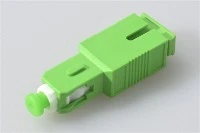
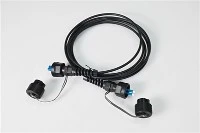
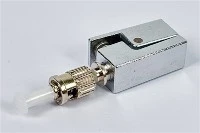
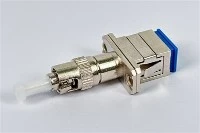
If you've ever stared at the back of a fiber patch panel and noticed a mix of green and blue connectors, you've already encountered the APC vs. UPC divide - even if nobody explained the difference. The green ones are APC. And for a growing number of network applications, they're the only option that makes technical sense.
This guide covers SC APC connectors specifically: what the 8-degree angle actually does to your signal, where SC APC outperforms other connector types, how to avoid the installation mistakes that destroy return loss performance, and when you should - and shouldn't - choose APC over UPC.
What Makes SC APC Different from SC UPC?
Every fiber optic connector works by aligning two glass fiber cores so light passes from one to the other with minimal loss. The difference between APC and UPC comes down to what happens to light that doesn't make it across the connection - the back reflection.
UPC (Ultra Physical Contact) connectors have a flat, slightly domed endface polished perpendicular to the fiber axis. When light hits this flat interface, a small percentage reflects straight back into the fiber core. That reflected light is called Optical Return Loss (ORL), and it causes problems - signal noise, laser instability, and bit errors - especially in analog and high-sensitivity digital systems.
APC (Angled Physical Contact) connectors solve this by polishing the endface at an 8-degree angle. That angle redirects reflected light into the fiber cladding instead of back down the core. The result: dramatically lower back reflection.
The numbers tell the story:
|
Parameter |
SC UPC |
SC APC |
|
Endface angle |
0° (flat/domed) |
8° |
|
Typical return loss |
≥50 dB |
≥60 dB |
|
Connector color code |
Blue |
Green |
|
Ferrule size |
2.5 mm |
2.5 mm |
|
Typical insertion loss |
0.1–0.2 dB |
0.2–0.3 dB |
A note on return loss values: Return loss is expressed as a positive dB number - higher is better. A return loss of 60 dB means reflected power is one-millionth of the input signal. At 50 dB (UPC), reflected power is ten-millionths. That 10 dB gap represents a 10× difference in reflected energy reaching the laser source.
That 10 dB difference in return loss sounds small, but in optical terms it's a 10× reduction in reflected power. For a GPON network carrying RF video overlay, or a DWDM system running 96 channels at tight spacing, that factor of ten is the difference between a clean signal and visible artifacts on every screen.
Critical rule: Never mate an APC connector with a UPC connector. The angled endface of an APC connector will not make proper contact with a flat UPC endface. The result is an air gap that causes extreme insertion loss (often >3 dB) and can physically damage both ferrule endfaces. If you see green plugged into blue - or vice versa - disconnect it immediately.
We learned this one the hard way. A data center client in New Jersey called us after an entire row of PON OLTs went into alarm following a routine patch panel migration. The overnight crew had grabbed a box of blue SC UPC patch cords instead of green SC APC and cross-connected 48 ports. By morning, 23 SFP transceivers had flagged high back-reflection faults, 6 had permanently degraded receiver sensitivity, and the ferrule endfaces on every mismatched pair showed visible scoring under a microscope. Total damage: 29 replacement SFPs, 48 replacement patch cords, and 14 hours of unplanned downtime. All because the wrong color connector came out of the box. That $50,000 lesson is why we tell every installer: check the color, check the adapter, check every single time.
The SC Connector: Why It's Still Everywhere
The SC (Subscriber Connector, sometimes called "Standard Connector") has been an industry staple since its inclusion in the TIA-568 standard. Its push-pull latching mechanism makes it one of the simplest connectors to use - no twisting, no threading, just click in and pull out.
Key characteristics of the SC fiber optic connector:
2.5 mm zirconia ceramic ferrule - precise core alignment, low insertion loss
Snap-in push-pull latch - tool-free connection and disconnection
Rectangular housing - naturally keyed, prevents rotational misalignment
Duplex-capable - two SC connectors clip together for duplex applications
Rated for 1,000+ mating cycles with less than 0.2 dB insertion loss change
SC connectors remain the dominant connector type in FTTH deployments, passive optical networks (PON), CATV distribution, and telecom outside plant. While LC connectors have gained ground in data centers due to their smaller form factor, SC holds firm in applications where ease of handling and robust mechanical reliability matter more than port density.
Where SC APC Connectors Are the Right Choice
Not every application needs APC. But the ones that do, really do. Here's where SC APC is either required or strongly preferred:
FTTH / GPON / XGS-PON deployments. Every major PON standard (ITU-T G.984, G.987, G.9807) specifies APC connectors throughout the optical distribution network. The reason: PON systems use splitters that are inherently sensitive to back reflections, and many FTTH deployments carry analog RF video overlay alongside digital data. Back reflections from UPC connectors cause visible interference on video channels. This is why every ODN component - PLC splitters, patch panels, drop cables - uses SC APC in FTTH.
DWDM and WDM systems. When you're multiplexing 40, 80, or 96 wavelength channels onto a single fiber, even small reflections can cause crosstalk between adjacent channels. APC minimizes this risk.
Analog CATV. Cable television signals are amplitude-modulated, making them extremely sensitive to return loss. Industry practice mandates APC connectors for all analog video paths.
Test and measurement. High-precision OTDR and optical power meter connections often use APC to prevent measurement artifacts from reflected light.
Long-haul and amplified systems. Erbium-doped fiber amplifiers (EDFAs) amplify everything - including reflected light. APC connectors at amplifier input and output prevent reflected power from destabilizing the amplifier.
When UPC Is Fine (and More Practical)
For multimode fiber applications, short-reach single-mode links, and data center switch-to-switch connections where return loss isn't critical, UPC connectors work perfectly and cost less. Most SFP/SFP+ transceivers in data center environments use LC UPC. There's no need to over-specify APC where the application doesn't demand it.
The Cost Question: Is APC Worth the Premium?
SC APC connectors typically cost 15–25% more than SC UPC - driven by the more complex angled polishing process and tighter manufacturing tolerances. On a single patch cord, that's a few cents. On a 10,000-port FTTH deployment, it adds up.
But here's the math that matters: a single truck roll to troubleshoot a reflection-related service issue costs $150–$300 in labor and vehicle time. A batch of cheap UPC connectors used where APC was specified can trigger dozens of those truck rolls over a network's lifetime. We've seen ISPs spend $40,000 in Year 1 field service calls that traced back to a purchasing decision that saved $800 on connectors.
For any application where the equipment manufacturer specifies APC - and that includes virtually all PON, CATV, and DWDM deployments - the APC premium pays for itself before the first subscriber goes live.
Installation Best Practices for SC APC Connectors
The 8-degree endface angle that makes APC connectors perform better also makes them less forgiving of poor installation practices. A few field tips from years of deployment experience:
Always clean before connecting. A single dust particle on an APC endface causes more insertion loss than on a UPC endface because the angled surface concentrates contact pressure on a smaller area. Use a one-click cleaner for dry cleaning first - it's fast and handles 90% of contamination. If the endface still fails inspection, follow up with a wet-then-dry method: lint-free wipe dampened with IPA (isopropyl alcohol), then a dry wipe, always in one direction. Never re-use the same wipe area twice.
One detail most installation guides miss: static electricity. In dry environments - especially heated server rooms in winter - APC ferrules attract airborne particles like magnets. You clean the endface, set the connector down for 10 seconds, and it's dirty again. Use anti-static cleaning tools and connect immediately after cleaning. Don't clean a batch of connectors and then go back to plug them in.
Inspect with a fiber microscope. We've seen technicians "clean" a connector, plug it in, and wonder why the loss is 1.5 dB. A 400× inspection scope reveals contamination that's invisible to the naked eye. Industry standard (IEC 61300-3-35) defines pass/fail criteria for endface cleanliness - learn them and use them.
Use APC-to-APC adapters only. SC APC adapters (green housing) have an angled internal alignment sleeve. SC UPC adapters (blue housing) are flat. Mixing them causes the air gap problem described above. Check every adapter in the patch panel before connecting.
Respect the bend radius. SC APC patch cords typically use 2.0 mm or 3.0 mm jacketed cable. Minimum bend radius is 10× the cable diameter under no load, 20× under tension. Over-tight cable routing behind patch panels is the most common cause of excess loss in field installations. For space-constrained deployments, consider bend-insensitive fiber (G.657.A2) patch cords that tolerate 7.5 mm bend radius without significant loss increase.
Document your measurements. After every SC APC connection, measure insertion loss with a calibrated optical power meter. Record the value. A good SC APC connection measures 0.2–0.3 dB. Anything above 0.5 dB should be cleaned and re-measured; above 0.75 dB should be replaced. This takes 30 seconds per connection and saves hours of troubleshooting later.
Troubleshooting Common SC APC Problems
High insertion loss (>0.5 dB): Clean both connector endfaces and the adapter sleeve. Re-inspect and re-test. If loss persists, the ferrule endface may be scratched or chipped - replace the patch cord. Check for APC/UPC adapter mismatch.
Unstable signal / fluctuating power levels: Usually a loose connection. Make sure the SC connector is fully seated - you should hear and feel the latch click. Also check for a cracked ferrule, which can cause intermittent contact.
High back reflection on OTDR trace: If an APC connection shows return loss below 55 dB on an OTDR, suspect contamination or a damaged endface. Clean, inspect, replace if necessary. Also verify you're testing with an APC OTDR connector - using a UPC OTDR port to test an APC network introduces artificial reflection at the test reference point.
For a deeper dive into SC connector diagnostics, see our troubleshooting guide for fiber optic SC connectors. If your connectors consistently fail to meet the ≥60 dB return loss threshold even after proper cleaning and inspection, the issue may be in the ferrule manufacturing quality itself. Evolux Fiber's SC APC connectors are 100% factory-tested for insertion loss and return loss before shipment - every unit, not a sample batch.
SC APC vs. LC APC: Choosing the Right Connector
Both connectors use APC polish and deliver similar optical performance. The choice comes down to form factor and ecosystem:
|
Feature |
SC APC |
LC APC |
|
Ferrule diameter |
2.5 mm |
1.25 mm |
|
Density per panel RU |
24 fibers (duplex) |
48 fibers (duplex) |
|
Latching |
Push-pull |
Retention clip |
|
Transceiver compatibility |
GBIC, X2, XENPAK, GPON OLT/ONT |
SFP, SFP+, XFP, QSFP |
|
Typical applications |
FTTH drop, PON ODN, CATV headend, outside plant |
Data center interconnect, enterprise backbone, 5G fronthaul |
|
Primary market |
Telecom, service providers, CATV |
Hyperscale DC, enterprise, cloud |
In FTTH and telecom outside plant, SC APC remains the standard - it's easier to handle with gloved hands, more robust in outdoor enclosures, and universally supported by PON equipment. In data centers, LC APC is gaining traction for high-density single-mode deployments. For OEM and system integrator projects, we manufacture both SC APC and LC APC connectors with custom cable lengths, fiber types, and jacket materials.
SC APC Installer's Quick Checklist
Print this. Tape it inside your splice case lid. It takes 60 seconds per connection and prevents 90% of field callbacks.
[ ] Verify connector type - Green boot/housing = APC. Blue = UPC. Confirm adapter color matches.
[ ] Dry-clean endface - One-click cleaner, single press, don't reuse.
[ ] Inspect at 400× - Pass/fail per IEC 61300-3-35. No scratches in core zone. No particles in cladding zone.
[ ] If dirty after dry clean - Wet-then-dry: IPA wipe → dry wipe → re-inspect.
[ ] Connect - Push until latch clicks. Don't force at an angle.
[ ] Measure insertion loss - ≤0.3 dB = good. 0.3–0.5 dB = clean and retest. >0.5 dB = replace.
[ ] Measure return loss - ≥60 dB for APC. Below 55 dB = endface damage, replace connector.
[ ] Record values - Log connector ID, loss, return loss, date. You'll thank yourself later.
[ ] Secure cable routing - Respect bend radius (≥30 mm for 3.0 mm cord). No sharp kinks behind panel.
[ ] Cap unused ports - Dust caps on every open adapter and connector. Always.
Frequently Asked Questions
Q: Can I Use SC APC Connectors With Multimode Fiber?
A: Technically possible, but rarely done. APC polish is designed to address return loss in single-mode systems. Multimode fiber has a much larger core (50 µm vs. 9 µm) and return loss is less critical. UPC is the standard for multimode.
Q: How Many Times Can I Plug And Unplug An SC APC Connector?
A: The IEC 61753-1 standard requires SC connectors to maintain performance for at least 500 mating cycles. Most quality manufacturers test to 1,000+ cycles. In practice, if you're cleaning before each insertion and not forcing connectors at bad angles, SC APC connectors last well beyond these minimums.
Q: What Causes The Green Color On APC Connectors?
A: It's an industry convention standardized by TIA-568 to prevent accidental APC/UPC cross-mating. Green = APC (angled). Blue = UPC (flat). Some manufacturers use the color on the connector boot, others on the housing. Always verify by checking the endface angle if you're unsure - the color is a visual aid, not a guarantee.
Q: Where Can I Source SC APC Connectors, Patch Cords, And Splitters In Bulk?
A: Evolux Fiber manufactures a complete range of SC APC connectors, fiber optic patch cords, and PLC splitters with OEM customization, factory testing on every unit, and competitive pricing for volume orders. Contact our team for a quote and free samples.