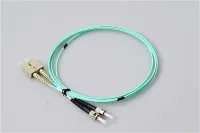
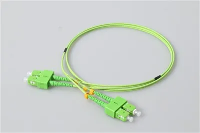
If you are evaluating OM5 fiber for a data center or campus project, the first thing you need to understand is that OM5 is not automatically a better version of OM4. It is a wideband multimode fiber (WBMMF) engineered to support multi-wavelength transmission across the 850–953 nm range. That means OM5 delivers its real advantage only when paired with optics that can use that wider waveband - such as SWDM transceivers designed for high-speed duplex links. For standard 850 nm multimode optics, OM5 does not automatically extend reach or improve performance over OM4.
This distinction matters because many procurement teams treat OM5 as a universal upgrade. It is newer, yes - but newer does not always mean better for every link. The right choice depends on your transceiver type, required reach, fiber count strategy, and future upgrade path.

What Is OM5 Fiber?
OM5 is a 50/125 µm laser-optimized multimode fiber standardized under ANSI/TIA-492AAAE, published in June 2016. The ISO/IEC designation "OM5" was approved in October 2016. Unlike earlier multimode grades that are characterized only at 850 nm, OM5 specifies effective modal bandwidth (EMB) at both 850 nm and 953 nm - with minimum values of 4700 MHz·km and 2470 MHz·km, respectively.
In practical terms, OM5 was created to help data centers carry more data over fewer fibers in certain high-speed multimode designs. Instead of relying on a single wavelength, compatible optics can use multiple short wavelengths across the same duplex fiber pair. That is why OM5 is commonly referred to as WBMMF, or wideband multimode fiber.

You will typically see OM5 cables identified by a lime green jacket, which helps distinguish them from the aqua (OM3/OM4) cables common in structured cabling environments. OM5 uses the same fiber optic connectors as OM3 and OM4 - most commonly LC connectors for duplex interconnects and MPO/MTP connectors for trunk cabling.
Why OM5 Is Called Wideband Multimode Fiber
All laser-optimized multimode fibers - OM3, OM4, and OM5 - are designed for VCSEL-based transceivers operating near 850 nm. What sets OM5 apart is that its bandwidth performance is also specified at 953 nm. According to Corning's published OM5 technical overview, OM5 must meet the same OM4 bandwidth criteria at 850 nm while also meeting a separate EMB requirement at 953 nm. That additional specification across a broader wavelength range is what earns it the "wideband" designation.
This is also why describing OM5 as simply "faster fiber" is misleading. A more accurate description is that OM5 is multimode fiber with a broader usable waveband for specific optics architectures - particularly those employing shortwave wavelength division multiplexing.
OM5 vs OM4: What Actually Changes?
This is the question most buyers care about. The answer is more nuanced than many product pages suggest:
- At 850 nm only, OM5 does not outperform OM4. Both fiber types share the same minimum EMB specification at 850 nm (4700 MHz·km). For any transceiver operating solely at that wavelength, there is no reach or bandwidth benefit from upgrading to OM5.
- With multi-wavelength optics that include longer wavelengths, OM5 provides a guaranteed performance advantage. Because OM4 has no specified EMB at 953 nm, its bandwidth at longer wavelengths is uncontrolled - it could be adequate or it could be poor. OM5 removes that uncertainty.
Cisco's white paper on OM4 vs OM5 states this clearly: OM5 cable is not intrinsically better than OM4 cable, and the meaningful performance improvement appears only for transceivers with lanes operating at longer wavelengths such as 940 nm. For conventional 850 nm multimode transceivers, OM4 remains a cost-effective solution.
OM5 vs OM4 Quick Comparison
| Parameter | OM4 | OM5 |
|---|---|---|
| Core/Cladding | 50/125 µm | 50/125 µm |
| EMB at 850 nm | ≥ 4700 MHz·km | ≥ 4700 MHz·km |
| EMB at 953 nm | Not specified | ≥ 2470 MHz·km |
| Wavelength Range | Optimized at 850 nm | 850–953 nm (wideband) |
| SWDM Suitability | Supported, shorter reach | Optimized, longer guaranteed reach |
| Jacket Color | Aqua | Lime green |
| Connector Types | LC, MPO/MTP, SC | LC, MPO/MTP, SC (same as OM4) |
| Best-Fit Optics | Standard 850 nm SR, eSR4 | SWDM4, multi-wavelength BiDi |
| Backward Compatibility | With OM3 | With OM3 and OM4 |
| Cost Premium | Baseline | Approximately 20–30% over OM4 |

How SWDM and OM5 Work Together?
To understand where OM5 delivers value, you need to understand SWDM - shortwave wavelength division multiplexing. SWDM uses four wavelengths (typically 850 nm, 880 nm, 910 nm, and 940 nm) transmitted over the same multimode fiber pair, rather than requiring multiple parallel fibers. This allows 40G and 100G speeds over a duplex fiber link instead of an 8- or 12-fiber parallel connection.

OM5's wideband optimization means each of those wavelengths maintains controlled bandwidth performance across the full range. On OM3 or OM4, the longer wavelengths (910 nm, 940 nm) may perform adequately, but there is no guarantee - the bandwidth at those wavelengths is simply not specified in the standard.
Corning's published SWDM distance guidance illustrates the practical impact. For 40G SWDM, expected reaches are approximately 240 m on OM3, 350 m on OM4, and 440 m on OM5. For 100G SWDM, the figures are roughly 75 m, 100 m, and 150 m respectively. Those are the kinds of differences that matter in real data center designs.
Does OM5 Reduce Fiber Count?

It can - but only when combined with the right optics architecture.
If you compare a duplex SWDM approach on OM5 against an older parallel multimode design using 8 or 12 fibers per link, the SWDM approach needs far fewer fibers. That translates into simpler cable management, fewer adapters, and lower density at patch panels and distribution frames. For projects where pathway space is constrained, this operational benefit can be significant.
However, the fiber count reduction comes from the SWDM optics design, not from the fiber cable itself. If you install OM5 but continue using standard 850 nm parallel transceivers, you will not see any fiber count reduction. That is why any serious evaluation of OM5 should always consider the transceiver roadmap alongside the cabling specification.
OM5 Distance by Application

There is no single "OM5 distance" because reach depends on the transceiver and the application standard. Here is a practical overview:
For standard 850 nm applications like 10GBASE-SR, 40GBASE-SR4, and 100GBASE-SR4, OM5 supports the same maximum reach as OM4. Cisco confirms that most of its multimode transceivers are single-wavelength 850 nm devices, and there is no reach difference between OM4 and OM5 for those modules.
For multi-wavelength SWDM applications, OM5 extends reach noticeably. For example, with the Cisco QSFP-40G-CSR4 module, reach is 440 m on OM5 versus 400 m on OM4. For 100G SWDM, OM5 can support approximately 150 m versus about 100 m on OM4.
For 40G BiDi, Corning's published data shows the same 200 m capability on both OM4 and OM5 in certain structured cabling configurations - a useful reminder that the module matters as much as the fiber.
For 400G, IEEE 802.3 400GBASE-SR4.2 is the first standards-based Ethernet application that uses multimode WDM technology, supporting links up to 150 m on OM5 fiber over four fiber pairs.
How OM5 Fits into Real Cabling Architectures?
If you already have a duplex LC multimode plant and you are planning a speed migration from 10G to 40G or 100G, OM5 lets you stay on that familiar duplex cabling model by using SWDM transceivers - rather than moving to 8-fiber or 12-fiber MPO/MTP trunk cables. In brownfield environments, that can simplify the upgrade significantly.

In new builds, OM5 makes the most sense when the design team wants to stay in the multimode ecosystem but also wants to minimize parallel fiber counts. A typical deployment would use Base-8 or Base-12 MTP backbone cables that break out into duplex LC patch cords at the cross-connect. That approach works equally well with OM4 or OM5 trunk cabling - the difference shows up in SWDM reach and the number of fibers needed per link.
In environments with very short links - under 100 m - the performance gap between OM4 and OM5 becomes negligible even for SWDM applications. Industry data suggests that over 90% of enterprise data center links fall within 100 m, which is part of why OM5 adoption has been slower than some predicted.
When to Choose OM5
- You are planning to deploy SWDM or similar multi-wavelength multimode transceivers, and need guaranteed reach at wavelengths beyond 850 nm.
- Reducing fiber count per link is a priority - either because of pathway constraints, patch panel density limits, or cable management goals.
- Your project is a new data center build with a clear optics roadmap that includes multi-wavelength duplex links at 40G, 100G, or 400G.
- You want backward compatibility with your existing OM4 infrastructure while adding wideband capability for future upgrades.
When OM4 or Single-Mode May Be Smarter
- Your transceivers are standard 850 nm multimode modules (SR, SR4, eSR4). In this case, OM4 provides identical reach at lower cost.
- Your link distances comfortably fit within OM4 limits and your roadmap does not include SWDM optics.
- You need distances well beyond 150–400 m. At that point, single-mode fiber becomes the more appropriate solution, especially as singlemode transceiver prices have dropped significantly due to silicon photonics and hyperscale volume purchasing.
- Your budget is constrained and OM5's 20–30% cost premium over OM4 does not provide a return given your current optics plan.
OM5 vs OM4 vs Single-Mode: A Quick Decision Framework
For short-reach links (under 150 m) using standard 850 nm multimode optics, OM4 is the mainstream, cost-effective choice. It supports all current IEEE multimode Ethernet applications at full specified distance.

For short-reach links using SWDM or multi-wavelength optics, OM5 adds value through guaranteed bandwidth at longer wavelengths and extended reach.
For links longer than a few hundred meters, or when planning for 800G and beyond, single-mode fiber is the right direction. All current and future IEEE standards for 100G through 800G include single-mode options, and many next-generation speeds will require it.
Is OM5 Worth the Extra Cost?
OM5 cabling typically costs 20–30% more than OM4 for the cable itself. When you factor in the full channel cost - including SWDM transceivers - the premium can be higher. The question is whether that premium buys you something you will actually use.
If your optics roadmap includes SWDM-style duplex links and you need the reach that OM5 provides at longer wavelengths, the investment is defensible. You are paying for a guaranteed performance floor that OM4 cannot provide at 910–940 nm.
If your roadmap does not include those optics, the extra cost buys you a capability you may never exercise. In that case, OM4 remains the more practical choice, and putting the savings toward other infrastructure - better patch cords, cleaner cable management, or a reserve for future singlemode migration - may be a better use of budget.
Common Mistakes When Specifying OM5
Assuming OM5 automatically means faster networking.
The cable alone does not create a speed upgrade. The advantage comes from the combination of OM5 fiber with compatible multi-wavelength optics. Without the right transceivers, OM5 performs identically to OM4.
Ignoring the transceiver side of the equation.
We see this in procurement decisions where teams specify OM5 cabling but continue deploying standard 850 nm SR4 modules. The result is a premium cabling investment with no performance benefit. Always verify that your planned transceivers operate across the wider waveband before specifying OM5.
Treating OM5 as a formal Ethernet transmission standard.
As Fluke Networks notes in its OM5 overview, there are no transmission standards that specifically designate OM5 or SWDM. OM5 is a cabling capability that supports certain proprietary and pre-standard applications - not a universal new Ethernet tier.
Overlooking backward compatibility in planning.
OM5 is fully backward compatible with OM4 and OM3 environments. That makes phased upgrades practical - you can install OM5 trunk cabling now and start with standard transceivers, then migrate to SWDM optics later. But backward compatible does not mean legacy equipment will suddenly gain new performance.
OM5 Compatibility and Connector Details

OM5 uses the same connector types as OM3 and OM4. In most data center deployments, that means:
- LC duplex connectors at patch panels and equipment ports - the standard interface for SWDM transceivers.
- MPO/MTP connectors for backbone trunk cables, typically Base-8 or Base-12 configurations that break out into LC at the cross-connect.
- Standard UPC (Ultra Physical Contact) polish for multimode applications.
No special connector hardware or polishing is required for OM5. The only visible difference is the lime green color coding on cable jackets, connector boots, and adapter housings, which follows TIA guidance for identifying wideband multimode cabling.
Field channel loss testing at 850 nm is sufficient to verify OM5 installations - separate testing at 953 nm is not required per current standards.
Frequently Asked Questions
Is OM5 backward compatible with OM3 and OM4?
Yes. OM5 meets all OM4 specifications at 850 nm and is fully compatible with existing OM3 and OM4 multimode environments. You can mix OM5 trunk cabling with OM4 patch cords in the same link, although for best SWDM performance, using OM5 throughout the channel is recommended.
Can I use OM5 fiber with standard 850 nm transceivers?
Yes, OM5 works with any transceiver designed for 50/125 µm multimode fiber. However, with single-wavelength 850 nm modules, you will not see any reach or performance benefit over OM4. The advantage of OM5 only appears with multi-wavelength optics operating across the wider 850–953 nm range.
What connectors are used with OM5 fiber?
OM5 uses the same standard multimode connectors as OM3 and OM4 - primarily LC for duplex connections and MPO/MTP for parallel or trunk cabling. No special connector hardware is required.
Is OM5 worth it for 400G?
It depends on the specific 400G standard. For 400GBASE-SR8 (which uses eight parallel lanes at 850 nm), OM4 provides the same reach as OM5. For 400GBASE-SR4.2 - the first IEEE standard that uses multimode WDM - OM5 can deliver better reach and more predictable channel performance. Evaluate based on which 400G module your switch vendor supports.
Does OM5 help with reducing fiber count in my data center?
Only when combined with SWDM or similar multi-wavelength optics that use duplex fiber rather than parallel fiber architectures. The fiber count reduction comes from the transceiver design, not from the cable type alone. OM5 makes that duplex multi-wavelength approach viable over longer distances.
How does OM5 compare to single-mode fiber for future-proofing?
For very long links or speed tiers above 400G, single-mode fiber offers a clearer upgrade path. Single-mode supports all IEEE Ethernet speeds from 1G through 800G and beyond with no distance limitations within typical data center and campus scales. OM5 is best suited for organizations committed to the multimode ecosystem that want the best multimode option available for short-reach, high-density deployments.