OS1 and OS2 are both single mode fiber classifications defined under ISO/IEC 11801 and referenced in the IEC 60793-2-50 standard. They share the same 9/125 µm core-cladding geometry and operate at standard wavelengths of 1310 nm and 1550 nm. But the similarities end there. OS1 fiber allows a maximum attenuation of 1.0 dB/km, while OS2 fiber is specified at a much tighter 0.4 dB/km - a difference that directly affects reach, link budget, and deployment flexibility. For anyone specifying single mode fiber for campus backbones, building-to-building links, carrier access, or FTTH distribution, understanding this distinction is essential.
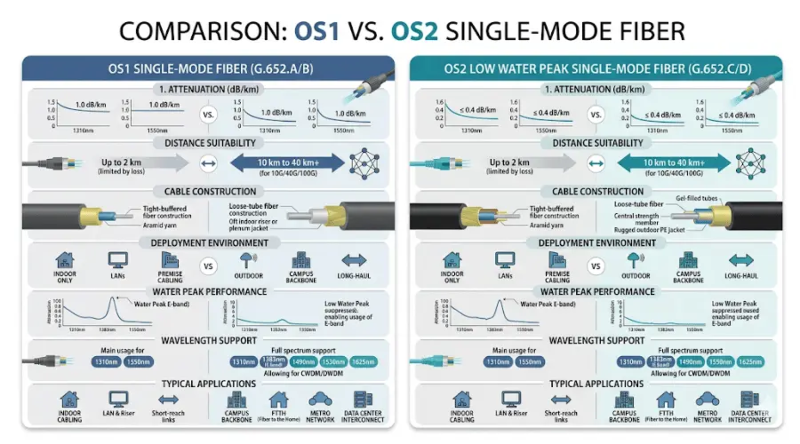
OS1 vs OS2 Fiber Comparison Table
| Parameter | OS1 Fiber | OS2 Fiber |
|---|---|---|
| Fiber type | Single mode (9/125 µm) | Single mode (9/125 µm) |
| ITU-T alignment | G.652A / G.652B (IEC Type B1.1) | G.652D (IEC Type B1.3) or G.657A/B (IEC Type B6a) |
| Max attenuation (1310 nm) | 1.0 dB/km | 0.4 dB/km |
| Water peak performance | Not specified as low water peak | Low water peak - supports CWDM across full spectrum |
| Typical cable construction | Tight-buffered indoor | Loose-tube, or tight-buffered indoor/outdoor designs |
| Primary environment | Indoor premises cabling | Indoor, outdoor, and indoor-outdoor universal |
| Distance suitability | Up to ~2 km structured cabling | 5 km, 10 km, and beyond depending on optics and link budget |
| Typical applications | Short equipment-room and riser links | Campus backbone, inter-building, carrier access, FTTH, data center interconnect |
What Are OS1 and OS2 Fiber?
OS1 and OS2 are performance categories - not fiber types in the optical physics sense. Both use single mode glass, meaning one guided light mode propagates through the core. The distinction sits at the cable level: how the fiber is constructed, jacketed, and tested determines whether a cable assembly earns an OS1 or OS2 designation.
OS1 traces back to the original premises cabling scope of ISO/IEC 11801, published in 1995, which covered buildings up to 2 000 metres. The fiber glass underneath typically complies with ITU-T G.652A or G.652B, designated as IEC 60793-2-50 Type B1.1. OS2 arrived later, when the development of ISO/IEC 24702 (published 2006) required industrial premises of larger dimensions. Because 1000BASE-LX reaches 5 km and 10GBASE-LR reaches 10 km on single mode, the new category needed lower cable attenuation - and that became OS2, referencing G.652D (Type B1.3) or G.657A/B (Type B6a) fiber with a low water peak.
Put simply: every OS2 cable contains single mode fiber that can match or exceed the optical performance of OS1 fiber, but the reverse is not true. OS1 cable attenuation budgets are too loose for the longer links that modern Ethernet standards support.
OS1 vs OS2: Key Differences Explained
Attenuation and Distance
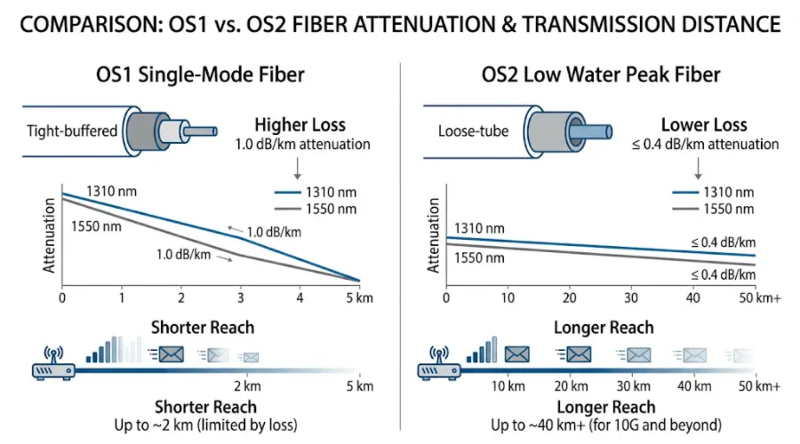
Attenuation is the single most consequential difference between OS1 and OS2. Under CommScope's technical documentation, OS1 cable is specified at a maximum of 1.0 dB/km at 1310 nm and 1550 nm. OS2 cable is specified at 0.4 dB/km at 1310 nm, 1383 nm, and 1550 nm. That 0.6 dB/km gap per kilometre compounds quickly: over a 5 km route, OS1 cable could introduce up to 5.0 dB of fiber attenuation, while OS2 cable stays under 2.0 dB.
In practical terms, that margin matters for link budget calculations. Every fiber optic connector pair, every fusion splice, and every bend along the route adds loss. If the fiber itself consumes most of the budget, there is little room left for connectors and splices. OS2 gives the designer significantly more headroom, which is why virtually all structured cabling standards written since the mid-2000s assume OS2-class attenuation for links beyond short in-building runs.
Cable Construction: Tight-Buffered vs Loose-Tube
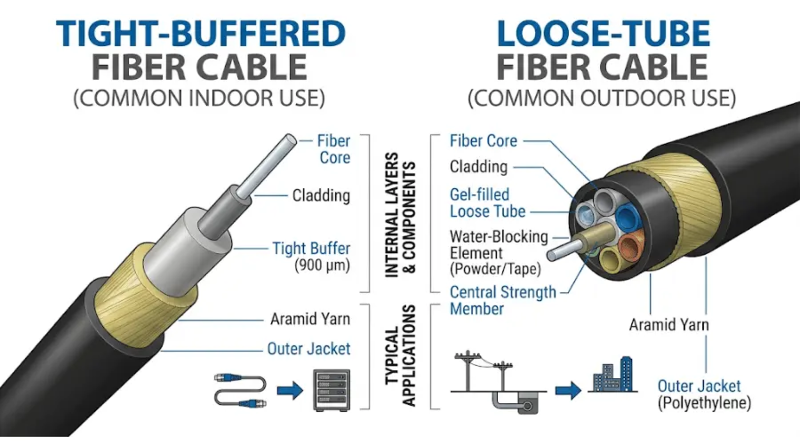
The market has long associated OS1 with tight-buffered indoor cables and OS2 with loose-tube outdoor cables. That association has a basis in engineering - loose-tube construction isolates the fiber from mechanical stress, making it easier to achieve the 0.4 dB/km ceiling - but it is not an absolute rule.
CommScope has addressed this misconception directly, explaining that tight-buffered cable can meet OS2 attenuation when the manufacturer invests in protective construction techniques such as controlled yarn weaving and central strength members. Today, multiple vendors ship OS2-rated tight-buffered cables for indoor riser and plenum environments. Corning's SMF-28 Ultra fiber, for example, is used in indoor and outdoor cable assemblies that carry OS2 ratings with tight-buffered sub-units.
The takeaway for specifiers: do not assume that a cable labelled "tight-buffered" must be OS1, or that "indoor" automatically excludes OS2. Read the cable datasheet and confirm the tested attenuation per kilometre.
Indoor, Outdoor, and Universal Deployment

OS1 was originally scoped for premises cabling - equipment rooms, risers, and horizontal runs inside a single building. OS2, by contrast, was developed with longer industrial and campus distances in mind, which naturally included outdoor and indoor-outdoor pathways.
Modern cable products blur the boundary further. OS2 indoor-outdoor universal cables - rated OFNR or OFNP for inside-plant fire codes and simultaneously jacketed for UV exposure and moisture - are now a standard catalogue item from most major manufacturers. For a campus retrofit where the route starts in a telecom room, passes through a conduit to a second building, and terminates in a server closet, a single OS2 indoor-outdoor cable can serve the entire path without a splice point at the building entry. That eliminates a transition enclosure, saves labour, and reduces potential failure points.
Water Peak and Wavelength Range
OS2 fiber based on G.652D eliminates the water peak around 1383 nm. This matters because coarse wavelength division multiplexing (CWDM) uses channels across the 1270–1610 nm window, including wavelengths that fall in the water peak region. An OS1 cable built on older G.652A or G.652B fiber may show elevated attenuation at those wavelengths, limiting CWDM channel count. For any network that might deploy CWDM in the future - a common upgrade path for campus and metro access - OS2 is the safer foundation.
Cost and Long-Term Value
Per-metre pricing for OS2 cable is marginally higher than OS1 in equivalent constructions, but the gap has narrowed considerably as OS2 has become the volume product. Where the real cost difference emerges is in rework. If a building backbone is installed with OS1 today and the network later extends across a campus or requires lower-loss margins for 25G/100G optics, the OS1 cable may need to be replaced. Cable labour - pulling, terminating, testing - typically costs several times more than the cable itself. Specifying OS2 upfront avoids that risk on projects where there is any possibility of future expansion.
When to Choose OS1 Fiber
OS1 still has a place, though it is a narrowing one. It makes sense when all of the following conditions are true:
- The cable route is entirely indoors and confined to a single building.
- The longest link in the route is well under 2 km.
- There is no planned outdoor extension, inter-building link, or future backbone upgrade.
- The network will not require CWDM or wavelengths in the water peak region.
- Budget is the primary constraint and the existing infrastructure already uses OS1.
A practical example: replacing a short fiber optic patch cord between two switches in a telecom closet, where the run is 5 metres and the facility has standardised on OS1 throughout. Here, there is no engineering benefit to switching to OS2 - the link loss is negligible at any attenuation class, and maintaining consistency with the installed base may reduce inventory complexity.
When to Choose OS2 Fiber
OS2 is the stronger default for the majority of new single mode deployments. It is the right choice when:
- The route includes any outdoor segment, duct pathway, or building-to-building span.
- The link length exceeds a few hundred metres, making attenuation a meaningful factor.
- The design must support 10G, 25G, or 100G optics that rely on tight loss budgets.
- There is any chance the route will be extended beyond the original building footprint.
- The project wants to standardise on a single fiber class across mixed indoor and outdoor environments.
In a campus backbone scenario - say, three buildings connected by underground conduit with a total route of 1.2 km - OS2 loose-tube or indoor-outdoor cable is the obvious choice. The attenuation budget stays well within margin, the cable handles both the outdoor conduit and the indoor riser transitions, and the installation is future-proofed for higher-speed optics without re-cabling.
For FTTH distribution and carrier access, OS2 is effectively the only option specified by operators. Corning's SMF-28 Ultra fiber product line, one of the most widely deployed single mode fibers globally, is positioned explicitly for these applications with G.652D and G.657A1 compliance.
Can OS2 Replace OS1?
From a pure fiber-performance standpoint, yes. OS2 fiber meets or exceeds every optical parameter that OS1 specifies. If you place an OS2 fiber optic pigtail or patch cord in a short indoor link designed for OS1, it will work - the lower attenuation simply means more margin.
The practical check is at the cable level, not the fiber level. Before swapping OS1 for OS2, confirm:
- Jacket rating: Does the OS2 product carry the required fire rating (OFNR, OFNP, LSZH, or equivalent) for the installation environment?
- Physical dimensions: Will the cable fit the existing pathways, trays, and conduit?
- Connector compatibility: OS1 and OS2 share the same 9/125 µm geometry, so standard LC connectors, SC connectors, and fiber optic adapters are interchangeable.
- Bend radius: Some OS2 cables based on G.657A/B fiber offer improved bend performance, but verify the cable-level bend radius matches the installation path.
In most new projects, the replacement question is moot - OS2 is the starting point, and OS1 only enters the conversation when matching an existing installed base.
How to Choose Between OS1 and OS2 Fiber: A Decision Framework
Step 1 - Map the physical route
Trace every segment of the cable path: telecom room, riser shaft, ceiling plenum, outdoor conduit, underground duct, aerial span. If any portion leaves the building envelope, OS2 with appropriate outdoor or indoor-outdoor rating is the default. For purely internal routes, continue to Step 2.
Step 2 - Calculate the link budget
Add up projected losses: fiber attenuation (dB/km × route length), connector insertion loss (typically 0.2–0.5 dB per mated pair for a quality PC, UPC, or APC polish), splice loss (0.05–0.1 dB per fusion splice), and any margin required by the transceiver specification. If OS1-class attenuation leaves less than 3 dB of margin, OS2 is the safer specification.
Step 3 - Consider future expansion
Will the building eventually connect to adjacent structures? Could the network move from 10G to 25G or 100G optics? Is there any prospect of CWDM overlays? If the answer to any of these is "possibly," OS2 provides the flexibility to accommodate those changes without recabling.
Step 4 - Match the cable product to the environment
Fiber class alone does not define a cable. Specify the right product for each segment:
- Patching and cross-connects: Tight-buffered simplex or duplex single mode patch cords
- Riser backbone: Multi-fibre distribution cable with OFNR or equivalent rating
- Plenum spaces: OFNP-rated cable or LSZH where required by local codes
- Outdoor conduit: Loose-tube with gel fill or dry-block water blocking
- Direct burial: Armored or double-jacketed armored fiber cable
- Indoor-outdoor transition: Universal indoor-outdoor cable rated for both fire codes and UV/moisture
Common Misconceptions About OS1 and OS2 Fiber

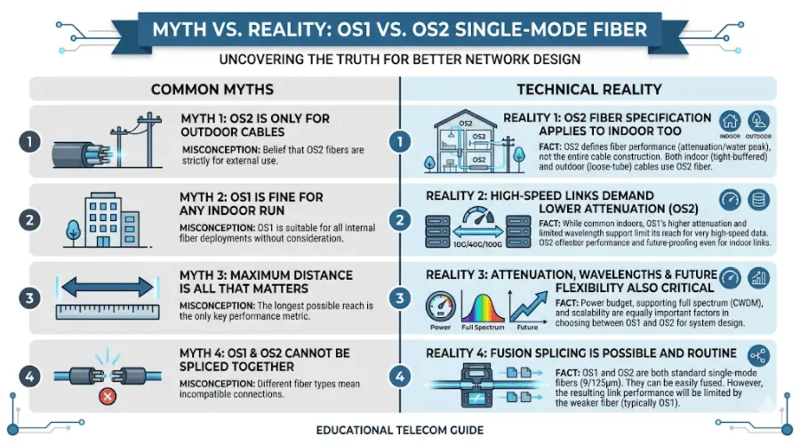
"OS2 is only for outdoor cables"
This is outdated. OS2 tight-buffered cables with riser and plenum ratings are standard products. The notion that OS2 equals outdoor was loosely true in the early 2000s when only loose-tube cables consistently met the 0.4 dB/km threshold, but manufacturing advances have long since closed that gap.
"OS1 is fine for any indoor run"
It depends on the run length and the loss budget. A 15-metre patch in a data hall - yes, OS1 is adequate. A 400-metre backbone riser that feeds a campus aggregation switch - OS2 is the better specification, because the link budget is tighter and the route may eventually extend further.
"Maximum distance is the only number that matters"
Published distance figures (e.g., "OS2 supports 10 km at 10G") assume a clean link with minimal connectors and splices. In reality, every connector pair and splice reduces the effective reach. A link with six connector pairs and three splice points will reach significantly less than the headline number. Always design from the link budget, not the headline distance.
"OS1 and OS2 fibers cannot be spliced together"
They can - both are 9/125 µm single mode, and fusion splicing between them yields typical splice loss well under 0.1 dB. The concern sometimes raised about water peak mismatch applies only to CWDM systems using wavelengths around 1383 nm; for standard 1310/1550 nm operation, mixed splicing is not an issue.
Scenario: Choosing Fiber for a Three-Building Campus

Consider a project connecting a headquarters building (Building A), a warehouse (Building B, 300 m away via underground conduit), and a new office annex (Building C, 150 m from Building A, connected by an above-ceiling pathway through a covered walkway).
The network design calls for 10GBASE-LR between the buildings and 1000BASE-LX within each building's riser backbone. Total cable route from A to B is approximately 350 m including riser runs; A to C is roughly 200 m.
In this scenario, specifying OS2 across all three buildings eliminates the need for different fiber classes in inventory. The A-to-B underground link uses a 12-fibre OS2 loose-tube cable. The A-to-C walkway link uses a 12-fibre OS2 indoor-outdoor tight-buffered cable with UV-resistant jacket. Internal risers within each building use OS2 distribution cable with OFNR rating. Patch panels use OS2 LC fiber jumpers. Splitter distribution for a future IP camera overlay uses PLC fiber optic splitters also rated for single mode.
If the project had instead used OS1 for the internal risers and OS2 only for the outdoor segments, it would require two cable inventories, two sets of test references, and splice transitions at every building entry point. OS2 standardisation is simpler and more cost-effective over the project lifecycle.
OS1 vs OS2 Fiber: Frequently Asked Questions
What is the attenuation difference between OS1 and OS2?
OS1 cable is specified at a maximum of 1.0 dB/km at 1310 nm and 1550 nm. OS2 cable is specified at 0.4 dB/km at 1310 nm, 1383 nm, and 1550 nm. The OS2 specification is based on IEC 60793-2-50 Type B1.3 (G.652D) or Type B6a (G.657A/B), while OS1 aligns with Type B1.1 (G.652A/B). This means OS2 cable introduces less than half the signal loss per kilometre compared to OS1.
Can OS1 fiber be used outdoors?
The original OS1 specification was developed for indoor premises cabling with dimensions not exceeding 2 000 metres. While outdoor-rated OS1 cable products exist, their higher attenuation limits practical reach. For outdoor routes, OS2 cable is the standard recommendation because it meets the tighter loss budgets required for longer spans and the environmental demands of duct, direct burial, or aerial installation.
Is OS2 more expensive than OS1?
The per-metre price difference between OS1 and OS2 in equivalent constructions is small and continues to narrow as OS2 becomes the default production volume. The real cost comparison should include total installed cost: cable, labour, connectors, testing, and the risk of future recabling if OS1 proves insufficient for network expansion.
Which fiber is better for campus backbone cabling?
OS2. Campus backbones typically span hundreds of metres to several kilometres, may cross outdoor segments, and must support current and future high-speed Ethernet standards. OS2 provides the loss budget, environmental flexibility, and CWDM readiness that campus backbones require. For connector and cabling guidance in high-density environments, see this guide to high-density LC fiber connector solutions.
Is OS1 obsolete?
Not formally - the standard still exists and OS1 products remain available. But in practical terms, OS2 has become the default for new installations. The FOA (Fiber Optic Association) notes that TIA TR-42 now specifies attenuation per cable application rather than rigidly separating OS1 and OS2, reflecting the industry's shift toward OS2-class performance for both indoor and outdoor cables.
Can I splice OS1 and OS2 fibers together?
Yes. Both are 9/125 µm single mode glass, and a properly executed fusion splice typically produces less than 0.1 dB loss. The splice itself does not degrade performance, though mixing OS1 and OS2 in the same link means the overall attenuation is limited by the OS1 segment.
What standards define OS1 and OS2?
The OS1 and OS2 designations originate from the ISO/IEC 11801 structured cabling standard. The underlying fiber specifications are defined in IEC 60793-2-50 (Type B1.1 for OS1, Type B1.3 and B6a for OS2). Cable-level requirements are covered by the IEC 60794 series - IEC 60794-2 for indoor cables and IEC 60794-3 for outdoor cables. The ITU-T G.652 and G.657 recommendations define the optical and mechanical properties of the fiber itself.
How do I verify whether a cable is OS1 or OS2?
Check the manufacturer's datasheet for the tested attenuation per kilometre at 1310 nm and 1550 nm. If the cable meets 0.4 dB/km or lower, it qualifies as OS2-class. Also confirm the referenced fiber standard (G.652D or G.657A for OS2) and the applicable cable standard (IEC 60794-2 or 60794-3). Jacket markings and print legends on the cable sheath usually include the OS designation, fiber count, and fire rating.
OS1 vs OS2: Which Single Mode Fiber Should You Choose?
For most new fibre installations, OS2 is the practical default. It provides lower attenuation, broader environmental flexibility, full-spectrum wavelength support, and a forward-looking loss budget that accommodates higher-speed optics and potential network expansion. OS1 remains a valid option for short, purely indoor links where the installed base is already OS1 and there is no prospect of route extension.
The decision should never rest on fiber class alone. Match the cable construction, jacket rating, and connector type to the specific route, environment, and fire code requirements of each segment. And always design from a calculated link budget - not from a headline distance number on a comparison chart.