If you are comparing FTTH vs FTTB, the core question is usually straightforward: which fiber architecture should I choose for my building or project? The short answer is that FTTH delivers stronger performance and better long-term scalability, while FTTB can be the more practical and cost-effective option for multi-dwelling buildings that already have usable internal wiring. The right choice depends on the building type, the condition of the existing cabling, the deployment budget, and the performance expectations of the end users.
This guide breaks down how FTTH and FTTB actually work, where each one fits, and how to make a well-grounded decision based on real deployment conditions rather than marketing labels.
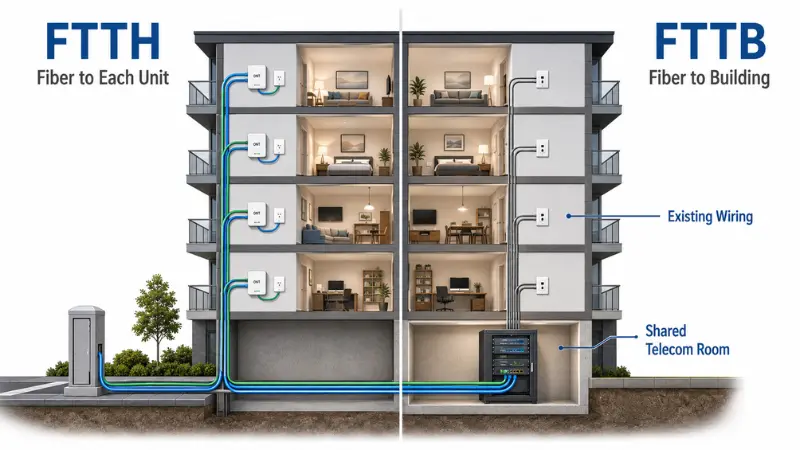
FTTH vs FTTB: Quick Comparison
Choose FTTH if you want a dedicated fiber path to each unit, the lowest possible latency, symmetrical speed capability, and a network that supports future upgrades without rewiring.
Choose FTTB if you need a faster rollout in an existing apartment or office building, the internal cabling (such as Cat5e, Cat6, or coax) is in acceptable condition, and the project budget favors reusing what is already there.
What FTTH and FTTB Actually Mean
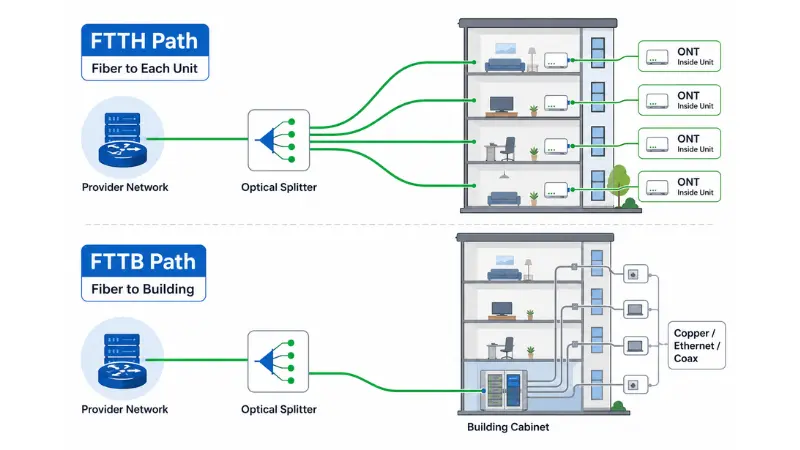
What Is FTTH (Fiber to the Home)?
FTTH stands for Fiber to the Home. In this architecture, the optical fiber runs all the way from the service provider's network to the individual apartment, house, or office unit. The optical signal is terminated inside the premises by an ONT (optical network terminal), which converts the light signal into an electrical signal for the user's router or devices.
Because the entire path from the central office to the end user is fiber, FTTH avoids the performance limitations of copper or coaxial cable on the last segment. This is a significant advantage in terms of bandwidth ceiling, signal integrity, and upgrade potential. According to the FTTH Council Europe, FTTH is defined as a network in which the optical fiber reaches the boundary of the living or working space, distinguishing it from architectures that terminate fiber at an intermediate point.
What Is FTTB (Fiber to the Building)?
FTTB stands for Fiber to the Building. In this design, fiber reaches a shared equipment point inside the building - typically a basement telecom room, a riser closet, or a communications cabinet on each floor. From that point, the connection to each unit is completed over the building's existing internal wiring, which may be copper telephone lines, coaxial cable, or structured Ethernet cabling.
FTTB is a common approach in multi-dwelling units (MDUs) where running new fiber to every apartment would require significant construction work. By reusing the in-building infrastructure, FTTB can reduce installation time and upfront cost. However, the quality of the last segment depends entirely on the age, type, and condition of the existing wiring.
Why the Last Segment Matters
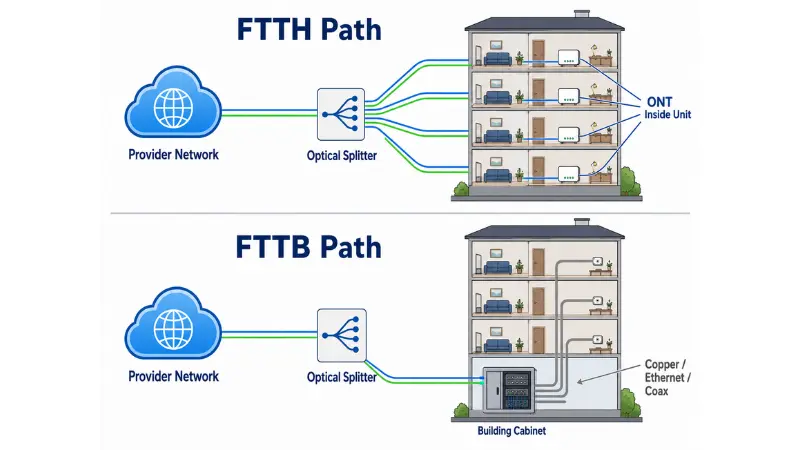
Both FTTH and FTTB bring fiber into the building. The difference is where the fiber ends and what carries the signal over the final meters. That last segment determines whether the connection benefits from full fiber performance or inherits the limitations of older media. In access networks built on passive optical network (PON) architectures such as GPON or XGS-PON, the optical path from the OLT to the ONT is designed for consistent, low-loss transmission. Any non-fiber segment introduced at the end of that path can become a bottleneck - not just in raw speed, but in latency, noise susceptibility, and symmetrical bandwidth capability.
FTTH vs FTTB: Side-by-Side Comparison
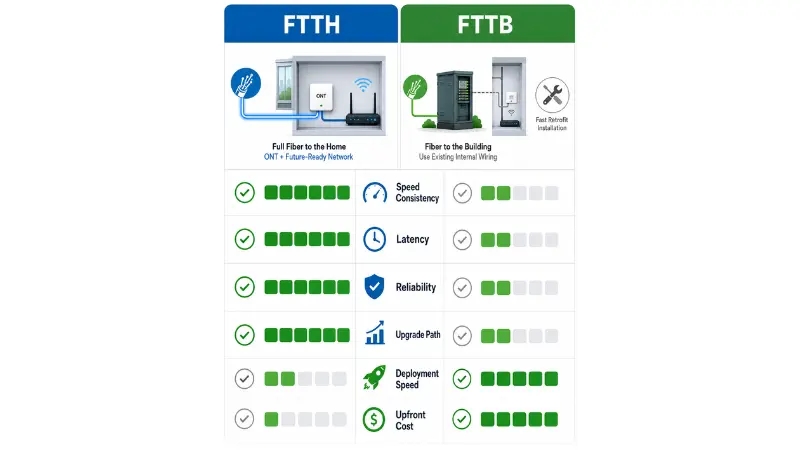
| Feature | FTTH | FTTB |
|---|---|---|
| Fiber termination point | Inside each unit (home, apartment, or office) | Shared location in the building (basement, riser, cabinet) |
| Last-mile medium | Fiber optic cable | Existing copper, coax, or Ethernet wiring |
| Typical speed capability | 1 Gbps to 10 Gbps symmetrical (depending on PON standard) | Varies - depends on internal cabling type and distance |
| Latency | Lower and more consistent | Can be higher due to media conversion and wiring quality |
| Reliability | Less sensitive to environmental interference | More dependent on building wiring condition |
| Upgrade path | Strong - fiber supports future PON generations without rewiring | Limited by internal wiring ceiling |
| Upfront cost | Generally higher - requires fiber to each unit | Generally lower - reuses existing wiring |
| Best fit | New builds, greenfield projects, premium connectivity | Older MDUs, budget-sensitive retrofits, phased rollouts |
The Main Differences Between FTTH and FTTB
Speed and Bandwidth Consistency
FTTH typically provides more consistent throughput because the optical signal travels the entire distance to the user without media conversion. Under the ITU-T G.984 GPON standard, a single PON can deliver up to 2.5 Gbps downstream shared among subscribers, and the newer XGS-PON (G.9807.1) standard supports symmetrical 10 Gbps. In an FTTH setup, these speeds are available at the ONT inside each unit.
In an FTTB deployment, the fiber terminates at a shared point and the final connection relies on whatever wiring is already in the building. If that wiring is Cat5e Ethernet, the theoretical ceiling is around 1 Gbps over short runs. If it is older telephone-grade copper, the ceiling drops significantly, and performance varies with distance and interference. This is why two FTTB buildings in the same city can deliver very different real-world experiences.
Latency and Reliability
For applications that depend on low and stable latency - video conferencing, cloud-based collaboration, online gaming, real-time monitoring - FTTH has a measurable advantage. Fiber connections are not susceptible to electromagnetic interference, crosstalk from adjacent pairs, or the signal degradation that affects copper over distance. In buildings where the internal wiring passes near power lines, elevator shafts, or HVAC equipment, these factors can introduce noticeable instability in an FTTB setup.
Reliability also extends to maintenance. Copper and coaxial cabling age, and older wiring in buildings constructed before structured cabling standards were common may have splices, corroded connectors, or non-standard runs that are difficult to diagnose. A full FTTH path avoids these inherited risks.
FTTH vs FTTB Cost: Installation and Deployment
FTTB is often faster and less expensive to deploy in existing buildings. The main reason is simple: less new cabling work. If the building already has Ethernet risers or coaxial distribution, FTTB only requires running fiber to a central point, installing shared distribution equipment, and connecting to the existing wiring. This can mean fewer wall penetrations, less tenant disruption, and a shorter project timeline.

FTTH typically costs more upfront because fiber must be routed through the building's pathways - risers, conduits, or cable trays - all the way to each individual unit. In buildings with limited duct space, this may require micro-duct installation, surface-mount indoor fiber cable solutions, or even minor construction to create new pathways. The per-unit cost is higher, but the resulting infrastructure has a longer useful life and supports a broader range of future services.
It is worth noting that FTTB is not always cheaper over the full lifecycle. If the internal wiring needs replacement within a few years, or if user demand grows beyond what the existing cabling supports, the cost of a later upgrade may exceed the savings achieved at installation. Planners should weigh both the initial deployment cost and the expected lifespan of the in-building medium.
Future Upgrades and Long-Term Scalability
One of the strongest arguments for FTTH is its upgrade path. Because optical fiber has an enormous inherent bandwidth capacity, upgrading the network usually means upgrading the electronics at each end - not replacing the cable itself. A building wired with single-mode fiber today can support GPON, XGS-PON, and future 25G or 50G PON standards without pulling new cable.

FTTB inherits the limitations of the internal wiring. Cat5e Ethernet tops out around 1 Gbps at 100 meters. Cat6 can support up to 10 Gbps, but only at shorter distances (under 55 meters for 10GBASE-T). Telephone-grade copper is more restrictive still. As user bandwidth expectations increase - driven by 4K and 8K video, cloud gaming, smart home devices, and work-from-home traffic - an FTTB network may hit its ceiling sooner.
FTTH vs FTTB: Pros and Cons
FTTH Pros
- Dedicated fiber path to each unit eliminates last-segment bottlenecks.
- Supports symmetrical multi-gigabit speeds on current and future PON standards.
- Lower latency and higher reliability due to end-to-end optical transmission.
- Longer infrastructure lifespan - fiber does not corrode or degrade like copper.
- Easier to upgrade electronics without replacing physical cabling.
FTTH Cons
- Higher upfront installation cost, especially in older buildings with limited duct space.
- More disruptive to install - may require access to each unit for terminal box installation.
- Longer deployment timeline in large MDU projects.
- Requires skilled technicians for fiber termination and splicing or fast connector installation.
FTTB Pros
- Lower upfront cost when usable internal wiring already exists.
- Faster deployment with less tenant disruption.
- Suitable as a phased step toward future FTTH conversion.
- Can deliver strong performance in buildings with good-quality structured cabling (Cat5e/Cat6).
FTTB Cons
- Performance depends on wiring type, age, and condition - hard to guarantee uniform quality across all units.
- Limited scalability - internal wiring creates a ceiling that fiber does not.
- Higher long-term maintenance exposure due to aging copper or coaxial infrastructure.
- May not support symmetrical speeds or future multi-gigabit service tiers.
Which Architecture Fits Different Building Types?

New Residential Developments
For greenfield residential projects, FTTH is almost always the better investment. When the developer is already planning utility trenches, riser shafts, and low-voltage pathways, the incremental cost of pulling fiber to each unit is relatively modest compared to the total project budget. It is also a marketability advantage: homebuyers and renters increasingly treat full-fiber connectivity as a baseline expectation, not a premium feature.
In new builds, the passive components - optical splitters, ODFs and patch panels, and distribution frames - can be specified from the start, avoiding retrofitting costs later.
Existing Apartment Buildings and Retrofits
For older apartment buildings, the choice between FTTH and FTTB depends on specific conditions:
- If the building has Cat5e or Cat6 Ethernet risers in good condition, FTTB can deliver solid gigabit service with minimal disruption. This is a common approach for buildings constructed in the 2000s or later.
- If the building only has old telephone copper or degraded coaxial cabling, the performance ceiling of FTTB drops significantly, and the investment in FTTH becomes easier to justify.
- If the building has accessible duct space or cable trays, pulling new fiber to each unit may be more feasible - and more cost-effective - than expected.
When the internal cabling condition is unclear, a pre-deployment survey of the building's pathways and wiring should come before any technology decision. The MDU fiber cabling guide covers this planning process in more detail.
Office Buildings and Commercial Properties
Office tenants tend to have higher and more varied bandwidth demands - VoIP systems, cloud ERP, video conferencing, backup traffic - and they often negotiate connectivity as part of their lease terms. In high-demand commercial buildings, FTTH (or more precisely, fiber to the suite) gives the landlord a stronger competitive position and reduces the risk of tenants outgrowing the network within the lease period.
In lower-demand commercial settings where the existing structured cabling is relatively new (Cat6 or better), FTTB can still be a reasonable approach, provided the operator is transparent about the performance ceiling.
High-Demand Users: Remote Work, Gaming, and Streaming
For end users who care most about low latency, stable connections, and symmetrical upload speeds, FTTH is the stronger fit. This includes remote workers relying on video calls and cloud applications, gamers who need minimal jitter, and households running multiple simultaneous 4K or 8K streams. If the building serves this demographic, FTTH better aligns with their expectations.
Can FTTB Be Upgraded to FTTH Later?

Yes, but the feasibility depends on building conditions. A successful FTTB-to-FTTH migration typically requires:
- Available pathway space. Are there spare ducts, micro-duct slots, or cable tray capacity to pull fiber to each unit? If the existing conduit is already full, this becomes the primary obstacle.
- Adequate telecom room capacity. The building's equipment room needs space for fiber distribution frames and PLC splitters to serve every unit individually.
- Access to each unit. Fiber termination inside each apartment or office requires entry, wall mounting, and fast connector or splice work - which means scheduling access with every tenant.
- Budget for a phased migration. Some operators deploy FTTB initially and upgrade floor by floor or building by building as demand and budget allow.
Planners who anticipate a future FTTH upgrade should ensure the initial FTTB design includes oversized conduit, spare duct space, and a telecom room layout that can accommodate per-unit fiber distribution. This is significantly cheaper to plan at the FTTB stage than to retrofit later.
How to Tell Whether a Building Has FTTH or FTTB

Many buildings advertise "fiber internet" without specifying where the fiber actually ends. Here is how to tell the difference:
Check the termination point. If there is an ONT (a small device with a fiber input) mounted inside your unit, you likely have FTTH. If the fiber equipment sits in a shared room and your unit connects through an Ethernet port, phone jack, or coaxial outlet, that points to FTTB.
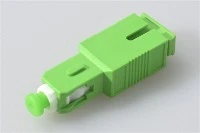
Look at the cable entering your unit. Fiber optic drop cables are thin, often with a green or blue SC/APC or SC/UPC connector. If the cable entering your unit looks like a standard Ethernet cable (RJ45) or coaxial cable, the fiber stops somewhere upstream.
Ask the right question. Instead of asking a provider "Do you offer fiber?", ask: "Does the fiber terminate inside my unit, or does it stop at the building level?" That single question reveals more than most marketing materials.
Common Mistakes When Choosing Between FTTH and FTTB
Treating All "Fiber" Claims as Equal
A building may legitimately advertise fiber-based internet even when the final connection to each unit runs over copper or coax. The label "fiber" tells you that fiber is involved in the access network - it does not tell you how close the fiber gets to your device. Always verify the termination point.
Comparing Only Headline Speed Numbers
Advertised speed is one data point, not the whole picture. Consistency, latency, symmetrical upload capability, and performance under load often matter more than peak download numbers. A 1 Gbps FTTB connection over aging coax and a 1 Gbps FTTH connection are not the same in practice.
Dismissing FTTB as Outdated
FTTB is not inherently inferior - it is a different tool for different conditions. In a well-maintained building with modern structured cabling, FTTB can deliver excellent service. The mistake is deploying FTTB where the internal wiring cannot support the promised performance, or assuming it will age as gracefully as a full fiber path.
Assuming FTTH Always Costs More Over Time
FTTH has a higher upfront cost in most retrofit scenarios, but that does not mean it is always the more expensive choice over a 10- or 15-year horizon. If FTTB requires a wiring upgrade within a few years to keep up with demand, the combined cost may exceed what FTTH would have cost from the start. The right comparison is total cost of ownership, not just initial deployment.
FTTH vs FTTB: Final Verdict
FTTH is the stronger technical choice in most scenarios. It offers better speed consistency, lower latency, higher reliability, and a clear upgrade path to future multi-gigabit services. For new builds, premium residential, and high-demand commercial properties, FTTH is the architecture that best protects the investment over time.

FTTB remains a legitimate and often practical choice for existing buildings where the internal wiring is in good condition, the project budget is constrained, or a phased migration to FTTH is part of the long-term plan. The key is to make that choice based on actual building conditions - wiring type, pathway availability, tenant demand - rather than on cost assumptions alone.
When in doubt, ask these questions before deciding:
- What type and condition of internal wiring does the building have?
- Is there duct space or pathway capacity for fiber to each unit?
- What bandwidth will end users realistically need over the next 5 to 10 years?
- Is this a one-time deployment or the first phase of a longer upgrade plan?
For deeper guidance on passive fiber components used in both architectures - including optical splitters, fiber connectors, and patch cords - the resources linked throughout this guide provide more technical detail on each component.
FAQ
What is the main difference between FTTH and FTTB?
The main difference is where the fiber terminates. In FTTH, fiber reaches the individual unit (home or office). In FTTB, fiber stops at a shared point in the building and the final connection uses existing copper, coax, or Ethernet wiring. This affects speed consistency, latency, and long-term upgrade potential.
Is FTTB still a good option for older apartment buildings?
It can be, provided the building's internal wiring is in reasonable condition. Buildings with Cat5e or Cat6 Ethernet can deliver solid gigabit service through FTTB. Buildings with only old telephone copper or damaged coaxial cabling will see significantly weaker results.
Can FTTB be converted to FTTH later?
Yes, but the difficulty depends on available pathway space, telecom room capacity, and whether fiber can be physically routed to each unit without major construction. The most cost-effective approach is to plan for future FTTH capability during the initial FTTB deployment by specifying oversized conduit and spare duct space.
Which is better for a new residential development?
FTTH is almost always the better choice for new builds. Since the pathways and utilities are being installed from scratch, running fiber to each unit adds relatively little incremental cost and creates a more marketable, future-ready property.
Does FTTH always mean faster internet?
FTTH does not automatically mean faster advertised speeds, but it does mean more consistent performance, lower latency, and better symmetrical bandwidth. The actual speed tier depends on the service plan and the PON standard in use (GPON, XGS-PON, etc.), but the fiber path itself is not the bottleneck.
Is FTTB enough for office buildings?
It depends on tenant demands. For basic office use, FTTB with Cat6 internal cabling can be adequate. For tenants running bandwidth-intensive operations - large-scale video conferencing, cloud-heavy workflows, or data-center-like connectivity - FTTH provides a higher and more future-proof ceiling.
How can I tell whether my provider offers FTTH or just fiber to the building?
Ask whether the fiber terminates inside your unit or at a shared point in the building. If there is an ONT device inside your premises with a fiber input, you have FTTH. If your connection comes through an Ethernet, phone, or coaxial outlet, the fiber likely stops at the building level.
What should property developers consider before choosing FTTH or FTTB?
The key factors are building type (new build vs. retrofit), internal wiring condition, available pathway and duct space, expected tenant bandwidth demand, project budget, and whether a phased upgrade to FTTH is part of the plan. A pre-deployment site survey should inform the decision before any architecture is specified.