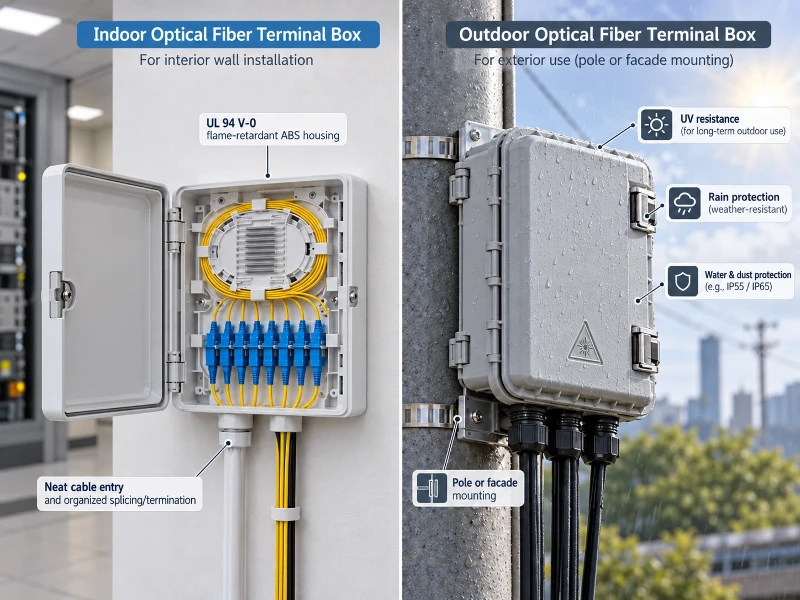
An indoor and an outdoor optical fiber terminal box can hold the same adapters and splice trays, but they are specified against different risks. Outdoor boxes are judged mainly on how well they keep out water and dust and how they cope with sunlight and temperature swings. Indoor boxes are judged mainly on fire performance, cable management and ease of access.
The IP rating matters, but only for part of that comparison, and it is often misread. A box marked IP68 is not automatically protected against water jets. "IP68" on its own also does not tell you how deep or for how long the box was immersed, because the standard leaves those conditions to agreement between manufacturer and user.
This guide covers what each IP level actually tests, how the mounting location should drive the specification, and which installation details decide whether a rating holds up in the field. It ends with a checklist you can send to suppliers.
Published by EVOLUX (Shenzhen Evolux Fiber Co., Ltd.), a manufacturer of fiber terminal boxes. Some examples below are our own models, with values taken from our public product pages. The IP test summaries are based on the clause structure and scope of ANSI/IEC 60529-2020 (the US identical adoption of IEC 60529) and on published secondary summaries of the IP code; this article does not reproduce the full standard text. IEC 61753-1 details come from the publisher's public preview. For contract specifications, refer to the purchased standards.
What actually separates an indoor and an outdoor optical fiber terminal box
The labels "indoor" and "outdoor" stand for different sets of requirements. Published product data from established vendors shows the pattern:
| Factor | Indoor (controlled space) | Outdoor |
|---|---|---|
| Main threats | Fire, accidental contact, messy cable routing | Rain, wind-driven water, dust, UV, freeze–thaw; flooding in some positions |
| Ingress protection | Rarely the deciding spec | Core requirement; the level depends on mounting position |
| Fire performance | Often the key requirement. Example: flame-retardant ABS rated UL 94 V-0 (Prysmian) | Check whether the installation requires it |
| Operating temperature (example) | −20 °C to +50 °C (Prysmian indoor box) | −40 °C to +60 °C (OFS SlimBox 12-Fiber Indoor/Outdoor Enclosure, rated for outdoor wall or pole installation; OFS) |
| UV exposure | Not relevant | Housing must resist UV ageing; ask for the test basis |
| Typical mounting | Wall, riser, rack | Façade, pole, aerial strand, pedestal |
The temperature figures are the manufacturers' own declarations for those specific products. They are not limits from any standard.
Why the IP code cannot settle the outdoor question by itself: IEC 60529 explicitly leaves solar radiation, condensation, mechanical impact and corrosion to the relevant product standard (clause 1). An IP marking tells you nothing about UV ageing, condensation or impact. Those need their own requirements.
Some terminals are designed for both environments. Corning, for example, specifies one of its terminals for indoor or outdoor deployment and cites both Telcordia GR-771 and UL 94 V-0 (Corning). The useful question is therefore not "is this an indoor or outdoor box?" but "does this box meet the requirements of the exact place it will be installed?"
Reading the IP code correctly
The IP code is defined in IEC 60529 (IEC). The first digit rates protection against solid objects and dust. The second digit rates protection against water. Amendment 2 (2013) added IPX9 without changing the existing levels. The current US adoption is ANSI/IEC 60529-2020 (NEMA).
The levels you will usually see on terminal box datasheets are summarized below. The clause numbers refer to IEC 60529; the test figures come from published summaries of the IP code (IP code overview).
| Level | What is tested (IEC 60529 clause) |
|---|---|
| IP5X | Dust-protected. Dust test in a chamber; some dust may enter, but not enough to interfere with safe operation (13.4–13.5) |
| IP6X | Dust-tight. Dust test with a vacuum applied to the enclosure, lasting up to 8 h depending on airflow. No dust ingress is allowed (13.4, 13.6) |
| IPX5 | Water jets from a 6.3 mm nozzle at 12.5 L/min, at about 3 m; 1 min per m² of surface, minimum 3 min (14.2.5) |
| IPX6 | Powerful jets from a 12.5 mm nozzle at 100 L/min, same distance and duration rules (14.2.6) |
| IPX7 | Temporary immersion for 30 min, with the lowest point of the enclosure 1 m below the surface or the highest point 0.15 m below, whichever is deeper (14.2.7) |
| IPX8 | Continuous immersion under conditions agreed between manufacturer and user, expected to be more severe than IPX7 (14.2.8) |
These are summaries. Details such as dust-chamber conditions and nozzle distance tolerances are set out in the standard itself.
For passive optical enclosures specifically, IEC TS 63334:2021 adds test conditions on top of IEC 60529 for IP5X, IPX4, IPX5 and IPX6 (SCC standards database). It does not cover IPX7 or IPX8. If a supplier quotes a dust or jet rating for a fiber box, it is reasonable to ask whether that test also followed IEC TS 63334.
Why IP68 is not automatically "better" than IP66
The second digit is not a simple ladder. Up to IPX6, each level includes the ones below it. Above that, the levels split: passing the IPX7 or IPX8 immersion test does not show that an enclosure can withstand IPX5 or IPX6 jets (Palazzoli).
An enclosure that has passed both kinds of test carries a dual marking. A product tested for dust-tightness, powerful jets and immersion would be marked, for example, IP66/IP68.
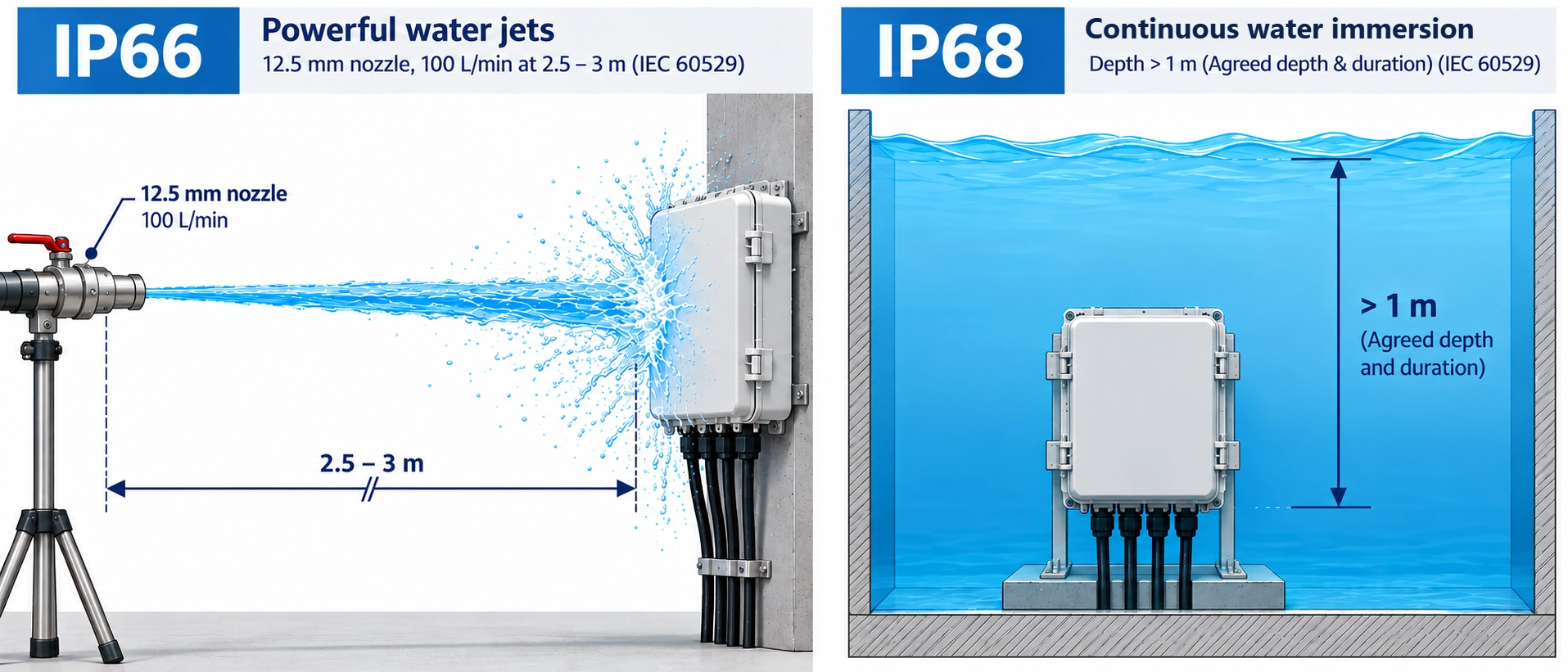
This matters in practice. A box on a pole or an exposed façade faces driving rain and spray rather than standing water. Neither laboratory test reproduces that exactly, but the jet tests are the relevant ones. A box at ground level that may sit in standing water faces immersion. A box marked only "IP68" has not demonstrated jet resistance. If a position involves both kinds of exposure, specify both ratings.
What to ask when a datasheet only says "IP68"
Because IPX8 conditions are agreed rather than fixed, two boxes can both be labeled IP68 after very different tests. An IP rating also describes the sample as it was tested: which entries held cables, which were plugged, and how it was mounted. It does not automatically cover every way the box might be installed. Before comparing two IP68 boxes, ask for:
- Immersion depth and duration
- The configuration tested: which cable entries were fitted with cables, which were plugged, and which glands or grommets were used
- Whether a jet test (IPX5 or IPX6) was also performed
- The test laboratory, the standard edition, and the report number
The same questions apply to our own range. Our 12-core FDB-55A terminal box is listed at IP68, and its product page does not yet state immersion depth and duration. Ask us for those conditions before you rely on it for a flooding position.
Match the box to the mounting location, not just the rating
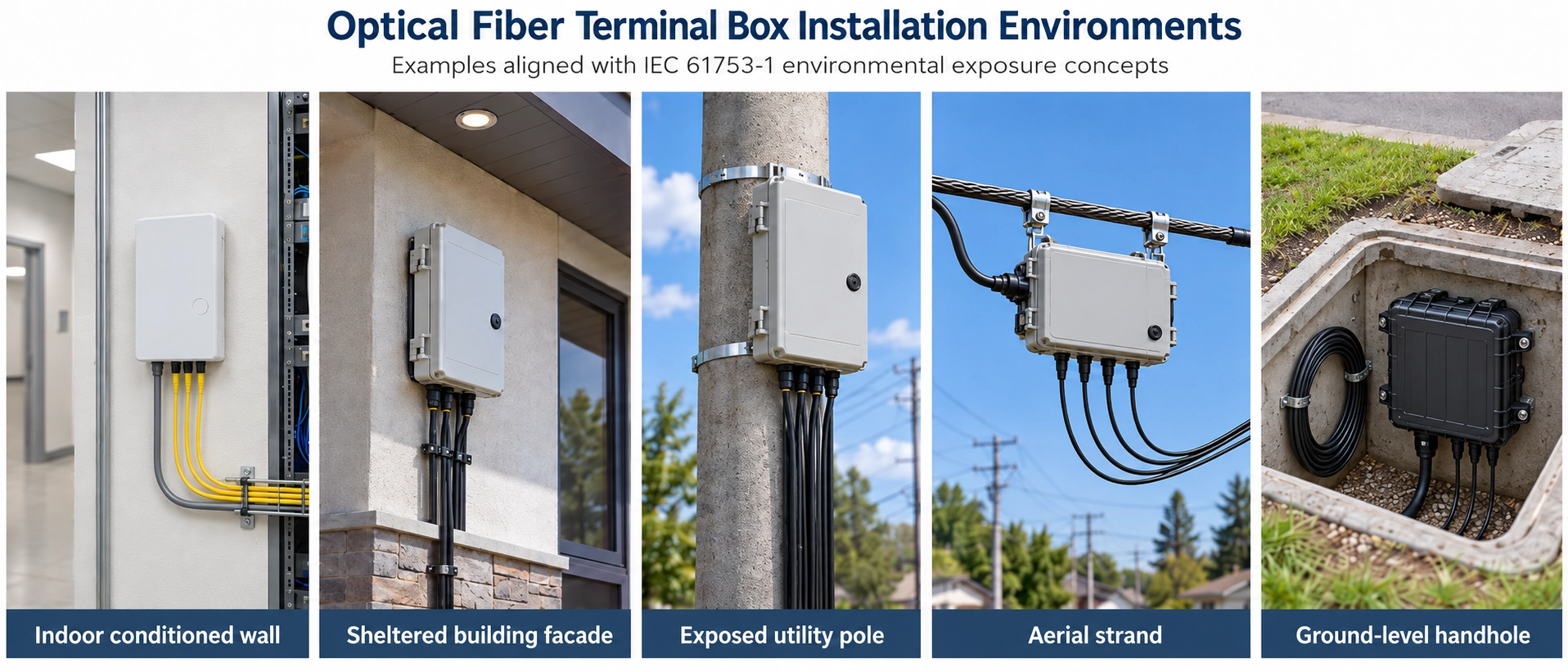
For passive fiber components, IEC 61753-1 defines environmental categories by where the component is installed, not by an IP number. The 2018 edition (Ed. 2.0) replaced the earlier U and O categories with OP and OP+ for outside plant, added an industrial category (I), and revised several existing categories. For example, the aerial category (A) now starts at ground level, and the ground category (G) now extends to 1 m below ground (IEC 61753-1 preview). The standard also covers controlled indoor (C), extreme (E) and subterranean (S) environments. In its test tables, wall or pole mounted boxes appear under categories C and A, while categories G and S are listed for closures and hardened connectors.
Each category has its own test conditions, which are set out in the standard itself and not reproduced here. Older documents may still refer to "Category U" or "Category O"; those labels belong to the 2007 edition. The categories and the IP code are separate systems: a category does not map to a fixed IP number.
The same location-first logic explains why minimum IP figures for outdoor boxes vary so much in supplier literature, from IP54 to IP65 and above. OFS, for instance, rates its SlimBox 12-Fiber Indoor/Outdoor Enclosure at IP55 for outdoor wall or pole installation (OFS). There is no single "outdoor" number, because the exposure under a façade canopy is very different from the exposure in a roadside handhole.
The matrix below is our own working summary of what to specify first at each location. The IP levels in it are starting points for typical exposure, not minimums from any standard. An operator specification, local regulations or unusual conditions (high-pressure cleaning, coastal spray, deep shelter) can raise or lower the requirement, so check it against your network operator's specification before you fix the RFQ.
| Mounting location | Main exposure | Specify first |
|---|---|---|
| Indoor, conditioned (apartment, office, comms room) | Fire, handling, cable congestion | Flame rating of the housing material, cable management, lockable cover in shared areas |
| Indoor, unconditioned (basement, car park, riser near outer wall) | Humidity, dust, condensation | Dust protection, sealed cable entries, adequate temperature range |
| Sheltered façade (under eaves or canopy) | Wind-driven rain, indirect UV | Jet rating (IPX5 as a typical start; IPX6 where wind-driven rain is heavy), UV-stable housing |
| Exposed façade or pole | Direct rain and sun, wide temperature swings | Jet rating, UV resistance, full outdoor temperature range, suitable mounting hardware |
| Aerial strand | Wind, vibration, direct sun | Weight and strand-mount hardware, UV resistance, temperature range |
| Ground level / pedestal / handhole | Standing water or flooding if drainage fails; impact | If the box can be submerged: immersion rating with declared conditions (dual-marked if jets are also expected). If the position is only damp: jet rating and sealed entries may be enough. Impact rating per IEC 62262 |
Indoor boxes: fire performance and cable management over sealing
Indoors, the specification usually turns on fire performance, not on ingress protection. Published terminals from major vendors that are used indoors cite UL 94 V-0 housing materials. Examples are Corning's indoor/outdoor MDU terminal (Corning) and Prysmian's compact termination box for interior walls, whose 2012 datasheet lists flame-retardant ABS rated UL 94 V-0 (Prysmian).
Keep in mind that UL 94 classifies how a plastic material burns. It describes the housing material, not the assembled box and not the installation. Building codes for risers and shared spaces vary by country, so confirm locally what is required. If a project calls for a specific flammability class, ask for the material certificate covering the exact resin grade used in the housing. A general "flame-retardant ABS" line on a datasheet is not the same thing.
Specifying a fully sealed outdoor-grade box for a dry indoor wall rarely adds value. It typically adds cost and makes routine access slower. Effort is better spent on bend-radius control, slack storage, clear port labeling and room for future drops.
For high-density indoor termination in a rack or equipment room, a wall box may not be the right form factor at all. Our comparison of fiber patch panels and ODFs covers that decision.
Outdoor installation details that decide whether the rating holds
An IP rating describes a box tested in a defined configuration. In the field, the rating only holds if the installed box matches that configuration. The following points are general good practice; where the manufacturer's instructions differ, follow the instructions.
- Check whether the box is designed to be opened in the field. Some outdoor boxes, including our ultrasonically welded 12-core FDB-55A, take drop cables through external ports and do not need to be opened on site. For those, the lid and gasket points below do not apply; check the port seals and unused-port plugs instead.
- Size cable entries to the cable. Use the gland or grommet matched to the cable's outer diameter. An oversized grommet around a thin drop cable is a common leak path.
- Plug every unused port with the manufacturer's sealing plugs. An open port defeats the rating.
- Point cable entries downward where the design allows, and form a drip loop so water runs off the cable before it reaches the entry.
- Keep gaskets clean and correctly seated, and close the lid to the manufacturer's fastening torque or latch sequence. Inspect gaskets whenever the box is reopened.
- Respect the minimum bend radius stated in the datasheet when routing fiber inside the box. Our 6-core and 16-core boxes, for example, list 40 mm bend-radius control.
- Do not drill extra holes or change the mounting orientation unless the manufacturer allows it. Either can invalidate the tested configuration.
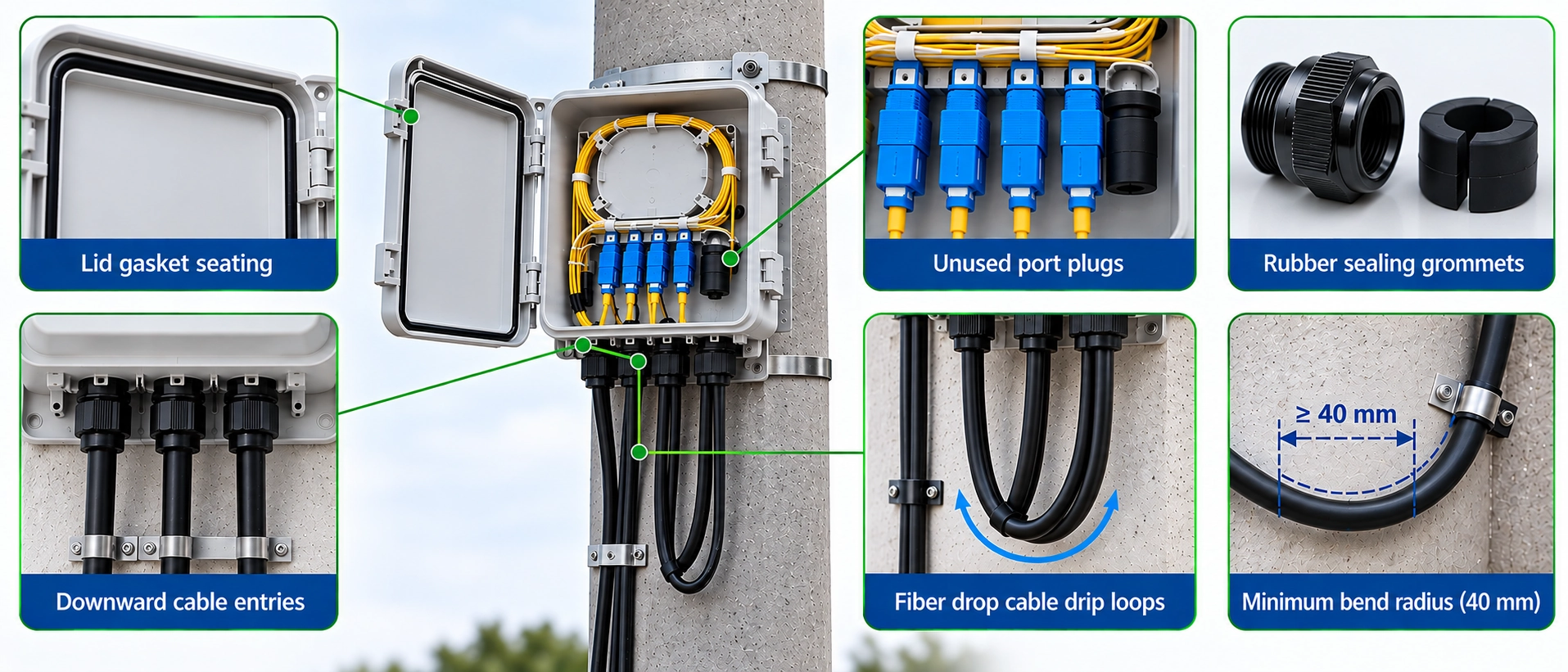
Before closing the job, a quick sealing check catches most field problems:
Every cable entry holds either a cable of the correct diameter or a sealing plug, with nothing left open.
On boxes with an opening lid, the gasket runs continuously around the lid, with no fiber, tie or debris trapped in it.
All latches or screws are fully home, in the sequence the instructions specify.
Each drop cable has its drip loop below the entry point.
A photo of the closed box and its entries is recorded for the next technician.
Repeat the check every time the box is reopened. Re-entry is when most seals are disturbed.
Temperature cycling and condensation
A sealed box "breathes" as its temperature changes. When it warms, internal pressure rises; when it cools, a partial vacuum forms.
Gore, which manufactures enclosure vents, demonstrated this in a 2011 technical note. It used a 4,000 cm³ sealed test enclosure, heated from 20 °C to 50 °C and cooled from 20 °C to −5 °C, each change within 90 seconds. It reports that the negative pressure can pull contaminants in through the seals, and that repeated pressure cycling can open gaps in them over time (Gore).
Gore has a commercial interest in vents, and the test used a generic enclosure, not a fiber terminal box. The underlying effect is ordinary gas behavior, though: a sealed volume of air builds pressure when heated and pulls a partial vacuum when cooled. It explains why a high IP rating at the factory does not guarantee a dry box after years on a sunny pole.
When you evaluate an outdoor box, ask the supplier how it handles pressure equalization and condensation. Also ask whether its temperature range is backed by a temperature-cycling test rather than a single high and low exposure.
EVOLUX terminal box options by installation requirement
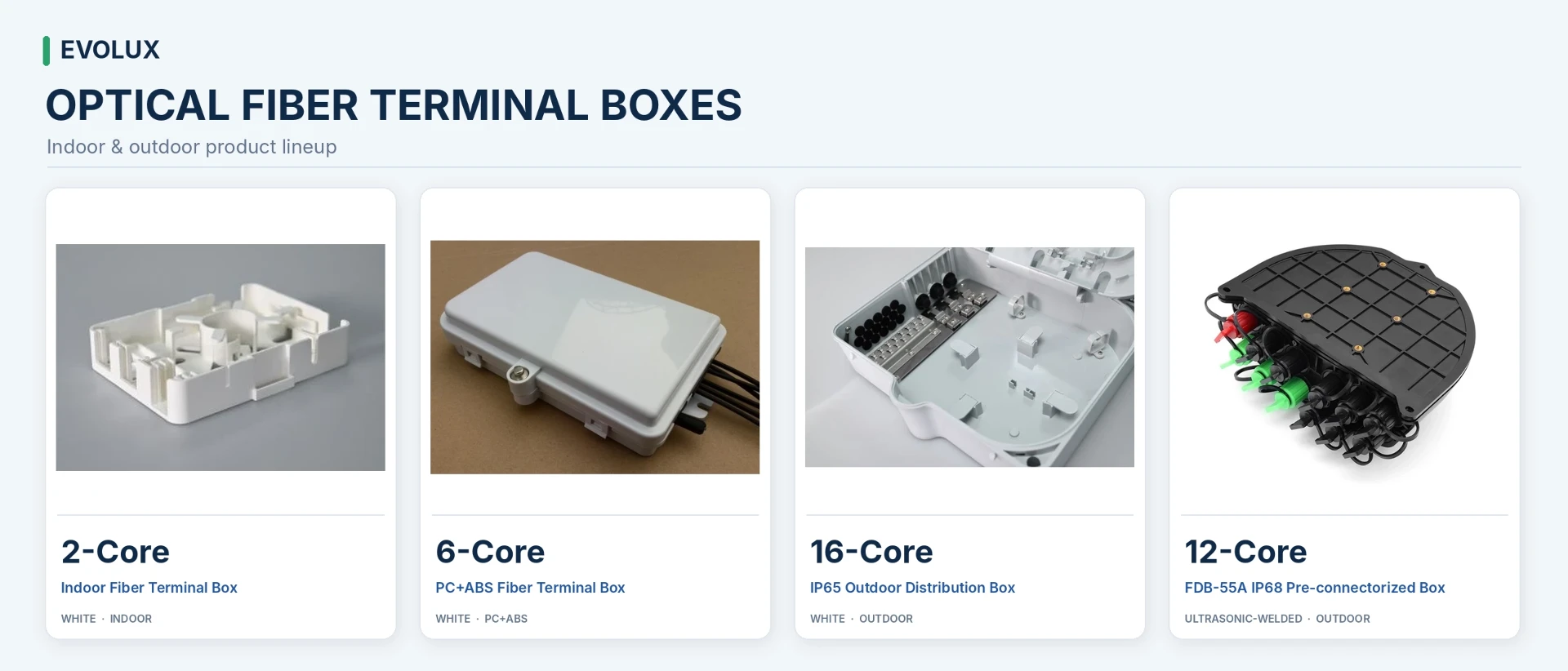
The table below maps some of our models to the locations discussed above. To shortlist, start with capacity and adapter type, then the mounting position, then the water exposure at that position; the last column lists what to confirm before ordering. Values are as published on each product page. Treat them as a starting point, and ask for the test basis that applies to your order.
| Model | Published on the product page | Where it may fit | Confirm before ordering |
|---|---|---|---|
| Fiber Optic Terminal Box 2 Core | 86 × 86 × 21 mm; up to 2 drop cables; SC or FC adapters; wall or pole mounting | Subscriber end point with one or two drops | IP marking if used outside; flammability of the housing material for shared indoor spaces |
| Fiber Optic Terminal Box 6 Core | PC+ABS; 186 × 116 × 41 mm; 6 drops; wall or pole mounting; 40 mm bend-radius control | Small multi-dwelling distribution point | Which IP marking applies to your order, and its test basis |
| 16 Core Outdoor Terminal Box | IP65; −40 °C to +85 °C operating; 280 × 220 × 85 mm; up to 16 SC or 32 LC; outdoor wall mounting | Sheltered or exposed façade distribution | IP test report and configuration; UV test basis. IP65 is a jet rating, not an immersion rating, so it is not intended for flooding positions |
| 12 Core FDB-55A | IP68; −25 °C to +60 °C; modified PP or PC+ABS; 9 or 12 pre-connectorized adapter ports; ultrasonically welded housing, drops connected without opening the box; wall or pole mounting | Outdoor wall or pole drop points where a sealed, pre-connectorized box is preferred | Immersion depth, duration and tested configuration behind the IP68 marking, and whether a jet test was also done. Until these are confirmed, do not treat it as qualified for flooding or below-grade positions |
A pre-order specification checklist
Send these questions to suppliers along with the mounting location.
Location and exposure
- Where will the box be installed (indoor conditioned, indoor unconditioned, sheltered façade, exposed façade or pole, aerial, ground level), and which exposures apply there?
Ingress protection
- What is the full IP marking? If the location involves both jets and immersion, is the box dual-marked (for example IP66/IP68)?
- For IPX7 or IPX8: what depth and duration, and what cable and plug configuration, were tested?
- Who performed the IP test, against which edition of IEC 60529 (and, for dust or jet ratings, IEC TS 63334), and can you share the report?
- If an IEC 61753-1 environmental category is claimed, which category, and under which edition?
Environment and materials
- What is the operating temperature range, and what test supports it (single high/low exposure or cycling)?
- For outdoor boxes: what is the UV resistance basis (test standard and duration)?
- For indoor boxes: what is the flammability rating of the housing material, and is there a certificate for that resin grade?
- Is an impact rating (IK, per IEC 62262) available for ground-level or exposed positions?
Installation and configuration
- Which glands or grommets fit which cable diameters, and are sealing plugs supplied for every port?
- What is the minimum fiber bend radius inside the box, and how much slack storage is provided?
- How does the box handle pressure equalization and condensation?
Next step
Once you have worked out the location and the requirement set, compare candidate boxes against the checklist instead of comparing headline IP numbers. You can review our indoor and outdoor models in the optical fiber terminal box range.
If you are shortlisting a model, send our team (sales@evoluxfiber.com) the following:
- Installation location (indoor or outdoor, and the mounting position)
- Required fiber capacity and adapter type
- Cable outside diameter and the number of entries
- Expected water, UV and temperature exposure
- The IP marking and test conditions your project requires
- Estimated order quantity and any customization needs
We will suggest a suitable model and tell you which test documentation is available for it.