If you work with fiber optic networks, the LC fiber connector is one of the first components you will encounter. It appears in nearly every modern structured cabling environment - from data center switch-to-server links to enterprise backbone patching and telecom distribution frames.
Yet many buyers and field installers still run into the same practical questions: What exactly is an LC connector? What LC connector types exist, and how do they differ? How is LC different from SC, ST, or FC? And when you are standing in front of a purchase order, how do you make sure the LC patch cable you pick actually matches your hardware?
This guide works through those questions step by step. Rather than listing products without context, it explains where LC connectors fit, what to verify before ordering, and what mistakes to avoid - so you spend less time troubleshooting mismatches after the cable arrives.

What Is an LC Fiber Connector?
LC stands for Lucent Connector. It was originally developed by Lucent Technologies (now part of Nokia) and has since become one of the most widely deployed small form factor (SFF) fiber optic connectors in the industry. The LC connector is standardized under TIA-604-10 (FOCIS-10), which defines its intermateability requirements for simplex, duplex, and quadruplex configurations.

What makes the LC design distinctive is its 1.25 mm ceramic ferrule - exactly half the diameter of the 2.5 mm ferrules used in SC, ST, and FC connectors. That smaller ferrule, combined with a compact push-pull latch mechanism similar to an RJ-45 clip, allows significantly higher port density on patch panels and equipment faceplates. In practice, you can fit roughly twice as many LC ports into the same panel space compared to SC.
The LC connector works with both single mode and multimode fiber. This is a point worth emphasizing early, because one of the most common misconceptions is that "LC" implies a particular fiber mode. It does not. The connector format and the fiber transmission mode are two separate specifications - and confusing them is one of the fastest ways to end up with incompatible cable on site.
Key Features and Advantages of LC Connectors
Compact Size for High-Density Cabling
The single biggest reason LC dominates modern fiber infrastructure is density. In a 1U rack-mount patch panel, LC adapters allow you to pack in far more fiber ports than you could with larger connector formats. When you are cabling a data center cabinet where every unit of rack space matters - or patching a high-port-count leaf switch - that density advantage is not just convenient, it is often a hard requirement.
Reliable Latch Mechanism and Consistent Alignment
The LC latch design provides secure mating with an audible click, making it straightforward for technicians to confirm a good connection during installation. The 1.25 mm zirconia ceramic ferrule delivers low insertion loss (typically under 0.3 dB per mated pair) and repeatable optical performance across connect-disconnect cycles. For environments with frequent patching activity - moves, adds, and changes in enterprise wiring closets or colocation facilities - that repeatability matters.
Standard Interface for SFP-Based Optical Modules
Most SFP, SFP+, and SFP28 optical transceivers use duplex LC interfaces. According to Cisco's SFP module documentation, all standard SFP ports use LC-type connectors. This means that if your network equipment relies on SFP optics - and most modern Ethernet switches, routers, and media converters do - LC patch cables are almost certainly what you need for interconnection.
LC Connector Types: What Are Your Options?
When people search for "LC connector types," they usually want to understand the different product forms that use the LC interface. Here is a breakdown of the main categories.

LC Fiber Patch Cables
LC fiber patch cables are the most commonly purchased LC-based products. They come in multiple connector-end combinations to handle different patching scenarios:
- LC to LC patch cords - the standard choice for switch-to-panel or panel-to-panel connections where both sides use LC
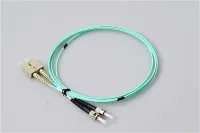
- LC to SC patch cords - frequently needed when connecting newer LC-equipped hardware to older SC-based infrastructure
- LC to FC or LC to ST patch cords - used in mixed-legacy environments or specialized test setups
- MPO/MTP to LC breakout assemblies - for transitioning between high-fiber-count backbone trunks and individual LC-facing switch ports
Each of these is available in single mode (OS2) or multimode (OM3, OM4, OM5) versions. The connector end does not determine the fiber mode - always verify the fiber specification independently.
Simplex vs Duplex LC Connectors
A simplex LC connector terminates a single fiber strand. A duplex LC connector pairs two fibers side by side - one for transmit, one for receive. Most transceiver-based Ethernet links require duplex cabling, because the SFP module needs separate TX and RX paths. However, certain bidirectional (BiDi) optics transmit and receive on different wavelengths over a single fiber, requiring only simplex LC cables. Always check the transceiver datasheet before ordering.

Standard Duplex vs Uniboot LC Cables
A standard duplex LC cable has two separate fiber legs, each with its own connector and boot. A uniboot LC design combines both fibers into a single jacket with a unified connector housing. The practical difference shows up most in high-density environments:
- In a crowded data center cabinet where you are patching 48 or 96 ports per panel, uniboot cables reduce bundle diameter significantly, improving airflow and making it easier to trace individual connections
- When you need to reverse polarity during installation, some uniboot designs allow tool-less polarity reversal at the connector - a real time-saver compared to swapping entire patch cords
- For lower-density or less space-constrained environments - a small telecom closet with a dozen fiber ports, for example - standard duplex cables work fine and typically cost less
LC Connector Polish Types: UPC vs APC

LC connectors are available in UPC (Ultra Physical Contact) and APC (Angled Physical Contact) polish. UPC connectors have a slightly curved end face and are the standard choice for most data and enterprise applications. APC connectors have an 8-degree angled end face, which provides higher return loss performance - critical in analog video, PON, and long-haul telecom systems where back-reflection sensitivity is a concern. For a deeper explanation of how polish type affects optical performance, see our guide on PC vs UPC vs APC fiber connector polish.
Important: Never mate a UPC connector with an APC connector. The angled and flat end faces are physically incompatible, and forcing a connection will damage both ferrules and produce unacceptable signal loss.
LC Adapters and Couplers
LC fiber optic adapters (also called couplers) are the mating sleeves that join two LC connectors inside a patch panel, enclosure, or wall outlet. They come in simplex and duplex formats, with options for SC-to-LC hybrid adapters when you need to bridge different connector types across a patch field.
LC Pigtails
LC fiber pigtails are short lengths of fiber with an LC connector factory-terminated on one end and a bare fiber on the other. They are typically fusion-spliced onto incoming cable in splice trays within distribution boxes or optical distribution frames (ODFs). Pigtails are common in both telecom outside-plant terminations and data center structured cabling.
Where Are LC Connectors Commonly Used?

Data Centers
LC is the dominant connector format inside data centers. It handles the short interconnect links between top-of-rack switches and servers, the cross-connects between patch panels, and the breakout connections from high-fiber-count MPO/MTP trunk cables to individual switch ports. In high-density environments running 10G, 25G, or even 100G Ethernet over SFP28 or QSFP breakout configurations, LC is the interface you will work with most.
Enterprise and Campus Networks
In enterprise buildings, LC patch cords connect switches, routers, and access-layer hardware within structured fiber cabling systems. LC is especially practical in IDF (intermediate distribution frame) closets and MDF (main distribution frame) rooms where multiple departments share patching infrastructure and organized cable management is essential.
Telecom and Fiber Distribution
LC connectors appear in telecom central offices, fiber distribution hubs, and fiber optic terminal boxes where high fiber counts need to be terminated and managed in compact enclosures. In FTTH (fiber to the home) and MDU (multi-dwelling unit) cabling, LC is frequently used alongside SC-APC on the distribution side.
SFP Transceiver-Based Links
This deserves its own mention because it is the single most common context for LC patch cables. Whether you are deploying 1G SFP, 10G SFP+, or 25G SFP28 optics, the transceiver's fiber interface is almost always duplex LC. That means every time you install or replace a transceiver module, you are working with an LC patch cord. For a deeper look at how LC fits into high-density transceiver deployments, see our comparison of LC vs MTP/MPO for high-density fiber.
How to Choose the Right LC Patch Cable: A Step-by-Step Approach
Choosing the right LC product is not complicated, but it does require checking several specifications in the right order. Below is the process that avoids the most common ordering mistakes.

Step 1: Determine the Fiber Mode First - Not the Connector
Before anything else, confirm whether your link requires single mode or multimode fiber. Check the transceiver datasheet, the switch port specifications, and the existing fiber plant. An LC connector can be either single mode or multimode - the connector shape tells you nothing about the fiber inside.
A mistake we frequently see in procurement: someone orders "LC patch cables" based on the connector alone, without verifying fiber mode. The cable arrives, the LC connector clicks into the adapter just fine - but the link fails or shows excessive loss because the fiber type does not match the optics. Connector compatibility and fiber compatibility are two separate checks.
Step 2: Confirm Simplex or Duplex
Most standard SFP transceiver links use duplex LC cables. But if your design uses BiDi (bidirectional) optics or a specific single-fiber application, you may need simplex. Check the port interface on your device - do not assume duplex by default without verifying.
Step 3: Choose the Connector Polish
For the majority of data center and enterprise Ethernet applications, UPC polish is standard. If you are working in a PON, CATV, or long-haul telecom environment, APC may be required. The color coding helps: blue boots typically indicate UPC single mode, green boots indicate APC. Multimode connectors usually have beige (OM1) or aqua (OM3/OM4) boots. Verify against your adapter polish - mixing UPC and APC will damage the ferrules.
Step 4: Decide on Standard Duplex or Uniboot
If you are patching fewer than 24 ports in a low-density rack, standard duplex cables are simple and cost-effective. If you are working in a dense cabinet - 48, 96, or more LC ports - uniboot cables significantly reduce cable congestion. Consider uniboot especially when airflow management, cable tracing, or frequent polarity changes are priorities.
Step 5: Verify Connector End Combinations
Not every link is LC-to-LC. Check both ends of the link path. In mixed environments, one end might be LC (at the switch SFP port) while the other end is SC, FC, or ST (at an older patch panel or legacy device). Hybrid patch cords such as SC to LC cables handle these transitions without additional adapters.
Step 6: Check Cable Length and Jacket Rating
Measure the actual routing path - not the straight-line distance. Account for service loops, vertical cable runs, and patch panel positioning. For plenum-rated spaces, confirm the cable jacket meets local fire code requirements (OFNP or LSZH, depending on jurisdiction). Excess cable length creates management problems in dense racks; insufficient length creates strain on connectors.
Before-You-Order Checklist
Before finalizing any LC patch cable purchase, confirm these six items:
- Fiber mode: single mode (OS2) or multimode (OM3/OM4/OM5)?
- Cable construction: simplex or duplex?
- Connector polish: UPC or APC? (And does it match the adapter on both ends?)
- Connector types on both ends: LC-LC, LC-SC, or another combination?
- Cable length: measured along the actual routing path?
- Transceiver and hardware compatibility: does the patch cord specification match the optics datasheet?
LC vs SC, ST, and FC: A Practical Comparison
Understanding how LC compares to other common fiber optic connector types helps you decide when LC is the right choice and when another format may be more appropriate.
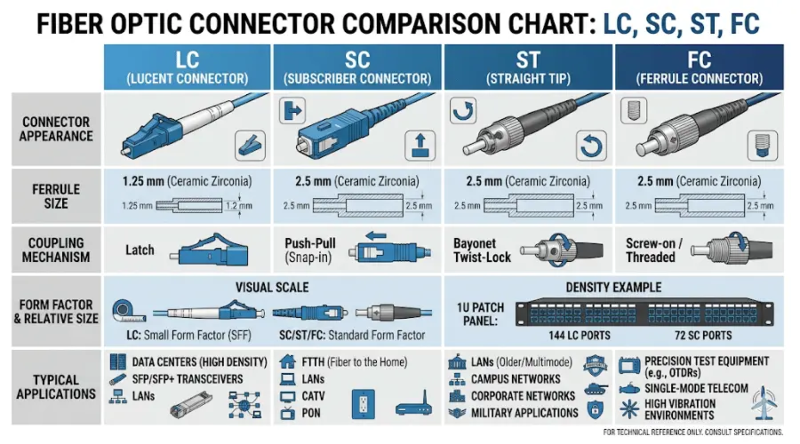
Comparison Table
| Feature | LC | SC | ST | FC |
|---|---|---|---|---|
| Ferrule diameter | 1.25 mm | 2.5 mm | 2.5 mm | 2.5 mm |
| Coupling mechanism | Push-pull latch | Push-pull snap | Bayonet twist-lock | Threaded screw-on |
| Relative size | Small (SFF) | Medium | Medium | Medium |
| Port density | High | Moderate | Low–moderate | Low |
| Typical use today | Data centers, SFP links, high-density patching | Enterprise, FTTH, legacy backbone | Legacy LAN, industrial, military | Test equipment, some telecom |
| SFP compatibility | Standard interface for SFP/SFP+/SFP28 | Available via adapter or specific SFP models | Rare | Rare |
| TIA FOCIS standard | FOCIS-10 (TIA-604-10) | FOCIS-3 (TIA-604-3) | FOCIS-2 (TIA-604-2) | FOCIS-4 (TIA-604-4) |
What Is the Difference Between LC and SC Connectors?
The most important difference is physical size. LC uses a 1.25 mm ferrule, while SC uses a 2.5 mm ferrule. This means LC supports roughly twice the port density in the same panel space. Both connectors work with single mode and multimode fiber, and both use a push-pull coupling design. In new deployments where SFP-based hardware is standard, LC is almost always the connector you will need. SC remains common in existing installations, FTTH ONT connections, and environments where the infrastructure was built around SC adapters.
When Should You Use ST or FC Instead of LC?
ST connectors use a bayonet twist-lock coupling and are mostly found in legacy campus LAN environments, government installations, and some industrial applications. FC connectors use threaded coupling for secure, vibration-resistant connections and appear primarily in test and measurement setups or older telecom equipment. For new structured cabling projects, LC is the more practical choice in the vast majority of cases - but if your existing hardware exposes ST or FC ports, you will either need matching patch cords or hybrid LC-to-ST/FC cables.
Common Mistakes When Selecting LC Fiber Components

Ordering the Right Connector but the Wrong Fiber Mode
This is the most frequent purchasing error we encounter. The LC connector physically mates with the adapter regardless of whether the fiber inside is single mode or multimode. The connection looks correct, but the link either fails entirely or shows excessive attenuation. Always confirm the fiber mode independently of the connector type.
Mismatching Polish Types
Inserting an APC-polished connector into a UPC adapter (or vice versa) damages both ferrule end faces. The air gap created by the mismatched angles causes high return loss and potentially permanent scratching. If you are working in an environment that mixes UPC and APC connections - common in telecom distribution - label adapters clearly and train installation staff on the color-coded boot system.
Ignoring Simplex vs Duplex Requirements
A duplex LC cable will not physically fit into a simplex LC adapter panel, and a simplex cable will leave half of a duplex transceiver unconnected. This sounds obvious, but it happens when ordering is done from a product list rather than from a verified link specification.
Assuming All LC Products Are Interchangeable
An LC connector is not a universal plug. The fiber mode, polish type, cable construction (simplex/duplex/uniboot), fiber grade (OM3 vs OM4, for example), and cable jacket rating all need to match the link design. Check the transceiver module specifications, the adapter panel, and the existing fiber plant before assuming compatibility.
Choosing Based on Price Alone
A lower-cost cable that arrives with the wrong fiber grade, an untested ferrule end face, or a jacket that does not meet your building's fire rating creates more expense in rework and downtime than the cost difference saved. Evaluate suitability first - then compare pricing among qualified options.
Frequently Asked Questions About LC Fiber Connectors
What does LC stand for in fiber optics?
LC stands for Lucent Connector. The design was developed by Lucent Technologies and is standardized under TIA-604-10 (FOCIS-10). It features a 1.25 mm ceramic ferrule and a push-pull latch mechanism.
Is the LC connector used for single mode or multimode fiber?
Both. LC is a connector format, not a fiber specification. You can get LC patch cables in single mode (OS2), and in multimode grades including OM1, OM2, OM3, OM4, and OM5. The fiber mode is determined by the cable and the optics, not by the connector shape. See our detailed comparison of single mode vs multimode fiber for more.
Why do most SFP transceivers use LC connectors?
SFP modules were designed around the small form factor concept - and LC's compact 1.25 mm ferrule makes it the natural match. The duplex LC interface allows separate TX and RX fibers in a footprint small enough to support high port density on switches and routers. This has made LC the de facto standard for SFP, SFP+, and SFP28 transceiver connections across the industry.
What is a uniboot LC cable, and when should I use one?
A uniboot LC cable combines both duplex fibers into a single round jacket with a unified connector boot, instead of the two separate legs in a standard duplex cable. Use uniboot cables when patching density is high, cable routing space is limited, or you need the ability to reverse polarity at the connector without replacing the cable. In high-density LC patching scenarios - 48 ports and above per panel - the space savings are substantial.
Can I connect an LC patch cable to an SC port?
Not directly. LC and SC connectors have different ferrule sizes and housing dimensions. To bridge the two, use a hybrid LC-to-SC patch cord, or install a hybrid LC-SC adapter panel. Make sure the fiber mode and polish type match on both sides.
What is the difference between UPC and APC on an LC connector?
UPC (Ultra Physical Contact) has a slightly curved, flat end face. APC (Angled Physical Contact) has an 8-degree angle that directs reflected light away from the fiber core, resulting in higher return loss values. UPC is standard for most data and enterprise applications. APC is preferred in PON, CATV, and analog systems where back-reflection can degrade signal quality. See our UPC vs APC guide for detailed technical comparisons.
How do I clean an LC connector?
Use a fiber optic cleaning tool designed for 1.25 mm ferrules - either a one-click pen cleaner or lint-free wipes with isopropyl alcohol. Inspect the ferrule with a fiber microscope before and after cleaning. Dirty or scratched ferrules are one of the most common causes of unexpected insertion loss in the field. For general maintenance practices, see our fiber optic maintenance and cleaning guidelines.
Conclusion: Making the Right LC Connector Decision
The LC fiber connector is the standard interface for most modern fiber optic patching - and for good reason. Its compact 1.25 mm ferrule supports high port density, its push-pull latch is practical for field technicians, and its universal adoption by SFP-based transceiver manufacturers means it is part of nearly every new network deployment.
But "LC" alone is not a complete specification. The right LC product for your project depends on getting six things right: fiber mode, simplex or duplex construction, connector polish, connector end combinations, cable length, and hardware compatibility. Skip any one of those checks, and you risk a cable that connects physically but fails optically.
If you are planning a fiber cabling project and need LC connectors, LC fiber optic connectors, patch cables, adapters, or pigtails matched to your specifications, explore our LC patch cable catalog or contact our technical team for project-specific guidance.