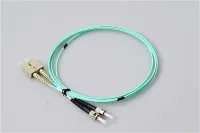
An ST connector (Straight Tip) is a fiber optic connector with a bayonet twist-lock design and a 2.5mm ceramic ferrule. It is best suited for legacy LAN maintenance, fiber optic test equipment, industrial networks, and existing installations that already rely on ST interfaces. For new high-density data center builds, LC connectors are typically the better choice.
Although ST connectors are no longer the default for new deployments, they remain essential for anyone maintaining older fiber infrastructure, working with test instruments, or supporting industrial fiber links. This guide covers how they work, where they fit, how to choose the right ST patch cable, and when to consider alternatives.

What Is an ST Connector?
An ST connector - commonly understood as Straight Tip - is a fiber optic connector designed to align two optical fibers so that light passes from one to the other with minimal loss. It was originally developed by AT&T in the mid-1980s as a cost-effective alternative to the older Biconic connector, and quickly became the dominant connector in multimode LAN environments through the 1990s and early 2000s. The ST connector is standardized under TIA-604-2 (FOCIS-2) in North America and IEC 61754-2 internationally.

The basic structure of an ST connector includes:
- A round metal or polymer connector body
- A spring-loaded 2.5mm zirconia ceramic ferrule that holds and centers the fiber
- A bayonet-style locking sleeve with a push-and-twist engagement
- A strain relief boot (available in straight or angled versions, for 900µm to 3.0mm cables)
- A mating adapter (coupler) with a precision alignment sleeve
The ferrule is the most critical part. It keeps the fiber core precisely centered so that when two ST connectors mate inside an ST adapter, the fiber end faces align with minimal offset. ST, SC, and FC connectors all share the 2.5mm ferrule size, which is why they can be cross-connected through hybrid mating adapters when necessary.
How Does an ST Fiber Connector Work?
To make a connection, you insert the ST connector into the adapter, align the keyed slot, push forward, and twist until the bayonet lock clicks into place. The spring-loaded ferrule then presses the fiber end face against the opposing connector with consistent force. This twist-lock mechanism - sometimes called "stab and twist" by field technicians - prevents the connector from pulling loose under cable tension or vibration.

In practice, this matters most in environments where patch cords may be tugged, moved, or handled frequently. Unlike push-pull connectors such as SC, the bayonet lock requires a deliberate twist to release, which reduces accidental disconnections. The trade-off is that the round body and twist-lock housing take up more panel space than smaller connectors like the LC, making ST less suitable for high-density rack configurations.
Where Are ST Connectors Used?
ST connectors are most commonly found in networks and equipment where legacy compatibility, physical durability, or instrument connection is the primary concern.

Legacy LAN and Campus Networks
Through the 1990s and into the 2000s, ST was the default multimode connector for many campus backbone links, building risers, and horizontal fiber runs - especially over OM1 (62.5/125µm) fiber. Many of these installations still operate today. If a building already has ST patch panels, ST wall outlets, or ST-terminated backbone cables, replacing connectors with the same type is often simpler and cheaper than redesigning the entire cable plant.
The Fiber Optic Association's network design guide (PDF) notes that ST connectors have declined in popularity compared to LC and even SC, but they remain present in many existing installations.
Fiber Optic Test Equipment
Many optical power meters, light sources, visual fault locators, and older OTDR models still have ST ports. When testing or troubleshooting fiber links, you may need ST patch cords or ST hybrid adapters to connect your test equipment to the link under test. This is one of the most common reasons ST connectors are still purchased today.
Industrial Fiber Networks
The bayonet locking mechanism and metal body construction make ST connectors practical in industrial automation, manufacturing floors, and other environments where mechanical vibration, handling, or environmental exposure demand a secure physical connection.
Existing Network Maintenance and Retrofit
When a fiber link fails or needs extension, you need the same connector type that is already installed. If the existing infrastructure uses ST adapters, ST pigtails, or ST-terminated panels, ordering replacement ST components is the most straightforward approach. In retrofit projects, switching from ST to LC may require adapter panel changes, new patch cords for every port, and documentation updates - costs that may not be justified if the existing system works.
Single Mode vs. Multimode ST Connectors
ST connectors are available for both single mode and multimode fiber, but you must match the connector to the installed fiber type and equipment.
Multimode ST Connectors
This is where ST originated and where it remains most common. Multimode ST connectors are used with OM1, OM2, OM3, or OM4 fiber in older LAN backbones, campus links, and building distribution systems. If you are maintaining or extending an existing multimode network with ST infrastructure, multimode ST patch cords and pigtails are the standard replacement parts.
Single Mode ST Connectors
Single mode ST connectors are used where long-reach fiber performance is needed but the installed infrastructure already uses ST interfaces. This is less common than multimode ST but does occur in legacy telecom, utility, and government networks. Note that ST connectors do not support angled physical contact (APC) polish, which limits their use in modern FTTH and telecom access networks where SC/APC is typically specified.
Common Mistake
Do not assume a connector is single mode or multimode based on appearance alone. Before ordering, confirm the fiber type (OS2, OM1, OM2, OM3, OM4), cable category, and transceiver specification. Mixing a single mode ST patch cord with multimode fiber - or vice versa - will produce high loss or an unstable link.
ST vs. SC vs. LC vs. FC: How Do They Compare?

Choosing between common fiber optic connector types depends on your equipment interface, density requirements, and existing infrastructure. Here is a practical comparison:
| Connector | Ferrule Size | Locking Style | Typical Applications | Best For |
|---|---|---|---|---|
| ST | 2.5mm | Bayonet twist-lock | Legacy LANs, test equipment, industrial networks | Existing ST systems, vibration-prone environments |
| SC | 2.5mm | Push-pull | Telecom, FTTH, enterprise networks | Easy handling, moderate density, SC/APC for FTTH |
| LC | 1.25mm | Latch | Data centers, SFP/SFP+/QSFP transceivers | High-density modern networks |
| FC | 2.5mm | Threaded screw | Test equipment, measurement, high-vibration links | Secure threaded connection, precision instruments |
Because ST, SC, and FC all use a 2.5mm ferrule, they can be interconnected through hybrid adapters when needed - for example, using an ST-to-SC adapter to bridge two different connector systems on the same link. The Fiber Optics Tech Consortium confirms that these three 2.5mm connector types can be mixed and matched through hybrid mating adapters.
For new data center projects, LC is the standard choice. Most modern SFP, SFP+, QSFP, and QSFP28 transceivers use LC ports, and LC's smaller 1.25mm ferrule allows roughly twice the port density per rack unit compared to ST or SC.
What Are the Advantages of ST Connectors?
Secure bayonet locking.
The twist-lock mechanism provides a firm mechanical connection that resists accidental pull-out. In field environments where cables are handled frequently, this is a meaningful advantage over push-pull connectors that may come loose.
Durable metal construction.
Many ST connectors feature nickel-plated metal bodies and precision zirconia ceramic ferrules, giving them good resistance to repeated mating cycles and physical handling.
Broad compatibility.
ST connectors are available for both single mode and multimode fiber, in PC and UPC polish types, and for 900µm, 2.0mm, and 3.0mm cable structures. This makes them flexible enough for most legacy applications.
Standards-backed intermateability.
ST connectors manufactured to TIA-604-2 (FOCIS-2) and IEC 61754-2 are designed to intermate regardless of manufacturer, reducing the risk of compatibility issues when sourcing replacement parts from different suppliers.
What Are the Limitations of ST Connectors in Modern Networks?
Lower port density.
The round body and bayonet housing are physically larger than LC connectors. In a 1U patch panel, you can fit far fewer ST ports than LC ports, making ST impractical for high-density data center racks.
No APC polish option.
Unlike SC and LC connectors, ST does not support angled physical contact (APC) polish. This limits its use in modern singlemode deployments where APC is required - particularly FTTH, CATV overlay, and PON access networks.
Declining equipment support.
Most modern optical transceivers, media converters, and switches ship with LC interfaces. Designing a new network around ST connectors would require either hybrid adapters at every port or custom equipment orders - neither of which is cost-effective.
Less common in supply chains.
As demand has shifted to LC and SC, some ST-specific components (specialty lengths, certain fiber grades, or unusual configurations) may have longer lead times from distributors.
How to Choose an ST Connector or ST Patch Cable
Whether you are ordering ST-to-ST patch cables, hybrid jumpers, or ST pigtails, use the following checklist to avoid common ordering mistakes.

1. Confirm Fiber Mode
Match single mode ST to single mode fiber (typically OS2, yellow jacket) and multimode ST to multimode fiber (OM1/OM2 in orange, OM3/OM4 in aqua). Do not assume based on connector appearance - always verify against the installed fiber and transceiver specification.
2. Specify Connector End Types
Common configurations include ST-to-ST, ST-to-LC, ST-to-SC, and ST-to-FC. Hybrid fiber optic patch cables are useful when one side of the link uses ST and the other uses a different connector - for instance, connecting a legacy ST patch panel to a switch with LC SFP transceivers.
3. Check Cable Diameter and Boot Size
ST connectors may be used with 900µm tight-buffer fiber, 2.0mm zipcord, or 3.0mm jacketed cable. Make sure the boot and connector housing are rated for the cable structure you need.
4. Verify Polish Type
Most ST connectors use PC (Physical Contact) or UPC (Ultra Physical Contact) polish. Always match the polish type to the rest of the link. Mixing PC and UPC in the same mated pair can degrade return loss performance.
5. Check Insertion Loss Requirements
For standard links, typical ST insertion loss is ≤ 0.5 dB maximum per mated pair. For demanding applications - such as long single mode runs, tight link budgets, or high-end test setups - specify low-loss or factory-tested patch cords with ≤ 0.2 dB typical insertion loss.
6. Confirm Adapter Compatibility
If you need to connect ST to SC or ST to FC, use the correct hybrid fiber optic adapter. The alignment sleeve inside the adapter directly affects connection quality - a worn or low-quality adapter sleeve will increase insertion loss even with clean, undamaged connectors.
Example Ordering Specification
A complete ST patch cable specification might look like this: ST/UPC to LC/UPC, OS2 single mode, simplex, 3.0mm LSZH jacket, yellow, 5 meters, low-loss grade (≤ 0.2 dB typical). Having this level of detail ready before sending an RFQ to your supplier avoids delays and incorrect shipments.
Installation, Cleaning, and Troubleshooting

Installation Tips
Align the connector key with the adapter slot before inserting. Push the connector fully into the adapter, then twist until the bayonet lock engages with a positive click. Do not force the connector - if it does not seat smoothly, withdraw and re-align. Maintain proper bend radius on the fiber cable behind the connector, and always cap unused ST ports to prevent contamination.
Cleaning the End Face
Contamination on the fiber end face is the single most common cause of high insertion loss in fiber optic links. Always clean the ST connector end face before mating, especially after storage, handling, or field work. Use a dry fiber cleaning cassette or lint-free wipes with IPA, and inspect the end face with a fiber inspection microscope if available. Never touch the ferrule tip with bare fingers. If a connector remains dirty or shows scratches after cleaning, replace it.
Troubleshooting High Loss on ST Links
If an ST fiber link shows high loss or intermittent performance, work through these checks in order:
- Dirty end faces. Clean both connectors and re-test. This resolves the majority of high-loss issues.
- Poor seating. Because ST connectors are spring-loaded, a partially engaged bayonet lock can result in the ferrule not pressing firmly against the mating connector. Disconnect, re-seat, and confirm the lock is fully engaged.
- Worn adapter sleeve. Adapter alignment sleeves wear over time, especially in frequently re-connected test setups. Replace the adapter if loss improves with a new one.
- Scratched or chipped ferrule. Inspect the ferrule end face under magnification. Deep scratches or chips in the fiber zone require connector replacement.
- Wrong fiber type. Verify that both patch cords and the installed cable are the same fiber type. A single mode to multimode mismatch will produce severe loss.
- Incorrect hybrid adapter. If using an ST-to-SC or ST-to-LC adapter, confirm it is the correct type and that the alignment sleeve is undamaged.
- Excessive cable bend. Check for tight bends, kinks, or pinch points in the patch cord or installed cable near the connector.
Should You Still Use ST Connectors Today?
Yes - but in the right context. The decision depends on your existing infrastructure and project requirements.
| Scenario | Recommendation |
|---|---|
| Maintaining an existing ST-based LAN or campus network | Use ST - replacing with the same connector type is the most practical choice |
| Test equipment with ST ports | Use ST patch cords or ST hybrid adapters |
| Industrial system requiring a secure twist-lock connector | Use ST - the bayonet lock is well-suited to vibration and handling |
| New high-density data center build | Use LC - smaller footprint, higher port density, native SFP/QSFP compatibility |
| New FTTH or telecom access deployment | Use SC/APC or LC - ST does not support the APC polish required by most PON systems |
| Mixed-connector environment (legacy ST + new LC equipment) | Use hybrid ST-to-LC patch cables to bridge both systems without re-terminating |
In short, ST remains a reliable connector for maintenance, testing, and industrial applications. For new builds where density, transceiver compatibility, and APC polish matter, LC and SC are the standard choices.
ST Connector Selection Checklist
Before sending an RFQ or placing an order, confirm all of the following:
| Parameter | What to Confirm |
|---|---|
| Fiber mode | Single mode (OS2) or multimode (OM1, OM2, OM3, OM4) |
| Connector end A | ST/UPC, ST/PC, or other |
| Connector end B | ST, LC, SC, FC, or other |
| Polish type | PC or UPC (ST does not support APC) |
| Cable jacket | PVC, LSZH, OFNR, OFNP, or armored |
| Cable diameter | 900µm, 2.0mm, or 3.0mm |
| Length | Measured to actual routing, not straight-line distance |
| Jacket color | Yellow (single mode), orange (OM1/OM2), aqua (OM3/OM4) |
| Insertion loss grade | Standard (≤ 0.5 dB) or low-loss (≤ 0.2 dB) |
| Application | Patch panel, test reference, pigtail splice, wall outlet, etc. |
FAQ About ST Connectors
What does ST connector stand for?
ST is commonly understood as Straight Tip. It refers to a fiber optic connector with a round body, bayonet-style locking mechanism, and 2.5mm ferrule. The name distinguishes it from the older Biconic connector, which used a tapered (non-straight) alignment approach.
Is an ST connector single mode or multimode?
It can be either. ST connectors are available for both single mode and multimode fiber. The connector must match the fiber type and network equipment - verify before ordering.
What is the difference between ST and SC connectors?
ST uses a bayonet twist-lock mechanism, while SC uses a push-pull latching design. Both share a 2.5mm ferrule. SC is more common in telecom and FTTH applications, partly because SC supports APC polish, which ST does not.
What is the difference between ST and LC connectors?
ST uses a 2.5mm ferrule and a round twist-lock body, while LC uses a smaller 1.25mm ferrule with a latch design. LC's compact size makes it the standard for high-density data center environments.
Are ST connectors still used?
Yes. They are still actively used in existing fiber networks, test equipment, industrial systems, and some military applications. However, LC and SC dominate most new installations.
Can I connect ST to LC or SC?
Yes. You can use a hybrid patch cable (such as ST-to-LC or ST-to-SC) or a hybrid mating adapter. Always confirm that the fiber mode and polish type are compatible on both sides of the connection.
What is an ST-to-LC patch cable used for?
An ST-to-LC patch cable bridges two different connector systems - for example, connecting a legacy ST patch panel to a modern switch with LC-based SFP transceivers. This avoids the need to re-terminate or replace the existing ST infrastructure.
Can ST connectors be used with OS2 fiber?
Yes. Single mode ST connectors with UPC polish can be used on OS2 fiber. However, if the application requires APC polish (common in FTTH and PON systems), ST is not suitable - use SC/APC or LC/APC instead.
What causes high insertion loss in ST connectors?
The most common causes are end face contamination, poor seating (bayonet lock not fully engaged), worn adapter alignment sleeves, scratched ferrules, fiber type mismatch, and excessive cable bending. Cleaning and re-seating the connector resolves the majority of issues.
What standard covers ST connector intermateability?
The ST connector is covered by TIA-604-2 (FOCIS-2) in North America and IEC 61754-2 internationally. These standards define the physical dimensions and mechanical requirements that ensure ST plugs and adapters from different manufacturers will intermate correctly.
Conclusion
The ST connector has been part of fiber optic networking for over three decades. Its bayonet twist-lock design and 2.5mm ceramic ferrule make it a durable and reliable choice for legacy multimode LANs, fiber test equipment, industrial applications, and existing network maintenance.
For new projects, the right connector depends on your equipment interface, fiber type, density requirement, link budget, and polish type. If your infrastructure already uses ST, staying with ST for maintenance and expansion is the practical decision. If you are building from scratch, LC is typically the better fit for modern data center and enterprise deployments, while SC/APC is standard for FTTH and telecom access.
Before ordering ST fiber patch cables, adapters, or pigtails, confirm the fiber mode, connector end types, cable diameter, polish type, insertion loss requirement, and adapter compatibility. Getting these details right up front avoids costly re-orders and installation delays.