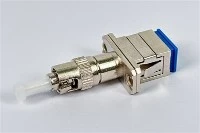
An FC fiber connector is a round, threaded fiber optic connector that screws into an adapter or equipment port instead of pushing in like an SC or LC connector. The name is usually read as Ferrule Connector, and the whole design exists to do one thing well: hold a stable, repeatable optical connection that stays put when equipment is handled, moved, or exposed to vibration.
FC is no longer the default for new high-density networks - that role belongs to LC connectors. But it is still common on optical test instruments, in parts of older telecom and transmission infrastructure, and in laser, sensor, and polarization-maintaining (PM) fiber systems. This guide covers how FC works, how FC/PC, FC/UPC, and FC/APC differ, where FC is still specified today, and how to choose the right FC connector, patch cord, pigtail, or adapter for a project.

How Does an FC Fiber Connector Work?
An FC connector uses a threaded coupling nut to lock onto an adapter or device port. As the nut is tightened, the spring-loaded ferrule is pushed into contact with the mating ferrule, lining up the two fiber end faces so light can pass with low loss. The interface dimensions are defined internationally in IEC 61754-13, which specifies the FC connector family around a 2.5 mm ferrule and a threaded, spring-loaded coupling.

The Threaded Coupling Mechanism
The screw-on coupling is the connector's signature feature. Instead of clicking into place, you rotate the nut until the connector seats. The payoff is mechanical stability: the connection resists accidental pulls and holds its alignment under vibration, which is exactly what test benches and instrument ports need.
The trade-off is speed. Threading and unthreading every connection is slower than the push-pull action of SC or LC, so FC is rarely the right tool for a dense patch panel that gets re-patched often. It earns its place where a connection is set once and expected to stay reliable.
Ferrule, Key, and the Parts That Matter

Knowing the main parts makes both specifying and troubleshooting easier:
- Ferrule - usually a 2.5 mm ceramic (zirconia) cylinder that holds and centers the fiber at the end face, the same nominal size as SC and ST ferrules.
- Coupling nut - the rotating metal collar that threads onto the adapter and applies contact force.
- Alignment key - a small male key on the connector body that sets orientation and stops the ferrule from rotating against the mating end face.
- Connector body and boot - the housing that holds everything together, plus the strain-relief boot that protects the fiber where it exits.
- Adapter sleeve - inside the FC adapter, a split alignment sleeve receives both ferrules and lines them up.
Alignment matters because a poorly seated or cross-keyed connector raises insertion loss and return loss, and forcing or twisting a ferrule against its mate can scratch the polished end face. The keying is especially important on angled (APC) connectors, where rotational position directly affects performance.
FC Connector Polish Types: PC, UPC, and APC
FC connectors come with different end-face polishes, and the polish - not the connector body - is what mainly drives reflection and insertion loss. If you remember one thing from this section, remember the three-letter suffix on the part number. For a deeper look across all connector families, see our guide to PC, UPC, and APC polish.

FC/PC (Physical Contact)
PC is the original domed polish, where the fiber cores touch under light spring pressure. It works, but its reflection performance trails newer polishes, so it is rarely specified in new single-mode projects and now mostly appears on legacy equipment.
FC/UPC (Ultra Physical Contact)
UPC is a finer, more tightly controlled version of PC. It delivers low insertion loss and solid return loss, and it is the practical default for general single-mode links, lab connections, and equipment interfaces that need a straight physical-contact polish. UPC parts are usually marked with blue boots, though color coding can vary by maker.
FC/APC (Angled Physical Contact)
APC polishes the end face at an angle - the standardized value is 8° - so reflected light is directed into the cladding instead of straight back toward the source. That sharply lowers back reflection, which is why APC is chosen for systems sensitive to reflected light: CATV and analog video, PON and FTTH feeds, laser sources, and precision measurement. APC parts typically carry green boots.
APC connectors must only mate with APC connectors that share the same key. Forcing an APC face against a UPC or PC face causes high loss and can permanently damage both end faces.
PC vs UPC vs APC at a Glance
| Polish | End face | Typical return loss | Common color | Best for |
|---|---|---|---|---|
| PC | Lightly domed | ≥ 40 dB | - | Legacy equipment, older links |
| UPC | Domed, finer polish | ≥ 50 dB | Blue | General single-mode, lab and equipment ports |
| APC | Angled 8° | ≥ 60 dB | Green | CATV, PON/FTTH, lasers, precision test |
The return-loss figures above reflect levels commonly cited in international performance standards such as IEC 61753 and in supplier datasheets; always confirm the exact grade against the test report for the parts you order.
How to Tell FC/APC and FC/UPC Apart

In practice you can usually identify the polish four ways: boot color (green for APC, blue for UPC), the visible angle on the ferrule tip, the suffix on the order spec or label (FC/APC vs FC/UPC), and the marking on the equipment port. When in doubt, check the port label first rather than judging by appearance - it is the single easiest way to avoid an APC/UPC mismatch.
Where Are FC Fiber Connectors Still Used Today?
A fair question for any connector that predates LC is whether it is obsolete. FC isn't - it has simply narrowed to the places where its stability is worth the slower connection.

Test and Measurement Equipment

FC is a familiar sight on optical power meters, light sources, OTDRs, and optical spectrum analyzers, as well as on reference-grade test cords. The threaded coupling holds a constant, repeatable contact, which keeps measurements consistent across many connect/disconnect cycles - a real advantage when a loose port could skew a reading.
Telecom and Transmission Systems
Some telecom and transport equipment, particularly older platforms, was built around FC ports and still uses them. New builds lean toward SC connectors in access networks and LC on equipment, but FC may still be required to match an existing chassis or distribution frame.
Lasers, Sensors, and PM Fiber
Laser instruments, fiber sensors, research setups, and PM fiber assemblies often use FC because mechanical stability and precise, repeatable alignment matter more than connection speed. In these systems even small amounts of back reflection can destabilize a source or corrupt a measurement, so FC/APC is common here.
Industrial and High-Vibration Environments
Because the coupling is threaded, FC can suit connections exposed to vibration or movement. Suitability still depends on the full assembly - strain relief, adapter quality, and installation - not the connector alone.
FC vs SC vs LC vs ST Connectors
FC is one option among several. Comparing it with the other mainstream connectors makes the decision clearer.

| Connector | Locking | Ferrule | Typical use | Strength | Limitation |
|---|---|---|---|---|---|
| FC | Threaded screw | 2.5 mm | Test gear, telecom, lasers, PM fiber | Stable, vibration-resistant | Slower to connect |
| SC | Push-pull | 2.5 mm | FTTH, telecom, patch panels | Easy to use, widely stocked | Larger than LC |
| LC | Push-pull latch | 1.25 mm | Data centers, transceivers, high density | Compact, high density | Small latch is easier to mishandle |
| ST | Bayonet twist-lock | 2.5 mm | Legacy multimode | Simple twist-lock | Uncommon in new builds |
Which Connector Should You Choose?
- Choose FC when wiring test instruments, matching legacy FC equipment, or building laser/sensor/PM links where stable alignment outranks speed.
- Choose LC for transceivers and high-density cabling, where its 1.25 mm ferrule roughly doubles port density.
- Choose SC for FTTH and access networks, where SC/APC is widely deployed and easy to terminate in the field.
- Choose ST mainly to match an existing multimode plant; it is rarely the pick for new work.
If you are weighing the two 2.5 mm screw-versus-push options specifically, our note on the differences between SC and FC connectors goes deeper on the trade-offs.
FC Connector Selection Matrix

For quick reference, here is how the choice usually falls by application:
| Application | Usual choice | Why |
|---|---|---|
| Optical test instrument | FC/UPC or FC/APC | Match the port and its reflection requirement |
| CATV / analog optical link | FC/APC | Low back reflection protects signal quality |
| Laser source / PM fiber | FC/APC | Reflection sensitivity and stable alignment |
| Legacy telecom port | Match the existing FC type | Compatibility with installed equipment |
| High-density data center | Usually LC | FC is bulkier and slower to patch |
| FTTH / access network | Usually SC/APC | Standard field deployment |
Advantages and Limitations of FC Connectors
The honest summary: FC trades convenience for stability. That is a good deal in some places and a poor one in others.
Where FC is strong. The threaded coupling resists accidental disconnection and vibration, the ferrule-and-key design supports repeatable alignment, and the connector is available in both UPC and APC to suit different return-loss needs - which is why it persists in test, laser, and PM applications.
Where FC falls short. It is slower to connect and disconnect than SC or LC, it is physically larger than LC and so a poor fit for high-density panels, and it demands more care during mating: the key must line up, and the ferrule should never be forced or rotated against its mate.
When Not to Use FC
Skip FC when port density or patching speed is the priority (reach for LC), when deploying a standard FTTH or access network (SC/APC is usually the norm), or when nothing on the link actually requires FC's threaded stability. Choosing FC "to be safe" on a dense panel typically just adds cost and slows installation.
FC Patch Cord vs FC Pigtail vs FC Adapter

These three FC products solve different problems, and mixing them up is a common ordering error:
- FC patch cords are finished on both ends and connect two ports directly - for example, an instrument to a patch panel. Jackets are typically 2.0 mm or 3.0 mm.
- FC pigtails have a connector on one end and bare fiber on the other, meant to be fusion-spliced into a cable or tray. They usually use 0.9 mm tight-buffered fiber.
- FC adapters (couplers) are the female bulkhead that joins two FC connectors through an alignment sleeve; they mount in panels, boxes, and enclosures.
How to Choose the Right FC Fiber Connector?
Before ordering an FC connector, patch cord, pigtail, or adapter, confirm these five things.

1. UPC or APC
Use FC/UPC for general single-mode links where low insertion loss is enough. Use FC/APC where back reflection matters - lasers, analog/CATV, PON, and precision measurement. Never mix APC with UPC or PC.
2. Fiber Type
Confirm whether the link is single-mode or multimode. Single-mode FC is the norm in telecom, test, and long-distance optics; multimode FC exists but is far less common in new work.
3. Cable Diameter
Match the boot and connector to the cable: 0.9 mm tight-buffered fiber for most pigtails, and 2.0 mm or 3.0 mm jackets for patch cords, depending on routing and durability.
4. Adapter and Key Compatibility
The adapter must match the polish and the key. FC adapters come in narrow key (often marked NK / 2.0 mm) and wide key (WK / 2.14 mm), with the narrow key more common today. For FC/APC, key alignment is critical because angular position sets the performance - a mismatched key can prevent proper seating or raise loss.
5. Performance Requirements
Don't stop at the connector name. Confirm the numbers that decide whether the link works:
- Insertion loss (IL) - light lost passing through the mated pair; lower is better. Ask for the typical and maximum values.
- Return loss (RL) - light reflected back toward the source; higher dB is better, and it is the main reason to pick APC.
- Operating wavelength - confirm the assembly is rated for your window (for example 1310/1550 nm on single-mode).
- Jacket, durability, and environment - jacket rating (such as LSZH), plug-cycle durability, and any outdoor or industrial requirements.
For B2B orders it is also worth confirming the supplier can provide test reports, custom lengths, labeling, and packaging.
Common Mistakes to Avoid?

- Mixing APC and UPC:Different end-face geometries mean pairing them causes high loss and can damage the polish. In procurement, most FC errors come down to polish mismatch, cable-diameter mismatch, or assuming every FC adapter is interchangeable.
- Ignoring cleanliness:Dust, oil, and scratches drive up loss and ruin test repeatability. Inspect and clean the end face before every mate, especially on instruments.
- Using FC where LC or SC fits better:High-density panels usually want LC; FTTH usually wants SC/APC. Reserve FC for threaded stability or equipment compatibility.
- Forgetting the ports at both ends:The connector has to match the device, adapter, panel, or instrument. Before ordering FC patch cords, check both ends of the link - and read the port label rather than guessing by appearance.
FC Fiber Connector Buying Checklist
Confirm these before placing an order:
- Connector configuration: FC to FC, or a hybrid such as FC to LC or FC to SC
- Polish: UPC or APC
- Fiber: single-mode or multimode
- Cable length
- Cable diameter: 0.9 mm, 2.0 mm, or 3.0 mm
- Jacket material and rating
- Simplex or duplex structure
- Adapter type, key, and mounting style
- Insertion loss and return loss targets
- Test report, labeling, and packaging needs
Procurement Notes for B2B Buyers
For project orders, catalog defaults often aren't enough. Cable length, jacket material, boot color, polish, label format, and packaging all affect how smoothly the parts install at scale - and most avoidable FC problems on site trace back to polish mismatch, the wrong cable diameter, or an adapter key that wasn't specified. Lock those details down on the purchase order, and ask for per-batch test reports on anything feeding test equipment or reflection-sensitive links.
FAQ
Q: What does FC mean in fiber connectors?
A: It is usually read as Ferrule Connector - a round-bodied fiber optic connector with a threaded coupling and, on standard parts, a 2.5 mm ferrule.
Q: How do I know whether my equipment needs FC/UPC or FC/APC?
A: Check the port label and the existing patch cords. Green boots and an "APC" suffix mean angled; blue boots and "UPC" mean straight contact. If the system involves lasers, analog/CATV, or PON, it is very likely APC. When unsure, match what is already installed rather than assuming.
Q: Can FC/APC connect to FC/UPC?
A: No. Their end-face geometry differs, so mating them causes high insertion loss and can damage both faces. APC mates only with APC.
Q: Is an FC connector single-mode or multimode?
A: It can be either, but FC is most often single-mode, used on test, telecom, laser, and precision optical links. Multimode FC exists but is uncommon in new installations.
Q: Is FC better than LC?
A: Neither is universally better. FC's threaded coupling suits test gear and vibration-prone connections; LC's compact 1.25 mm ferrule suits transceivers and high-density panels. Match the connector to the port and the environment.
Q: What should I check before ordering FC-to-LC patch cords?
A: Confirm the polish at each end (and don't cross APC with UPC), the fiber type, simplex versus duplex, the cable diameter and jacket, the length, and the IL/RL targets - then verify both equipment ports actually use those connector and polish types.
Conclusion
An FC fiber connector is a threaded connector built for stable, repeatable optical connections, which keeps it relevant on test instruments, in laser and sensor systems, and wherever existing equipment was designed around FC ports - even as LC and SC dominate new high-density and access networks. Pick FC when the port, the performance target, or the environment specifically calls for it; reach for LC for density and SC/APC for FTTH.
Before you order, run the quick checks that prevent most problems: confirm both equipment ports, the polish (UPC or APC), the fiber type, the cable diameter, and the adapter key, and ask for a test report on anything feeding instruments or reflection-sensitive links. Getting those right up front is what keeps insertion loss, return loss, and rework costs down.