An armored MPO/MTP patch cord wraps a steel-tube or Kevlar-reinforced jacket around a multi-fiber assembly to survive crush loads, rodent exposure, and high-vibration environments. A standard MPO trunk cable uses a lighter double-sheath construction optimized for clean, climate-controlled data center pathways. Choosing between them depends on where the cable will live, how much physical abuse it will face, and whether your link budget can absorb a slightly higher insertion loss from the armored design's thicker construction.
Why This Comparison Matters Right Now
Data center architects used to make a simple call: trunk cables for backbone runs, patch cords for short hops inside a cabinet. That distinction still holds, but the physical environment around fiber infrastructure has changed. Edge deployments push MPO assemblies into factory floors, mining control rooms, and outdoor 5G shelters where a standard trunk cable would fail within months. Meanwhile, hyperscale operators packing thousands of 400G and 800G links into a single hall need every tenth of a dB they can save - which means paying close attention to whether an armored jacket is adding unnecessary attenuation on a protected pathway.
The real engineering question is not which cable is "better." It is which cable matches the mechanical and optical demands of a specific link segment.
Where Each Cable Type Belongs
Before comparing specs, it helps to think in terms of deployment scenarios. The cable's surroundings - not its feature list - should drive every selection decision. Each scenario below also flags the mechanical and optical factors you should weigh, so the evaluation logic is built into the context rather than sitting in a separate checklist.
Inside a climate-controlled data center cabinet, standard MPO trunk cables are the correct pick. The environment is clean, temperature-stable, and physically protected. Cables here face only moderate tensile loads during installation, occasional lateral pressure from neighboring cables, and vibration from HVAC. A dual-layer jacket - inner aramid yarn plus an LSZH or plenum-rated outer sheath - handles all of that comfortably while meeting IEC 60794 and TIA-568 mechanical requirements. Using armored cables in this setting adds cost, weight, and diameter without delivering a meaningful reliability improvement. Trunk cables with 24 or 48 fibers efficiently connect spine-to-leaf switch layers using QSFP28 or QSFP-DD optics, and their smaller 3.0 mm outer diameter keeps routing through high-density cable management trays straightforward.
Inter-row backbone runs under a raised floor require more thought. A modern facility with sealed cable trays can rely on standard trunks. But older buildings with open pathways beneath raised floor tiles tell a different story - foot traffic, rolling carts, and occasional rodent activity all create crush and abrasion hazards that a double-sheath construction was never designed to handle. If you have documented pest incidents or your pathways are shared with heavy equipment, that alone justifies armored MPO assemblies on backbone segments. The decision point here is straightforward: inspect the pathway, assess the realistic mechanical threats, and let the physical evidence guide you.
Industrial and edge environments leave little room for debate. Factory floors subject cables to constant vibration from machinery. Mining control rooms introduce particulate contamination and temperature extremes. Outdoor 5G cabinets cycle through freeze-thaw conditions and UV exposure. Military field deployments combine all of the above with impact risk. In these settings, a standard trunk cable's rated operating range of −20°C to +60°C and its roughly 100–200 N crush resistance are simply insufficient. Armored MPO patch cords, rated from −40°C to +75°C and capable of withstanding over 1,000 N of lateral crush force, are not a premium upgrade here - they are a baseline requirement. If your link runs through any space that lacks traditional data center protections, the armored option removes a failure mode that no amount of careful cable management can fully eliminate.
Short cross-connect patches within a cabinet - typically under two meters between cassettes, adapter panels, and transceivers - favor standard MTP/MPO multimode patch cords. The environment is fully enclosed, the cable is barely handled after initial installation, and flexibility matters more than crush resistance. Armored stiffness can actually work against you in tight enclosures where bend radius is at a premium.
What's Actually Inside Each Cable
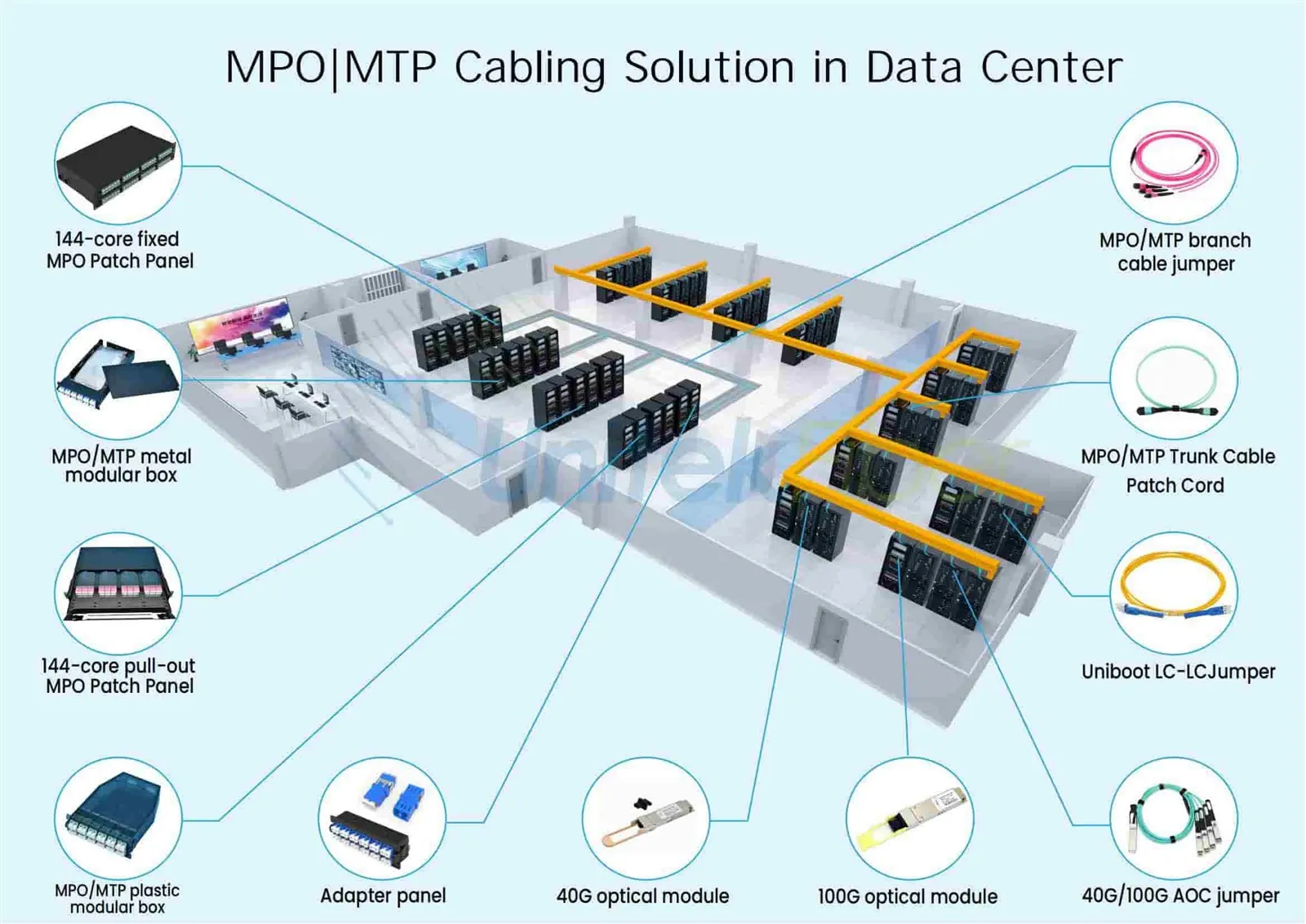
A standard MPO trunk cable typically bundles 12 to 144 fibers inside its dual-layer jacket. The MTP/MPO OM3 fiber patch cord in standard form measures roughly 3.0 mm in outer diameter. Both ends are factory-terminated with precision-polished MT ferrules - 8, 12, or 24 fibers per connector - and each assembly ships with individual test reports showing insertion loss per channel. The construction is deliberately minimal: just enough protection for a controlled indoor pathway, which keeps weight low and makes handling in dense cable trays easy.
Armored MPO/MTP patch cords introduce a corrugated steel tube or interlocking aluminum armor between the fiber bundle and the outer jacket. Some designs layer aramid yarn on top of a steel strength member, pushing crush resistance to roughly ten times that of standard constructions. This does increase the outer diameter to 4.0–5.0 mm and adds weight. However, modern armored designs remain surprisingly flexible. A well-engineered armored MPO cord can achieve a minimum bend radius of around 50 mm, which is workable in most structured cabling environments. The key manufacturing differentiator is whether a buffer layer sits between the armor and the fiber ribbon - without it, the rigid armor can press against fibers at bend points and introduce micro-bend loss that wouldn't show up in a straight-cable insertion loss test.

Does Armor Cost You Signal?
The armored jacket itself does not directly increase insertion loss at the connector interface. Insertion loss depends on ferrule geometry, fiber alignment, and end-face polish quality - not on what's wrapped around the cable body. A low-loss MTP connector on an armored assembly still hits 0.15–0.25 dB per mated pair when properly manufactured, identical to the same connector on a standard trunk. At 400G SR4 wavelengths, both cable types using equivalent connector grades deliver functionally identical loss - typically 0.15–0.35 dB for multimode OM4 assemblies.
Where armor can introduce a penalty is micro-bending. If the steel tube is poorly manufactured or the cable is routed with bends tighter than the specified minimum, the armor compresses against the fiber ribbon and micro-bend attenuation creeps in. This is a manufacturing quality issue and an installation discipline issue, not an inherent property of armored construction. When evaluating armored MPO cords, always request the bend-attenuation test data - not just the static insertion-loss certificate. Any vendor that only provides straight-cable loss numbers may be hiding a micro-bend problem. For a deeper understanding of how fiber grades affect loss budgets, the OM1 through OM5 multimode fiber comparison provides useful context on modal bandwidth and attenuation characteristics across different fiber classes.
This also means that for any link segment where your optical loss budget is tight - such as a long 400G SR4 reach pushing close to the 100-meter OM4 limit - you should factor in the bend-attenuation risk of armored cable if the routing path includes tight turns. If the path is straight and spacious, armor won't cost you anything optically. If the path forces the cable through several tight corners, standard cable's inherent flexibility may actually deliver lower total link loss in practice.
Mechanical Protection in Detail
Standard MPO trunk cables handle the stresses found in structured cabling environments: moderate tensile loads during installation pulls, lateral pressure from cable bundles in shared trays, and low-level vibration from building systems. The double-sheath design, reinforced with aramid yarn, meets the mechanical requirements of IEC 60794 and TIA-568 for indoor premises cabling. These are not fragile cables - they are simply engineered for the conditions they will actually encounter in a well-managed facility.
Armored assemblies address a different threat profile. The steel or aluminum layer resists crushing forces that would permanently deform a standard sheath. Rolling chairs on a raised-floor environment, heavy carts in a warehouse, rodent teeth in a facility where pest control is imperfect - these are not theoretical risks; they are documented failure modes that fiber maintenance teams encounter regularly. Some armored MPO designs withstand over 1,000 N of lateral crush force, five to ten times the capacity of standard constructions. The extended temperature range (−40°C to +75°C versus −20°C to +60°C for typical indoor trunks) further differentiates the two for any deployment outside climate-controlled spaces.
When assessing whether a particular segment needs armor, count the physical risk factors along the cable's actual path: exposure to crush or impact, documented rodent or pest activity, temperature or humidity excursions beyond indoor norms, and whether the routing forces bends tighter than 50 mm. Two or more of these factors on a single path segment make a strong case for armored construction. If the path is fully enclosed, climate-controlled, and free of mechanical hazards, standard trunk cable delivers the same optical performance with less bulk and cost.
Polarity and Compatibility
Both armored and standard MPO assemblies follow the same TIA-568 polarity methods - Type A (straight-through), Type B (reversed), and Type C (pair-flip). The armor layer does not affect pin alignment, gender configuration, or connector interoperability. A female armored MPO-12 cord mates with a male standard MPO-12 adapter panel without any compatibility issue, and you can freely mix armored and standard segments within the same link as long as fiber count, polarity type, and connector grade match.
One practical consideration worth noting: because armored cables are stiffer, plan connector orientation carefully in tight enclosures. Key-up to key-down mating in a densely populated MPO/MTP fiber optic adapter panel may require additional clearance when the cable's armor prevents the tight bends that standard cords handle easily. This isn't a compatibility problem - it's a cable management planning detail that can save significant frustration during installation if addressed on the rack elevation drawing before cables arrive on site.
For breakout applications where an MPO trunk feeds into individual duplex connections, MTP/MPO to SC or LC harness cables provide the transition, and the same armored-vs-standard evaluation applies to the breakout segment based on its physical environment.
Frequently Asked Questions
Q: Can I Mix Armored MPO Patch Cords With Standard MPO Trunk Cables In The Same Link?
A: Yes. Armored and standard MPO assemblies use identical MTP/MPO connectors compliant with IEC 61754-7 and TIA-604-5. A female armored cord mates with a male standard trunk through any compatible adapter panel. The armor affects only the cable body, not the optical interface. Verify that both assemblies share the same fiber count, polarity type, and connector grade (standard or low-loss) to avoid mismatched insertion loss.
Q: Does The Armored Jacket Affect Cleaning And Inspection Procedures?
A: No. The connector end-face is identical between armored and standard assemblies. Use the same MTP-specific reel-type or cassette cleaner, inspect with a 200x+ fiber scope before every mating, and keep dust caps in place when connectors are not in use. The armor has no bearing on ferrule contamination or cleaning access.
Q: What Fiber Counts Are Available In Armored MPO/MTP Cables?
A: Armored MPO cables are commonly available in 8-fiber, 12-fiber, and 24-fiber configurations, matching the standard counts used in 40G, 100G, 200G, and 400G parallel optics. Some manufacturers offer 48-fiber and higher-count armored trunks for backbone applications, though availability varies. The 12-fiber and 24-fiber versions cover the vast majority of data center and industrial use cases.
Q: Is An Armored MPO Cord Suitable For Plenum Spaces?
A: It depends on the jacket rating. The armor layer itself does not determine fire rating - the outer jacket material does. Armored MPO cords are available with OFNP (plenum), OFNR (riser), and LSZH jacket options. Always verify the cable's fire rating matches your building code requirements before installation in air-handling spaces.
Q: How Does Insertion Loss Compare Between Armored And Standard MPO Cables At 400G SR4 Wavelengths?
A: When both cables use equivalent MTP connector grades (e.g., low-loss or elite), insertion loss per mated pair is functionally identical - typically 0.15–0.35 dB for multimode OM4 assemblies. The armor does not degrade connector-level optical performance. The only scenario where armor may introduce additional loss is if the cable is routed below its minimum bend radius, causing micro-bend attenuation in the fiber. Respecting the manufacturer's specified bend radius eliminates this risk.