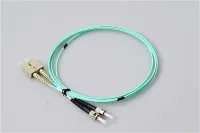
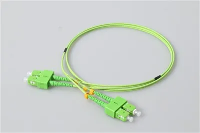
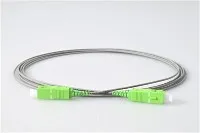
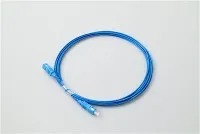
An 8-core SC to MTP/MPO patch cord is a breakout cable assembly that terminates in a single MTP/MPO multi-fiber connector on one end and four duplex SC connectors on the other, carrying eight optical fibers across a single jacket. It serves as a direct bridge between high-density parallel optics infrastructure and legacy SC-terminated equipment - making it one of the most practical tools for networks that aren't ready to rip and replace but still need to move to 40G or 100G.
If your facility still runs SC-based patch panels, OLTs, or test instruments alongside newer QSFP+ switching gear, this cable eliminates the need for intermediate cassettes or adapter panels. One end plugs straight into a QSFP+ SR4 transceiver port; the other fans out to your existing SC duplex infrastructure. That directness is what makes it valuable - and what makes it different from the more common MTP-to-LC breakout cables that dominate most data center catalogs.

Why the 8-Fiber Count Matters in Modern Cabling
The fiber optic industry has been gradually shifting from Base-12 to Base-8 architecture, and for good reason. A standard QSFP+ or QSFP28 transceiver uses four lanes for transmit and four lanes for receive - eight fibers total. When you deploy a 12-fiber MTP trunk cable for a QSFP application, four fibers in the center of the connector sit unused. Over a large-scale deployment with hundreds of links, that idle fiber adds up to significant wasted investment.
An 8-core SC to MTP/MPO fiber patch cord aligns perfectly with the actual fiber utilization of 40GBASE-SR4 and 100GBASE-SR4 optics. Every fiber carries traffic. No waste, no dead strands cluttering your documentation. Base-8 cabling also scales neatly into standard switch port configurations - most chassis have port counts in multiples of four (16-port, 32-port line cards), which maps cleanly onto 8-fiber MTP connectors without orphaned fibers.

Bridging Legacy SC Networks to Parallel Optics
Here is where the SC-to-MTP/MPO breakout cord earns its keep. SC connectors dominated enterprise and telecom cabling for over two decades. Plenty of campus networks, CATV headends, government facilities, and carrier central offices still have row after row of SC patch panels. Swapping all that infrastructure to LC just to access 40G speeds is expensive and disruptive.
Instead, an 8-fiber MTP-to-SC breakout cable lets you connect a 40G QSFP+ port directly to four existing SC duplex ports. Each SC pair handles one 10G lane, so a single QSFP+ transceiver effectively breaks out into 4×10G connections over your existing SC plant. The same logic applies to 100G QSFP28 SR4 transceivers splitting into 4×25G lanes. You preserve your cabling investment while accessing the bandwidth density of parallel optics.
This isn't a niche scenario. Telecom operators running legacy SONET/SDH infrastructure on SC connectors, university campuses with aging SC-terminated building backbones, and broadcast facilities wired with SC fiber for video transport all encounter this exact situation. The 8-core SC to MTP/MPO cord gives them a migration path that doesn't require a forklift upgrade.

Understanding Polarity Configuration for SC-to-MTP Links
Polarity is one of the most common failure points in MTP/MPO cabling, and getting it right on an SC breakout is no exception. For a standard 8-fiber SC to MTP/MPO breakout assembly, Type B polarity (Method B per TIA-568) is the default choice for QSFP transceiver applications. In a Type B configuration, fiber position 1 at one end maps to fiber position 8 at the other - a full array reversal that ensures transmit fibers align with receive fibers across the link.
Type A (straight-through) polarity is less common in breakout scenarios and typically reserved for trunk-to-trunk connections where cassettes handle the Tx/Rx flip. Type C (pair-flipped) is a specialty configuration used with specific cassette-based structured cabling designs. Unless your infrastructure documentation specifies otherwise, Type B is the safe choice for direct transceiver-to-SC breakout applications. Confirming polarity before ordering prevents the frustrating scenario of a clean installation that simply will not pass light.
Singlemode vs. Multimode: Matching Fiber Type to Application Distance
The 8-core SC to MTP/MPO patch cord is available in both singlemode (OS2, 9/125μm) and multimode (OM3 50/125μm, OM4 50/125μm) variants. The choice depends on your transceiver type and reach requirements.
For multimode applications, OM3 fiber supports 40GBASE-SR4 up to 100 meters and 10GBASE-SR up to 300 meters. OM4 extends those distances - 150 meters at 40G SR4 - and offers nearly double the effective modal bandwidth at 850 nm (4700 MHz·km vs. 2000 MHz·km). If you are building new horizontal runs inside a data center, the incremental cost of OM4 over OM3 is well worth the future-proofing. For a deeper comparison of multimode fiber grades from OM1 through OM5, each generation represents a measurable step up in bandwidth density and supported link length.
Singlemode OS2 fiber is the choice for longer-reach applications - 100GBASE-PSM4 over distances up to 500 meters, or 40GBASE-PLR4 reaching 10 km. Government and campus backbone deployments that span multiple buildings typically need singlemode, especially when the SC patch panels on the far end were originally installed for long-haul telecom applications.
Key Deployment Scenarios
Data Center 10G-to-40G Migration
A facility running 10G SFP+ transceivers across SC-terminated patch panels can upgrade the spine layer to 40G QSFP+ without re-terminating a single panel. The 8-core SC to MTP/MPO breakout cord connects the QSFP+ port directly to four SC duplex ports, each carrying one 10G lane. This migration path requires zero changes to existing horizontal cabling.
Telecom Central Office Interconnection
Central offices often maintain SC-based optical distribution frames that have been in service for years. Connecting new DWDM or ROADM equipment with MTP/MPO interfaces to those existing frames requires a breakout that speaks both connector languages. The 8-core assembly handles this without an intermediate cassette, saving 1U of rack space per connection point.
Broadcast and A/V Transport
Professional broadcast facilities frequently use SC fiber for uncompressed video transport between studios and control rooms. When adding IP-based video routers with QSFP ports, the SC to MTP/MPO breakout cord integrates new equipment into the existing fiber plant cleanly.
Test and Lab Environments
Network test labs often maintain a mix of connector types across different generations of equipment. An 8-core SC to MTP/MPO patch cord lets engineers patch between legacy test instruments with SC ports and newer multi-fiber test sets without hunting for adapters.
Connector Quality and Insertion Loss Considerations
Insertion loss budgets tighten as link speeds increase. At 40G and 100G, every tenth of a decibel at each connection point affects your link margin. Standard-grade MTP connectors typically spec at ≤0.50 dB maximum insertion loss per mated pair, while elite/low-loss MTP connectors bring that down to ≤0.35 dB (0.15 dB typical). The SC end of the breakout should maintain ≤0.30 dB per connector.
For demanding multi-hop links, specifying low-loss MTP connectors on the MTP/MPO multimode fiber patch cord end is worth the premium. Every cable should ship with individual test data - 3D interferometry verification of ferrule geometry at a minimum. If your supplier cannot provide per-cable test documentation, that is a red flag worth investigating before committing to a purchase order.
Connector cleanliness matters just as much as connector grade. A single contaminated ferrule on a 12-fiber MTP connector can add 1–2 dB of excess loss across the entire assembly. Dedicated MTP-specific reel cleaners should be standard equipment in any facility deploying multi-fiber cables. Keeping MTP/MPO fiber optic adapters dust-capped when not in use is a simple habit that prevents a surprising number of troubleshooting calls.
Choosing Between Round Cable, Oval Cable, and Bare Ribbon
The 8-core SC to MTP/MPO assembly comes in three jacket options, and the choice is more about your physical routing environment than signal performance.
Round cable (typically 3.0 mm diameter, LSZH or PVC jacket) is the default for most data center applications. It routes cleanly through standard cable management rings and vertical organizers, and its ruggedized construction handles repeated handling during moves, adds, and changes.
Oval (flat) cable works well in underfloor installations or tight horizontal cable trays where vertical stacking height is limited. Bare ribbon cable offers maximum density for ultra-high-density patch areas but trades off mechanical durability - it is best suited for permanent installations inside cassettes or patch panels where the cable won't be disturbed once routed.
How It Compares to MTP-to-LC Breakout Cables
The much more common breakout configuration is MTP to LC, simply because LC has become the dominant duplex connector in modern data centers. So why would you reach for an SC breakout instead? Compatibility with installed infrastructure is the deciding factor. If your facility has already standardized on LC, there is no advantage to an SC breakout. But if SC connectors are what's in the wall, in the patch panel, or on the equipment, the SC connector's interoperability with MTP/MPO multi-fiber systems through a breakout assembly is the fastest path to higher bandwidth without recabling.
SC connectors also retain advantages in certain applications: their larger 2.5 mm ferrule provides slightly more surface area for physical contact, they are easier to handle with gloved hands in industrial environments, and they remain the standard connector in FTTH OLT equipment across many regions.
Frequently Asked Questions
Q: Can I Use An 8-Core SC To MTP/MPO Patch Cord For 100G Connections?
A: Yes. A 100GBASE-SR4 QSFP28 transceiver uses four parallel 25G lanes across eight fibers - exactly what this cable provides. Each SC duplex pair carries one 25G lane. For singlemode 100G PSM4 applications, specify an OS2 version of the assembly.
Q: What Polarity Type Should I Order For QSFP+ Transceiver Applications?
A: Type B (Method B) polarity is the standard for direct QSFP breakout connections. It performs a full fiber array reversal so that transmit positions at the MTP end align with receive positions at the SC end. Unless your structured cabling design explicitly calls for Type A or Type C, order Type B.
Q: Do I Need A Male Or Female MTP Connector On The Multi-Fiber End?
A: Female (unpinned) MTP is the standard configuration for connecting to QSFP transceivers and most patch panel adapters, which use male (pinned) connectors. Order female unless your specific equipment documentation states otherwise.
Q: Is An 8-Fiber MTP Connector The Same As A Standard 12-Fiber MPO?
A: An 8-fiber MTP uses the same physical MPO-12 connector housing but only populates the outer eight fiber positions (1–4 and 9–12), leaving the center four positions empty. It is mechanically compatible with standard 12-fiber MPO adapters. The key difference is fiber utilization - an 8-fiber assembly eliminates the four unused fibers that would sit dark in a QSFP application.
Q: What Jacket Rating Do I Need For Plenum Installations?
A: For cabling that runs through air-handling spaces (above drop ceilings, under raised floors in plenum-rated areas), specify OFNP (Optical Fiber Nonconductive Plenum) jacket. For vertical risers between floors, OFNR (Riser) is sufficient. LSZH (Low Smoke Zero Halogen) is the standard for most international data center environments and is required in many European and Asian installations. Your local building code dictates the minimum requirement.