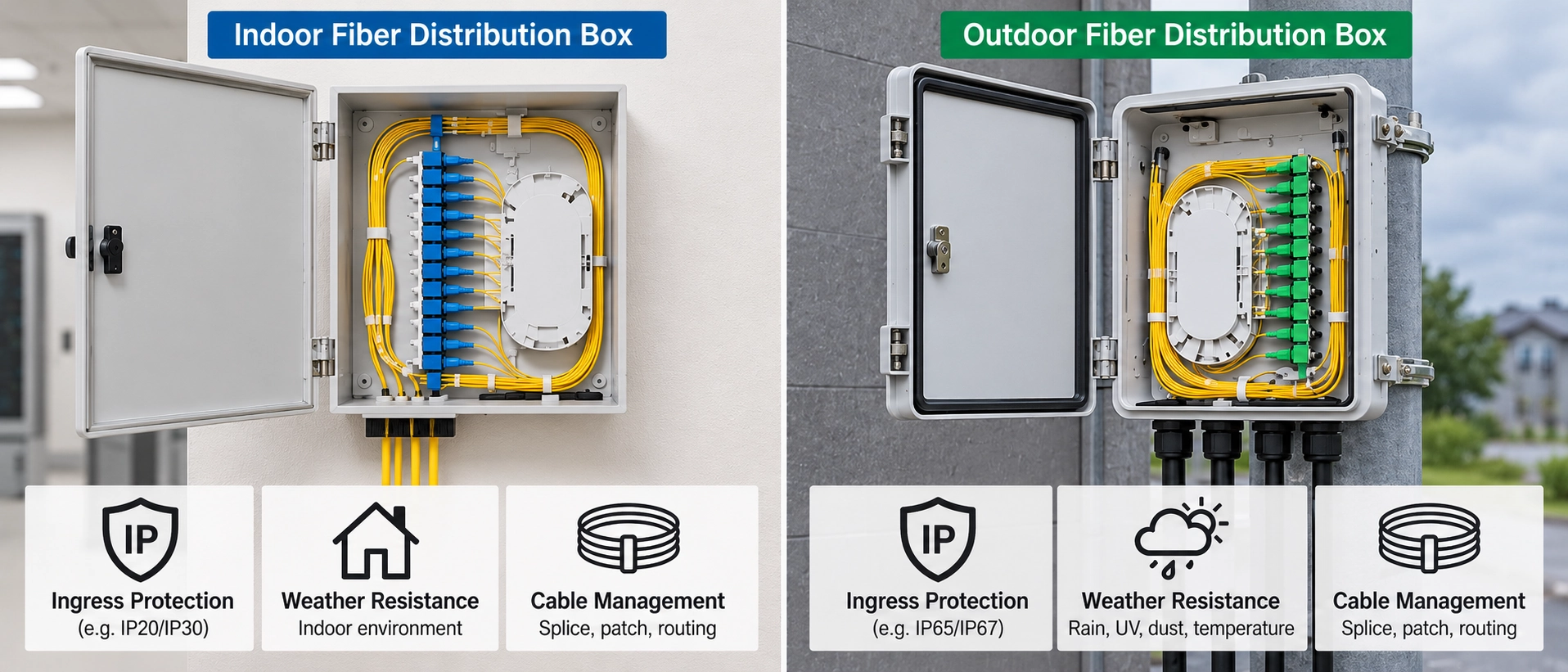
An indoor or outdoor fiber distribution box should be selected against the conditions at its installation point. The useful comparison is whether its enclosure, cable entries, mounting hardware, and service arrangement meet those conditions. An "outdoor" label or IP code alone leaves important questions unanswered.
Outdoor exposure adds weathering, water-entry, and mounting questions to the review. In a controlled indoor location, routing, working access, and building requirements may take priority. An unconditioned indoor space still needs a moisture and temperature review. This comparison focuses on sealing, material evidence, and maintenance access, without assigning universal IP ratings, temperatures, or service lives.
Compare Six Decision Factors Before Choosing a Model
Start by comparing the requirements below. These are questions for a configuration review, rather than specifications shared by every indoor or outdoor product.
| Decision factor | Protected indoor location | Outdoor or environmentally exposed location |
|---|---|---|
| Site conditions | Confirm whether temperature, humidity, dust, and cleaning exposure are controlled | Record rain, sunlight, temperature changes, pollution, and any flooding risk |
| Enclosure protection | Match protection to the actual room and building requirements | Match documented ingress protection to the specified exposure and installed configuration |
| Materials | Check housing-material flammability evidence and applicable local building requirements | Also request evidence addressing weathering and relevant corrosion exposure |
| Cable entries | Check routing, entry compatibility, and mechanical retention | Review those items together with the sealing arrangement for occupied and unused entries |
| Mounting | Confirm the wall, cabinet, or other approved mounting arrangement | Confirm the approved wall or pole kit, orientation, and associated hardware |
| Maintenance | Check access after fibers and components are installed | Also establish how the environmental seal is restored after service |
An outdoor-rated enclosure may be suitable indoors, but its environmental rating does not establish compliance with every building requirement. Likewise, installing an indoor box beneath a canopy does not establish outdoor suitability. Both decisions need confirmation for the model and location.
Define the Exposure Before Choosing the Box
Describe the installation point before comparing catalog labels. For procurement, it helps to distinguish four situations: controlled indoor rooms, uncontrolled indoor spaces, sheltered outdoor positions, and directly exposed outdoor positions. These are practical review categories, not standardized enclosure classes.
An enclosed equipment room and an unconditioned basement may both be indoors, while presenting different questions about moisture, temperature, and access. An entrance canopy and an exposed pole also require different exposure descriptions. For building network context, refer to the MDU fiber cabling layout.
Use a site record that identifies the following:
| Site input | Information to record |
|---|---|
| Position | Room, corridor, basement, exterior wall, or pole; include photographs |
| Water | Rain, wind-driven spray, cleaning water, runoff, and possible flooding |
| Sunlight | Direct exposure, shading, and changes in shading during the day |
| Temperature and humidity | Project design conditions and whether the space is conditioned |
| Contaminants | Dust, salt-bearing air, chemicals, or other site-specific exposure |
| Access | Working clearance, public access, and restrictions on maintenance |
Sheltered Locations Still Need an Exposure Check
A roof or canopy answers only part of the exposure question. Ask whether water can reach the box from the side, whether cleaning reaches the installation point, and whether the space remains humid when temperatures fall.
External ingress and internal condensation need separate review. nVent HOFFMAN's enclosure technical guide discusses condensation and moisture drawn through gasket areas after abrupt temperature drops. This is electrical-enclosure guidance, not evidence that a particular passive fiber box has the same behavior. It supports asking for a design-specific explanation rather than prescribing a heater, vent, or drain. (nVent HOFFMAN)
Where moisture cycling is relevant, ask the box manufacturer how the proposed configuration addresses it. Request a written explanation identifying whether the design relies on sealing, an approved vent or drain, or another provision, and what limitations apply under the recorded site conditions. Any vent, drain, or other modification needs approval for that design and its required protection.
What IP Ratings Establish-and What They Leave Open
In an IP code, the first characteristic numeral concerns access to hazardous parts and ingress of solid objects, including dust; the second concerns harmful water ingress. Read the stated code against its test conditions, rather than treating it as a general environmental certificate.
IEC 60529 defines the IP classification framework for enclosure protection. The public catalog for consolidated Edition 2.2, published in 2013, states its scope as enclosures for electrical equipment with rated voltage not exceeding 72.5 kV. This identifies the standard's scope; it does not establish that a particular fiber box has been tested. Product claims need evidence tied to the supplied model. (IEC)
nVent HOFFMAN's Technical Information (©2020) treats IP protection, UV resistance, corrosion, and impact as distinct evaluation topics. Consequently, an IP claim should not be presented as proof of all-weather suitability. Its documentation concerns its own enclosure products and does not certify another supplier's boxes. (nVent HOFFMAN)
The following evidence requests turn broad marketing descriptions into reviewable requirements:
| Claim being evaluated | Evidence to request |
|---|---|
| Stated IP rating | Model identification, test basis, sample configuration, cable-entry arrangement, and installation conditions |
| Outdoor suitability | Declared application limits and relevant environmental verification |
| UV resistance | Applicable material or product evidence, test conditions, and acceptance criteria |
| Coastal suitability | Evidence appropriate to the exposed materials, hardware, and project environment |
| Condensation management | Explanation of the approved design and its limitations |
For possible immersion, require explicit confirmation of the permitted conditions. Do not treat a generic "waterproof" description as permission for flooded chambers or direct burial.
Compre Sealing, Cable Entry, and Mounting Design
Request a drawing or photographs showing where the enclosure closes, how cables enter, and how the assembly attaches to its support. A closed-box photograph cannot resolve these details. Include close-ups of the cover-to-body sealing interface, occupied and unused cable entries, and the rear mounting points or support bracket.
For the proposed configuration, identify the sealing components and the closure procedure. Ask what must be inspected or replaced after opening. Include unused entries in the review, rather than checking only the holes occupied on the first installation day.
Match the Entry System to the Actual Cable
Cable fit needs more detail than nominal diameter. Supply the cable shape, dimensions, quantity, and the intended entry allocation. A flat drop cable and a round feeder cable should each be checked against the manufacturer's approved entry arrangement.
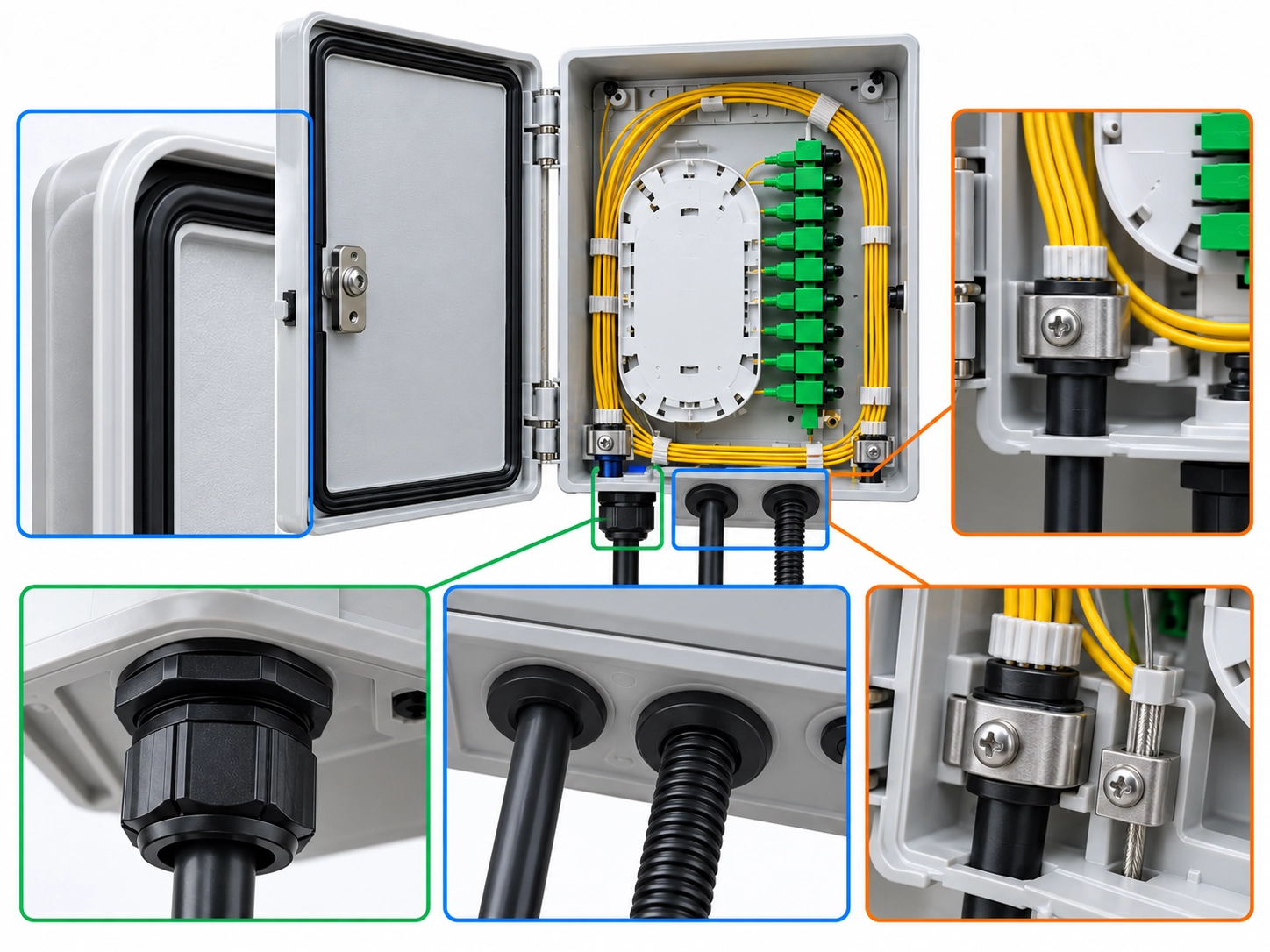
Clearfield's FieldSmart outdoor wall-box manual provides a concrete example: it specifies cable-size-dependent inserts, checks for the fitting O-ring, and describes strain relief separately. Its instructions apply to the listed Clearfield products; their dimensions and installation steps should not be transferred to another enclosure. (Clearfield, Manual 020012 REV B, May 2025)
For comparison, ask two questions: what seals around the cable, and what carries the mechanical load? A photograph should make both arrangements identifiable. If one component performs both functions, request confirmation of its intended use with the selected cable.
Check Wall and Pole Mounting Requirements
Clearfield's manual illustrates why mounting details need model-level review: its 24-port wall box uses a hanging bracket, while the 48-port version uses rear mounting tabs. These are wall-mount examples, not approval for pole mounting.
Treat wall and pole mounting as configurations that need their own hardware confirmation. Request the mounting drawing, approved orientation, cable approach, and working space needed for service.
For a pole location, include pole dimensions and the required bracket or strap arrangement in the inquiry. For a wall location, identify the substrate so the installer can specify suitable fixings. Avoid adding mounting holes through the enclosure unless the manufacturer approves the modification and its effect on protection.
Verify Materials and Environmental Claims by Model
A material name is useful identification, but the product specification still needs application limits. Request the exact enclosure material specification and the evidence behind any weathering claim.
As an example of model-specific documentation, CommScope lists PC-ABS construction, an indoor/outdoor environmental designation, gasket/grommet cable sealing, and an operating range of −40°C to +65°C for BUDI-R24JC1529D. The listed product is a rapid distribution terminal assembly supplied with cable, rather than an empty housing. These are manufacturer-published specifications for that model, not a temperature range for outdoor boxes generally or independent verification of another supplier's product. (CommScope)
For purchasing, keep a separate evidence record for each candidate: model revision, enclosure and seal materials, declared temperature limits, environmental test references, entry components, and approved mounting accessories. Ask whether each temperature statement describes the empty housing or the complete supplied assembly.
Do not infer service life or coastal suitability from the polymer name alone. If supporting documentation is unavailable, record that claim as unverified rather than converting it into a procurement guarantee.
Consider Maintenance Access and Re-Entry
Compare the tasks technicians will actually perform. Connecting a subscriber, inspecting a connector, replacing a splitter, and repairing an internal splice may require different access.
For a re-enterable box, request the opening and resealing procedure. In this comparison, "box" refers to the enclosure under review; a product described as a terminal may provide the connection interfaces within that enclosure. For a terminal with external pre-connectorized interfaces, establish which tasks can be completed externally and which require internal access or replacement. Pre-connectorization alone does not tell you whether the main housing can be opened and resealed.
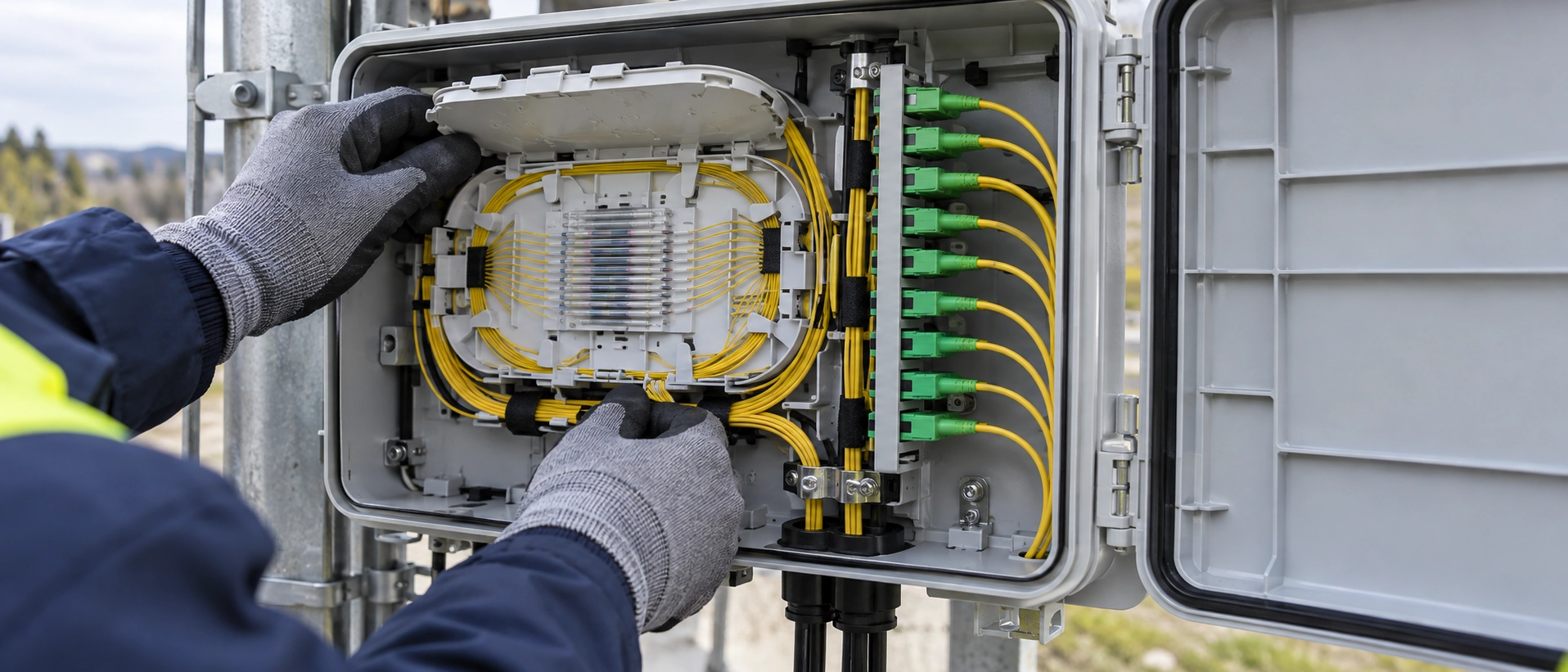
Use a populated layout to review access: ask how a technician reaches the intended connection without disturbing adjacent fibers, and how routing complies with the limits for the actual cable and components. Broader configuration questions are covered in the termination box configuration and acceptance checks.
If internal splice repair or splitter replacement is expected, require a written opening and resealing procedure, including re-entry limits. If subscribers will mainly connect through external ports, confirm which tasks avoid opening the housing and how an internal fault would be repaired or the assembly replaced.
A Scenario-Based Selection Checklist
Use this table to prepare the technical comparison. The confirmation column gives procurement decision rules, not standardized enclosure classes or prescribed ratings.
| Installation scenario | Priority review | Confirmation before ordering |
|---|---|---|
| Controlled indoor room | Building suitability, routing, and working access | Accept only when the indoor application, building requirements, and populated layout are addressed |
| Unconditioned basement or service area | Moisture, temperature changes, and potential water exposure | If moisture or temperature cycling is relevant, require documented limits and an explanation of the approved design |
| Exterior position under a canopy | Actual rain, sunlight, and cleaning exposure | If side rain, cleaning water, or runoff can reach the box, include that exposure in the review; otherwise confirm the declared sheltered application |
| Exposed wall or pole | Weathering, ingress, mounting, and service procedure | Do not approve until weathering, ingress, mounting, and service requirements have configuration-specific support |
| Position with possible flooding | Immersion conditions and intended use | Explicit manufacturer confirmation; reconsider the location if unsupported |
If the box's network role is still undecided, first review fiber distribution box types and functions. This environmental comparison assumes that the required distribution or termination function has already been established.
What to Send for a Configuration Review
Prepare one package containing site photographs and exposure conditions; incoming and outgoing cable details; interface and internal component requirements; mounting dimensions; expected service tasks; and the documents required for acceptance.
Ask for a response identifying the exact model, included accessories, installation restrictions, and evidence applicable to that configuration. Keep unsupported requirements visible until they are resolved.
Send the review package to sales@evoluxfiber.com or use the EVOLUX contact form. Request a reply identifying the proposed model, included entry seals and mounting accessories, installation and maintenance restrictions, and the applicable specification or test documents. Ask that unavailable evidence be identified explicitly so it can be resolved before approval.