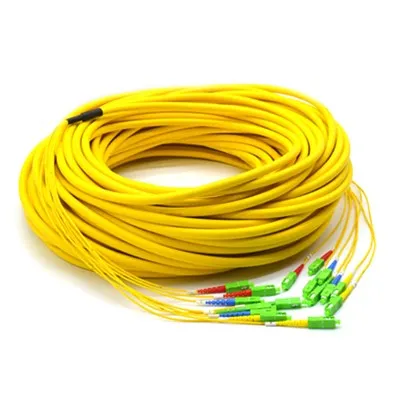
Product Introduction
Fiber optic FC Patch cable is used to attach one device to another for signal routing.
FC stands for Fixed Connection. It is fixed by way of a threaded barrel housing. FC connectors are generally constructed with a metal housing and are nickel-plated.ectors on either end of the cable; some of the most common cable configurations include FC-FC, FC-SC, FC-LC, FC-ST, SC-SC, and SC-ST
Specification
|
Connector Type |
LC/MU/SC/FC/ST/Others |
|
Polishing Type |
UPC/APC 8°/APC 9° |
|
Insertion Loss (dB) |
≤0.20 |
|
Random mating loss (dB) |
Max. 0.12dB mean, Max 0.25dB for 97% of samples |
|
Return Loss (dB) |
UPC ≥ 50, APC ≥ 65 |
|
Wavelength (nm) |
1310/1550 |
|
Installation Temperature (°C) |
-20 to 70 |
|
Storage Temperature (°C) |
-40 to +85 |
Feature
High-speed transmission: They are designed to transmit signals at high speeds, making them ideal for data centers and other high-bandwidth applications.
Low attenuation: low attenuation, ensuring minimal signal loss during transmission.
Durability: Made from durable materials that can withstand harsh environmental conditions and handling.
Interchangeability: Available in various connector types, ensuring interchangeability with different equipment.
Flexibility: They can be molded into different shapes, making them flexible and easy to manage.
Immunity to electromagnetic interference: Immune to electromagnetic interference, ensuring signal quality and stability.
Lightweight: easy to handle and install.
Low power consumption: Require less power than traditional copper cables, reducing energy consumption and cost.
Wide temperature range: Operate in a wide temperature range without affecting signal quality.
Application
Telecommunications Central Offices
The threaded screw-lock mechanism of FC connectors provides secure connections in telecom central offices where cables are frequently accessed. The metal housing withstands repeated mating cycles without degradation.
Industrial and High-Vibration Environments
FC/UPC patch cables with screw-lock design are preferred in factory automation, railway signaling, and outdoor cabinet installations where vibration resistance is critical. The threaded coupling prevents accidental disconnection.
Test and Measurement Labs
Precision testing equipment commonly uses FC interfaces due to their repeatable low-loss connections. This duplex cable supports bidirectional signal analysis for OTDR testing, optical power meter calibration, and network certification.
CATV Headend Facilities
Cable television headend operations rely on FC duplex connections for signal distribution. The nickel-plated metal housing ensures long-term stability in equipment rooms with dense cabling.
Military and Aerospace Communication Systems
FC connectors meet stringent requirements for secure optical connections in defense communication networks. The screw-lock mechanism complies with environments demanding high reliability under shock and vibration.
Frequently Asked Questions
Q1: What makes FC connectors different from LC or SC connectors?
A: FC connectors use a threaded screw-lock coupling mechanism, while LC and SC connectors use push-pull latching. The screw-lock design provides superior resistance to vibration and accidental disconnection, making FC ideal for industrial and telecom central office applications.
Q2: Why does this FC patch cable have a metal housing?
A: The nickel-plated metal housing provides enhanced durability for high-cycle mating, better EMI shielding, and improved mechanical protection compared to plastic housings. This construction is standard for FC connectors used in professional-grade installations.
Q3: What is the typical insertion loss of this FC/UPC duplex cable?
A: This cable is tested to achieve insertion loss ≤0.20dB per mated connector pair, ensuring minimal signal attenuation for long-distance and high-bandwidth transmission.
Q4: Is FC/UPC compatible with FC/APC equipment?
A: No. UPC (Ultra Physical Contact) and APC (Angled Physical Contact) connectors have different ferrule geometries. Mixing UPC and APC will result in high loss and potential damage. Always match polish types.
Q5: What does the 2.0mm cable diameter indicate?
A: The 2.0mm refers to the outer jacket diameter. This is a standard indoor cable size that balances flexibility for routing with sufficient protection for the fiber core.
Q6: Can this duplex cable be used for bidirectional single-fiber transmission?
A: This is a duplex cable with two separate fibers-one for transmit and one for receive in standard full-duplex systems. For single-fiber bidirectional (BiDi) applications, a simplex cable with WDM transceivers would be required.
Q7: What environments are suitable for this FC duplex patch cable?
A: Operating temperature range is -20°C to +70°C. It is designed for indoor use in telecom rooms, data centers, test labs, and equipment cabinets. For outdoor or harsh environments, additional protection may be needed.
Hot Tags: FC/UPC to FC/UPC Single-Mode 9/125 Duplex Fiber Patch Cord, China FC/UPC to FC/UPC Single-Mode 9/125 Duplex Fiber Patch Cord manufacturers, suppliers, factory, fiber optic patch cord for media writers in chief, fiber optic patch cord for shopping mall optical network, high performance fiber optic patch cord, affordable fiber optic patch cord, fiber optic link cable, oem fiber optic patch cord