As a supplier of Fiber Optic ST Pigtails, I often get asked about the refractive index of the fiber used in these pigtails. It's a pretty technical question, but I'll do my best to break it down in a way that's easy to understand.
First off, let's talk about what refractive index actually means. In simple terms, the refractive index is a measure of how much light is bent when it passes from one medium to another. When light travels from a material with a lower refractive index to one with a higher refractive index, it bends towards the normal (an imaginary line perpendicular to the surface). Conversely, when it moves from a higher to a lower refractive index material, it bends away from the normal.
In the context of fiber optic cables, which are used in Fiber Optic ST Pigtails, the refractive index is super important. The fiber in these cables is usually made up of a core and a cladding. The core is where the light travels, and the cladding helps to keep the light inside the core by using total internal reflection.
The refractive index of the core is higher than that of the cladding. This difference in refractive index is what allows the light to bounce off the boundary between the core and the cladding and stay confined within the core as it travels through the fiber. The specific refractive index values can vary depending on the type of fiber, but typically, the refractive index of the core in a single - mode fiber used in our Fiber Optic ST Pigtails is around 1.45 to 1.48, while the refractive index of the cladding is slightly lower, usually around 1.44 to 1.47.
For multimode fibers, the refractive index profile can be a bit more complex. There are two common types of refractive index profiles in multimode fibers: step - index and graded - index. In a step - index multimode fiber, the refractive index of the core is uniform, and there's a sudden drop in the refractive index at the core - cladding boundary. This can cause some issues with modal dispersion, where different modes of light (different paths that the light can take through the fiber) arrive at the end of the fiber at different times.
On the other hand, graded - index multimode fibers have a refractive index that gradually decreases from the center of the core to the core - cladding boundary. This helps to reduce modal dispersion because the light rays that travel near the outer part of the core, which have a longer path length, also travel faster due to the lower refractive index in that area. As a result, all the light rays tend to arrive at the end of the fiber at approximately the same time.
Why does all of this matter? Well, the refractive index affects the performance of our Fiber Optic ST Pigtails. If the refractive index values are not properly matched, it can lead to signal loss. For example, if there's an issue with the refractive index difference between the core and the cladding, the light might not be effectively confined within the core, and it could leak out, causing attenuation (a weakening of the signal) over the length of the fiber.
As a supplier, we make sure to use high - quality fibers with well - controlled refractive indices. This ensures that our Fiber Optic ST Pigtails provide reliable and efficient signal transmission. We test each pigtail thoroughly to guarantee that it meets the industry standards for refractive index and other important parameters.
Now, let's take a look at some other types of fiber optic pigtails that we also supply. We have Fiber Optic Lc Pigtails, which are popular for their small form factor and high - density applications. These pigtails use the LC connector, which is known for its low insertion loss and good return loss characteristics.
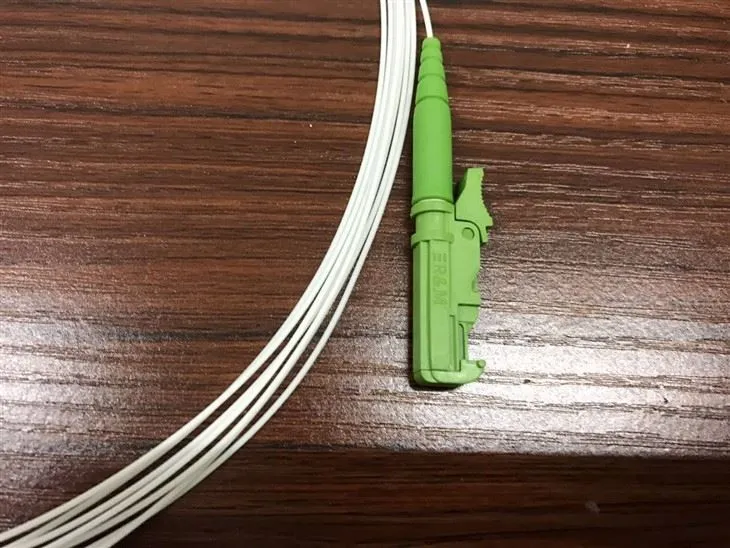
Another option is the Fiber Optic E2000 Pigtail. The E2000 connector has a shutter mechanism that protects the ferrule from dust and contamination, making it a great choice for environments where cleanliness is crucial.
We also offer Fiber Optic Pigtail Lc Upc Om3 12 Colors. These pigtails use OM3 fiber, which is designed for high - speed data transmission applications. The 12 - color option makes it easy to identify different fibers in a multi - fiber setup.
If you're in the market for fiber optic pigtails, whether it's our Fiber Optic ST Pigtails or any of the other types I mentioned, we're here to help. Our team of experts can answer all your questions about refractive index, fiber types, connectors, and more. We can also provide you with samples so you can test the performance of our products in your own applications.

Don't hesitate to reach out to us if you're interested in making a purchase or having a discussion about your fiber optic needs. We're committed to providing the best quality products and the most professional service.
References:
- “Fiber Optics: Principles and Applications”
- Industry standards for fiber optic cables and connectors