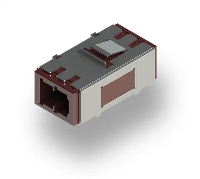
In the realm of fiber optic communication, ST couplers play a crucial role in ensuring seamless connections. As a trusted supplier of Fiber Optic ST Couplers, I often encounter questions regarding the differences between single - mode and multi - mode Fiber Optic ST Couplers. Understanding these differences is essential for customers to make informed decisions when it comes to their fiber optic network requirements.
Physical Characteristics
One of the most noticeable differences between single - mode and multi - mode Fiber Optic ST Couplers lies in their physical design, which is closely related to the type of fiber they are designed to work with. Single - mode fibers have a much smaller core diameter, typically around 9 microns. As a result, single - mode ST couplers are engineered to precisely align and couple these very fine fibers. The tight alignment requirements are necessary to minimize signal loss as the light travels through the small core.
On the other hand, multi - mode fibers have a larger core diameter, usually 50 or 62.5 microns. Multi - mode ST couplers are designed to accommodate these larger cores. The larger core provides more space for light to travel, which means that the alignment requirements for multi - mode ST couplers are relatively less strict compared to single - mode ones. However, this also means that multi - mode ST couplers may have slightly different physical dimensions and tolerances to ensure a proper fit with multi - mode fibers.
Transmission Distance
Transmission distance is a critical factor in fiber optic networks, and it is where the difference between single - mode and multi - mode Fiber Optic ST Couplers becomes particularly significant. Single - mode ST couplers are ideal for long - distance transmissions. The small core of single - mode fibers allows light to travel in a single path, reducing dispersion and attenuation. This means that signals can travel over much longer distances without significant loss of quality. For example, in telecommunications networks, single - mode ST couplers are commonly used for connections between cities or even countries, where distances can range from tens to thousands of kilometers.
In contrast, multi - mode ST couplers are more suitable for short - distance applications. The larger core of multi - mode fibers allows multiple paths for light to travel, which leads to modal dispersion. Modal dispersion causes the light signals to spread out over time, limiting the distance that the signals can travel without significant degradation. Multi - mode ST couplers are often used in local area networks (LANs) within buildings or campuses, where distances are typically less than a few hundred meters.
Bandwidth
Bandwidth refers to the amount of data that can be transmitted over a fiber optic connection in a given period. Single - mode ST couplers offer much higher bandwidth capabilities compared to multi - mode ones. Since single - mode fibers have a single path for light transmission, they can support higher data rates and more complex modulation schemes. This makes single - mode ST couplers well - suited for high - speed data transmission applications such as data centers, where large amounts of data need to be transferred quickly and efficiently.
Multi - mode ST couplers, while still capable of providing significant bandwidth, have limitations due to modal dispersion. The multiple paths of light in multi - mode fibers can cause interference and signal distortion at high data rates. As a result, multi - mode ST couplers are more commonly used in applications where the bandwidth requirements are relatively lower, such as in some office LANs or home networks.
Cost
Cost is always an important consideration when choosing fiber optic components. Single - mode ST couplers are generally more expensive than multi - mode ones. The manufacturing process for single - mode fibers and their associated couplers is more complex due to the precise alignment requirements and the need to minimize signal loss over long distances. Additionally, the equipment used to transmit and receive signals over single - mode fibers, such as lasers, is also more expensive.
Multi - mode ST couplers are more cost - effective, especially for short - distance applications. The larger core of multi - mode fibers makes them easier to manufacture, and the less strict alignment requirements reduce the production costs. For small - scale networks or applications with limited budgets, multi - mode ST couplers can be a more practical choice.
Compatibility
When it comes to compatibility, it is crucial to ensure that the ST couplers are compatible with the rest of the fiber optic network components. Single - mode ST couplers are specifically designed for single - mode fibers and may not work properly with multi - mode fibers. Similarly, multi - mode ST couplers are optimized for multi - mode fibers and may cause significant signal loss if used with single - mode fibers.


It is also important to consider the compatibility with other fiber optic adapters. For example, if you need to connect different types of fiber optic connectors, you may need to use adapters such as the Fiber Optic E2000 Adapter, China Lc Lc Duplex Fiber Optic Adapter, or Factory Price Ftth Networking Lc - lc Duplex Fiber Adapter. These adapters can help ensure a proper connection between different types of fiber optic components, but it is essential to choose the right ones based on the mode (single - mode or multi - mode) of your ST couplers and fibers.
Application Scenarios
The choice between single - mode and multi - mode Fiber Optic ST Couplers depends largely on the specific application scenario. As mentioned earlier, single - mode ST couplers are commonly used in long - distance telecommunications networks, high - speed data centers, and some specialized scientific and military applications. Their ability to support long - distance, high - bandwidth transmissions makes them indispensable in these critical applications.
Multi - mode ST couplers are widely used in local area networks, such as in offices, schools, and hospitals. They are also suitable for home networks and some industrial automation applications where the transmission distance is short and the bandwidth requirements are not extremely high.
Conclusion
In conclusion, the differences between single - mode and multi - mode Fiber Optic ST Couplers are significant in terms of physical characteristics, transmission distance, bandwidth, cost, compatibility, and application scenarios. As a supplier of Fiber Optic ST Couplers, I understand the importance of helping customers choose the right product for their specific needs. Whether you are building a large - scale telecommunications network or a small - scale local area network, it is crucial to carefully consider these differences before making a decision.
If you are in need of high - quality Fiber Optic ST Couplers or have any questions about the selection process, please feel free to contact us. Our team of experts is ready to provide you with professional advice and support to ensure that you get the most suitable fiber optic solutions for your project.
References
- "Fiber Optic Communication Systems" by Govind P. Agrawal
- "Optical Fiber Technology: Principles and Applications" by John Gowar