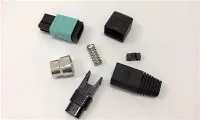
In the realm of fiber optic communication, understanding the cut - off wavelength of Fiber Optic ST Pigtails is crucial for both suppliers and end - users. As a supplier of Fiber Optic ST Pigtails, I am well - versed in the technical nuances of these products and am eager to share in - depth knowledge about the cut - off wavelength.
What are Fiber Optic ST Pigtails?
Before delving into the cut - off wavelength, let's first understand what Fiber Optic ST Pigtails are. ST pigtails are single - fiber cables with an ST connector on one end and a bare fiber on the other. They are widely used in fiber optic networks for splicing with other fibers or connecting to optical devices. The ST connector, with its bayonet - style coupling mechanism, provides a reliable and easy - to - install connection, making it a popular choice in many applications, including local area networks (LANs), data centers, and telecommunications.
The Concept of Cut - off Wavelength
The cut - off wavelength is a fundamental parameter in fiber optics. In simple terms, it is the wavelength above which a fiber optic cable will support only the fundamental mode of light propagation. Below the cut - off wavelength, the fiber can support multiple modes of light, known as multimode operation.
For single - mode fiber optic cables, such as those used in ST pigtails, operating above the cut - off wavelength is essential. This is because single - mode fibers are designed to transmit light in only one mode, which reduces signal dispersion and allows for longer - distance and higher - bandwidth communication. When the light wavelength is below the cut - off wavelength, multimode operation occurs, leading to increased dispersion and a degradation of the signal quality.


Importance of Cut - off Wavelength for Fiber Optic ST Pigtails
The cut - off wavelength has a direct impact on the performance of Fiber Optic ST Pigtails. If the operating wavelength is close to or below the cut - off wavelength, the fiber may experience multimode propagation, even if it is a single - mode fiber. This can result in higher attenuation, increased dispersion, and ultimately, a decrease in the overall transmission quality.
For example, in a high - speed data transmission network, if the ST pigtails are not operating above the cut - off wavelength, the data signals may become distorted, leading to errors in data transfer. This can be particularly problematic in applications where reliability and high - speed data transfer are critical, such as in financial trading systems or large - scale data centers.
Factors Affecting the Cut - off Wavelength
Several factors can affect the cut - off wavelength of Fiber Optic ST Pigtails. One of the most significant factors is the fiber's refractive index profile. The refractive index profile determines how light propagates through the fiber and has a direct influence on the cut - off wavelength. Fibers with different refractive index profiles will have different cut - off wavelengths.
Another factor is the fiber's core diameter. Generally, a larger core diameter will result in a lower cut - off wavelength. This is because a larger core can support more modes of light propagation, and the transition from multimode to single - mode operation occurs at a lower wavelength.
The manufacturing process also plays a role in determining the cut - off wavelength. Variations in the manufacturing process can lead to slight differences in the fiber's physical properties, which can in turn affect the cut - off wavelength. As a supplier, we pay close attention to the manufacturing process to ensure that our Fiber Optic ST Pigtails have consistent and accurate cut - off wavelengths.
Measuring the Cut - off Wavelength
Measuring the cut - off wavelength of Fiber Optic ST Pigtails is a precise process. There are several methods available for measuring the cut - off wavelength, including the 2 - meter method and the bend - insensitive method.
The 2 - meter method involves measuring the optical power at the output of a 2 - meter length of fiber as the input wavelength is varied. The cut - off wavelength is determined by observing the point at which the power in the higher - order modes drops to a certain level.
The bend - insensitive method takes advantage of the fact that the higher - order modes are more sensitive to bending than the fundamental mode. By carefully bending the fiber, the higher - order modes can be selectively attenuated, and the cut - off wavelength can be determined by measuring the power at the output of the fiber as the wavelength is varied.
Cut - off Wavelength and Other Fiber Optic Products
In addition to Fiber Optic ST Pigtails, the concept of cut - off wavelength is also relevant to other fiber optic products. For instance, Fiber Optic E2000 Pigtail and Fiber Optic Lc Pigtails also have specific cut - off wavelengths that need to be considered for optimal performance.
Similarly, Lc Simplex Fiber Patch Cord must operate above their cut - off wavelengths to ensure single - mode operation and high - quality signal transmission. Understanding the cut - off wavelength of these products is essential for system designers and installers to build reliable fiber optic networks.
Our Commitment as a Supplier
As a supplier of Fiber Optic ST Pigtails, we are committed to providing high - quality products with accurate and consistent cut - off wavelengths. We use advanced manufacturing techniques and strict quality control measures to ensure that our ST pigtails meet the highest industry standards.
Our technical team is always available to assist customers in selecting the right Fiber Optic ST Pigtails based on their specific application requirements, including the operating wavelength. We understand that different applications may have different requirements for the cut - off wavelength, and we work closely with our customers to provide customized solutions.
Contact Us for Procurement
If you are in need of high - quality Fiber Optic ST Pigtails or have any questions about cut - off wavelengths and fiber optic products, we encourage you to contact us. Our sales team is ready to discuss your requirements and provide you with detailed product information and pricing. Whether you are building a new fiber optic network or upgrading an existing one, we can help you find the right solutions for your needs.
References
- Ghatak, Ajoy, and K. Thyagarajan. "An Introduction to Fiber Optics." Cambridge University Press, 1998.
- Jeunhomme, Luc B. "Single - Mode Fiber Optics: Principles and Applications." Marcel Dekker, 1990.
- ITU - T Recommendations on fiber optic standards, available from the International Telecommunication Union.