When it comes to fiber optic networks, PLC (Planar Lightwave Circuit) splitters play a crucial role. As a supplier of Fiber Optic PLC Splitters, I've dealt with a ton of questions from customers about what the main standards for these splitters are. So, I thought I'd share some insights on this topic.
Insertion Loss
One of the most important standards for Fiber Optic PLC Splitters is insertion loss. Insertion loss refers to the reduction in optical power as the light signal passes through the splitter. It's usually measured in decibels (dB). A lower insertion loss means less power is lost, which is ideal for maintaining a strong and reliable signal.
The insertion loss of a splitter depends on several factors, including the splitting ratio. For example, a splitter with a 1:2 ratio will generally have a lower insertion loss compared to a 1:32 splitter. As a supplier, we strive to keep the insertion loss as low as possible for all our products. Our 1x32 Plc Fiber Optic Splitter is designed with advanced technology to minimize insertion loss, ensuring high - quality signal transmission.
Uniformity
Uniformity is another key standard. It measures the difference in insertion loss between the output ports of the splitter. In an ideal scenario, all output ports should have the same insertion loss. However, in reality, there will always be some variation.
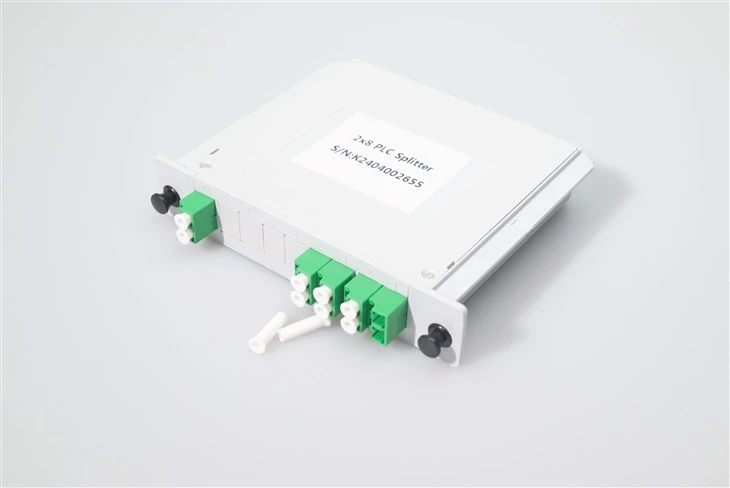
A low uniformity value indicates that the power distribution among the output ports is more even. This is important because it ensures that each connected device receives a consistent signal strength. Our 2*8 Plc Fiber Optic Splitter Cassette Sc Apc is carefully calibrated to achieve excellent uniformity, so you don't have to worry about uneven signal distribution.
Return Loss
Return loss is also a significant standard. It measures the amount of light that is reflected back towards the source. High return loss is desirable because it means less light is being reflected, which can cause interference and degrade the signal quality.
Return loss is affected by factors such as the quality of the optical components and the manufacturing process. At our company, we use high - quality materials and precise manufacturing techniques to ensure high return loss for our splitters. Our 1×2 Plc Fiber Splitter, Mini Module, Sc/apc has a great return loss performance, providing a stable and interference - free signal.
Wavelength Range
The wavelength range of a Fiber Optic PLC Splitter is the range of optical wavelengths over which the splitter can operate effectively. Different applications may require different wavelength ranges.

Most common splitters are designed to work in the 1310nm and 1550nm wavelength ranges, which are widely used in fiber optic communication systems. Our splitters are engineered to cover these standard wavelength ranges, and in some cases, we can also customize products to meet specific wavelength requirements.
Environmental Performance
Fiber Optic PLC Splitters need to perform well in different environmental conditions. Temperature, humidity, and vibration can all affect the performance of the splitters.
We test our products under various environmental conditions to ensure their reliability. For example, our splitters are designed to operate within a wide temperature range, from - 40°C to + 85°C. This makes them suitable for use in both indoor and outdoor environments, whether it's a data center or a harsh outdoor telecom installation.
Packaging and Durability
The packaging of the splitter is also an important consideration. A good packaging design can protect the splitter from physical damage, dust, and moisture.
We use high - quality materials for packaging our splitters. The cassettes and modules are designed to be sturdy and easy to install. This not only ensures the safety of the splitter during transportation but also makes it convenient for you to use in your network.
Compatibility
Fiber Optic PLC Splitters need to be compatible with other components in the fiber optic network, such as connectors and cables.
We offer splitters with different connector types, such as SC, FC, and LC, to meet your compatibility needs. Whether you are using a single - mode or multi - mode fiber system, our splitters can be easily integrated into your existing network.
Cost - effectiveness
Last but not least, cost - effectiveness is a major concern for many customers. As a supplier, we understand that you want high - quality products at a reasonable price.
We optimize our production process to reduce costs without sacrificing quality. This allows us to offer competitive prices for our Fiber Optic PLC Splitters. So, you can get top - notch products without breaking the bank.
In conclusion, when choosing a Fiber Optic PLC Splitter, you need to consider multiple standards, including insertion loss, uniformity, return loss, wavelength range, environmental performance, packaging, compatibility, and cost - effectiveness. As a professional supplier, we are committed to providing products that meet the highest standards. If you are in the market for Fiber Optic PLC Splitters, feel free to contact us for more information and to discuss your specific requirements. We're here to help you find the best solution for your fiber optic network.
References
- "Fiber Optic Communication Systems" by Govind P. Agrawal
- Industry standards and specifications from relevant fiber optic organizations.