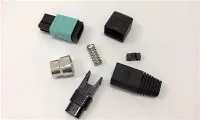
As a supplier of Fiber Optic MPO Patchcords, I understand the critical importance of ensuring the high - performance and reliability of these products. Testing the performance of a Fiber Optic MPO Patchcord is a multi - step process that involves several key aspects. In this blog, I will share with you the methods and procedures for comprehensively testing the performance of Fiber Optic MPO Patchcords.
1. Visual Inspection
The first step in testing a Fiber Optic MPO Patchcord is a visual inspection. This may seem simple, but it can reveal many potential problems.
- Inspect the Connector End - Face: Use a fiber optic microscope to examine the end - face of the MPO connector. Any scratches, dirt, or damage on the end - face can significantly affect the performance of the patchcord. A clean and smooth end - face is essential for efficient light transmission. For example, even a tiny dust particle on the end - face can cause light scattering, leading to increased insertion loss.
- Check the Cable Jacket: Inspect the outer jacket of the patchcord for any signs of cuts, abrasions, or kinks. A damaged cable jacket can expose the internal fiber to environmental factors such as moisture and mechanical stress, which may eventually lead to fiber breakage.
2. Insertion Loss Testing
Insertion loss is one of the most important performance parameters of a Fiber Optic MPO Patchcord. It measures the amount of optical power loss when light travels through the patchcord.
- Testing Equipment: To measure insertion loss, we typically use an optical light source and an optical power meter. The optical light source emits light at a specific wavelength (commonly 850nm, 1310nm, or 1550nm), and the optical power meter measures the power of the light before and after passing through the patchcord.
- Testing Procedure: First, connect the optical light source to one end of the MPO patchcord and the optical power meter to the other end. Measure the power of the light at the input end ($P_{in}$) and the output end ($P_{out}$). The insertion loss ($IL$) can be calculated using the formula $IL = 10\times\log_{10}(\frac{P_{in}}{P_{out}})$ (in dB). A low insertion loss indicates better performance. For a high - quality MPO patchcord, the insertion loss should be within the specified range, usually less than 0.5dB per connection.
3. Return Loss Testing
Return loss, also known as reflection loss, measures the amount of light that is reflected back from the connector interfaces. High return loss is crucial to prevent signal interference and ensure the stability of the optical communication system.
- Testing Equipment: An optical time - domain reflectometer (OTDR) or a return loss tester can be used to measure return loss. The OTDR sends a short optical pulse into the fiber and measures the back - reflected light. The return loss tester, on the other hand, directly measures the reflected power.
- Testing Procedure: Connect the testing equipment to one end of the MPO patchcord. The equipment will measure the amount of reflected light and calculate the return loss. A high return loss value (e.g., greater than 50dB) indicates that most of the light is transmitted through the patchcord and only a small amount is reflected back.
4. Bandwidth Testing
Bandwidth is an important parameter that determines the data - carrying capacity of a Fiber Optic MPO Patchcord. It indicates the range of frequencies over which the patchcord can transmit data effectively.
- Testing Equipment: A network analyzer or a specialized fiber optic bandwidth tester can be used to measure the bandwidth of the patchcord. These devices send a series of test signals with different frequencies through the patchcord and measure the response of the patchcord at each frequency.
- Testing Procedure: The testing equipment will sweep a range of frequencies and measure the attenuation of the signals at each frequency. The bandwidth is defined as the frequency range within which the attenuation is below a certain threshold. A higher bandwidth means that the patchcord can support higher - speed data transmission.
5. Environmental Testing
Fiber Optic MPO Patchcords are often used in various environmental conditions. Therefore, it is necessary to test their performance under different environmental factors.
- Temperature Testing: Place the patchcord in a temperature - controlled chamber and subject it to different temperatures, typically ranging from - 20°C to 70°C. Measure the insertion loss and return loss at each temperature. The performance of the patchcord should remain stable within the specified temperature range.
- Humidity Testing: Expose the patchcord to high - humidity environments (e.g., 85% relative humidity) for a certain period of time. Then, measure the insertion loss and return loss to check if the performance of the patchcord is affected by moisture.
- Vibration and Shock Testing: Use a vibration table or a shock tester to simulate the vibration and shock that the patchcord may encounter during transportation or installation. Measure the performance of the patchcord before and after the vibration and shock tests to ensure its mechanical stability.
6. Conclusion and Call to Action
In conclusion, testing the performance of a Fiber Optic MPO Patchcord is a comprehensive process that involves visual inspection, insertion loss testing, return loss testing, bandwidth testing, and environmental testing. By conducting these tests, we can ensure that our Fiber Optic MPO Patchcords meet the highest quality standards and provide reliable performance in various applications.
If you are interested in our Fiber Optic MPO Patchcords or other related products such as Sc/upc - sc/upc Ftth Drop Patch Cable, Fiber Optic Patch Cord Lc To Lc Upc Duplex Single Mode, and Fiber Optic Fc Patch Cable, please feel free to contact us for more information and to discuss your procurement needs. We are committed to providing you with the best products and services.


References
- "Fiber Optic Test and Measurement Handbook", by Telcordia Technologies
- "Optical Fiber Communication Systems", by Gerd Keiser