Hey there! As a supplier of fiber optic patch cords, I get asked all the time about how to choose the right connector for these cords. It's a crucial decision, and in this blog, I'm gonna break down the key factors to consider so you can make an informed choice.
First off, let's talk about the different types of connectors available. There are quite a few out there, but some of the most common ones include LC, SC, ST, and FC. Each of these connectors has its own unique features and applications, so it's important to understand what sets them apart.


The LC connector is super popular these days. It's small and compact, which makes it ideal for high - density applications. If you're working in a data center where space is at a premium, the LC connector is a great option. You can check out our FIBER OPTIC PATCH CORD LC TO LC UPC DUPLEX SINGLE MODE for a high - quality example of an LC - terminated patch cord. It offers low insertion loss and high return loss, which means better signal transmission.
The SC connector, on the other hand, is a bit larger than the LC. It's easy to use and has a push - pull mechanism, making it suitable for both single - mode and multi - mode applications. It's often used in telecommunications and LAN networks.
The ST connector has a bayonet - style coupling mechanism. It's been around for a while and is still used in some legacy systems. It's known for its reliability and ease of installation, but it's not as popular in modern high - density setups as the LC and SC connectors.
The FC connector has a screw - type coupling mechanism. It's typically used in single - mode applications where high precision is required, such as in long - haul telecommunications and some industrial applications.
Now, let's consider the end - face finish of the connector. There are two main types: UPC (Ultra Physical Contact) and APC (Angled Physical Contact). UPC connectors have a flat end - face and are suitable for most general - purpose applications. They provide good performance at a reasonable cost. APC connectors, on the other hand, have an angled end - face. This design reduces back - reflection, which is crucial in applications where high - power lasers are used, like in some long - distance fiber optic links.
Another important factor is the mode of the fiber optic patch cord. There are single - mode and multi - mode fibers. Single - mode fibers are designed to carry a single ray of light, which allows for long - distance transmission with low signal loss. They're commonly used in telecommunications networks that span large distances. Multi - mode fibers, on the other hand, can carry multiple rays of light simultaneously. They're suitable for shorter - distance applications, such as in local area networks (LANs) within a building.
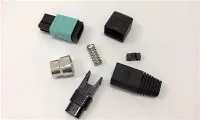
The number of fibers in the patch cord also matters. You can get single - fiber patch cords, which are useful for point - to - point connections. Duplex patch cords, as the name suggests, have two fibers and are often used for bi - directional communication. There are also multi - fiber patch cords, like the Fiber Optic MPO Patchcord, which can have anywhere from 4 to 72 fibers. These are great for high - density data center applications where multiple connections need to be made quickly and efficiently.
The environment in which the patch cord will be used is also a consideration. If it's going to be in a harsh environment, such as an industrial setting with a lot of dust, moisture, or vibrations, you'll need a connector that's rugged and can withstand these conditions. Some connectors come with additional protective features, like dust caps and ruggedized jackets.
The MU connector is another option to consider. It's a small - form - factor connector, similar to the LC but with some unique features. The Fiber Optic MU Patchcord is a great choice for high - density applications where space is limited and you need a reliable connection.
Compatibility is key. You need to make sure that the connector on the patch cord is compatible with the equipment it will be connected to. Check the specifications of your network devices, such as switches, routers, and servers, to ensure that the connector type and fiber mode match.
Cost is always a factor. While you don't want to skimp on quality, you also need to find a balance between performance and price. Sometimes, a more expensive connector might offer better performance, but it might not be necessary for your specific application. Evaluate your needs carefully and choose a connector that meets your requirements without breaking the bank.
In conclusion, choosing the right connector for a fiber optic patch cord involves considering multiple factors, including the connector type, end - face finish, fiber mode, number of fibers, environment, compatibility, and cost. By taking the time to understand these factors, you can select the connector that's best suited for your specific application.
If you're in the market for fiber optic patch cords and need help choosing the right connector, or if you have any other questions, don't hesitate to reach out. We're here to assist you in making the best decision for your network. Let's start a conversation and find the perfect fiber optic patch cord solution for you!
References:
- "Fiber Optic Communication Systems" by Govind P. Agrawal
- Industry standards and guidelines for fiber optic connectors and patch cords.