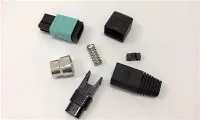
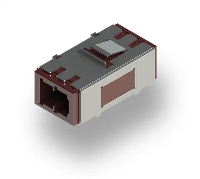
Fiber optic SC adapters are a crucial component in modern fiber optic networks, facilitating the connection between fiber optic cables. One of the most common questions we, as a fiber optic SC adapter supplier, encounter is whether these adapters are suitable for single - mode or multi - mode fiber. To answer this question comprehensively, we need to understand the characteristics of both single - mode and multi - mode fiber, as well as the design and functionality of fiber optic SC adapters.
Understanding Single - Mode and Multi - Mode Fiber
Single - mode fiber (SMF) is designed to carry a single ray of light, or mode, directly down the fiber core. It has a very small core diameter, typically around 9 microns. Due to its narrow core, single - mode fiber allows for long - distance transmission with minimal signal loss and dispersion. This makes it ideal for applications such as telecommunications, long - haul data transmission, and high - speed internet backbones. The light source used in single - mode fiber is usually a laser, which emits a highly focused beam of light that can travel several kilometers without significant degradation.
On the other hand, multi - mode fiber (MMF) has a larger core diameter, typically 50 or 62.5 microns. It can carry multiple modes of light simultaneously, which means that different rays of light can travel through the fiber at different angles. This characteristic allows for higher bandwidth over shorter distances. Multi - mode fiber is commonly used in local area networks (LANs), data centers, and short - distance communication systems. The light source for multi - mode fiber is often an LED, which is less expensive and easier to couple into the larger core.
Fiber Optic SC Adapters: Design and Functionality
Fiber optic SC adapters are a type of connector that uses a push - pull mechanism for easy installation and removal. They are designed to align the cores of two fiber optic cables precisely, ensuring efficient light transmission between them. SC adapters are known for their low insertion loss, high return loss, and excellent repeatability.


The design of SC adapters is such that they can be used with both single - mode and multi - mode fibers. However, there are some key differences in the specifications and performance when used with these two types of fibers.
Suitability for Single - Mode Fiber
When it comes to single - mode fiber, the precision requirements are extremely high. The small core diameter of single - mode fiber means that even a slight misalignment can cause significant signal loss. Fiber optic SC adapters designed for single - mode fiber are manufactured with high - precision components to ensure accurate alignment of the fiber cores.
These single - mode SC adapters typically have a lower insertion loss, which is crucial for long - distance transmission. Insertion loss refers to the amount of light that is lost when passing through the adapter. For single - mode applications, insertion losses are usually in the range of 0.2 to 0.3 dB. Additionally, single - mode SC adapters have a high return loss, which measures the amount of light that is reflected back towards the source. A high return loss is desirable as it indicates that less light is being reflected, reducing the potential for signal interference.
Single - mode SC adapters are also designed to work with the specific wavelengths used in single - mode fiber systems, such as 1310 nm and 1550 nm. These wavelengths are optimized for long - distance transmission and are commonly used in telecommunications and data center backbones.
Suitability for Multi - Mode Fiber
Multi - mode fiber has different requirements compared to single - mode fiber. Since multi - mode fiber can carry multiple modes of light, it is more tolerant of slight misalignments. Fiber optic SC adapters for multi - mode fiber are designed to meet these less stringent alignment requirements.
The insertion loss for multi - mode SC adapters is generally slightly higher than that of single - mode adapters, typically in the range of 0.3 to 0.5 dB. This is acceptable for the shorter distances used in multi - mode applications. The return loss for multi - mode SC adapters is also lower compared to single - mode adapters, but still sufficient to ensure reliable communication.
Multi - mode SC adapters are designed to work with the wavelengths commonly used in multi - mode fiber systems, such as 850 nm and 1300 nm. These wavelengths are optimized for short - distance transmission and are suitable for LANs and data centers.
Comparison with Other Fiber Optic Adapters
In addition to SC adapters, there are other types of fiber optic adapters available in the market, such as Fiber Optic Lc Adapters, Fiber Optic Mtrj Adapter, and Fiber Optic Mpo Adapter. Each type of adapter has its own advantages and disadvantages, and the choice depends on the specific application requirements.
LC adapters are smaller in size compared to SC adapters, making them suitable for high - density applications. MTRJ adapters are compact and offer a quick - connect feature, but they are less commonly used due to their relatively higher insertion loss. MPO adapters are designed for multi - fiber applications, allowing for the connection of multiple fibers at once, which is useful in data centers and high - speed networks.
Conclusion
In conclusion, fiber optic SC adapters are suitable for both single - mode and multi - mode fibers. However, the specific requirements and performance characteristics differ depending on the type of fiber being used. For single - mode applications, SC adapters need to provide high - precision alignment, low insertion loss, and high return loss to ensure efficient long - distance transmission. For multi - mode applications, the requirements are less stringent, allowing for slightly higher insertion loss and lower return loss.
As a fiber optic SC adapter supplier, we offer a wide range of products designed to meet the needs of both single - mode and multi - mode fiber applications. Our SC adapters are manufactured to the highest quality standards, ensuring reliable performance and long - term durability.
If you are in the market for fiber optic SC adapters or have any questions about their suitability for your specific application, we encourage you to contact us for a detailed discussion. Our team of experts is ready to assist you in making the right choice for your fiber optic network.
References
- "Fiber Optic Communication Systems" by Govind P. Agrawal.
- "Optical Fiber Technology: Principles and Applications" by R. Ramaswami, K. N. Sivarajan, and G. Sasaki.
- Industry standards and specifications from organizations such as the Telecommunications Industry Association (TIA) and the International Electrotechnical Commission (IEC).