Introduction
Pigtails are commonly known as a hairstyle in which the hair is divided into two sections and worn on either side of the head, either loose, braided, or twisted. The name may sound as if it came directly from the hairstyle's resemblance to a pig's tail, but its history is more complicated. The English word "pigtail" was first associated with twisted tobacco before it was applied to hair, and the same tail-like idea was later adopted in electrical wiring and fiber optics. This article explains where the name came from, what pigtails mean in different contexts, and why a fiber optic pigtail is now an important component in modern optical networks.
Origins of the Name "Pigtails"
The word "pigtail" did not originally describe two ponytails. In English, the term was recorded in the 1680s for tobacco twisted into a tight roll, so named because the twisted bundle resembled a pig's tail. By 1753, "pigtail" was also being used for a braid of hair hanging from the head.
Soldiers and sailors later became strongly associated with the single braided hairstyle, but they were not the original source of the word. This history also explains why modern usage can seem inconsistent. A pigtail originally referred to a single twisted or braided form, while in contemporary English the plural "pigtails" often describes two ponytails or braids worn on opposite sides of the head.
As the word entered other fields, its meaning expanded beyond hair. Short wires, tubes, and fiber assemblies could also be described as pigtails because they extended from a larger component like a small tail.
Why Is a Cable or Fiber Also Called a Pigtail?
In electrical engineering, a pigtail is a short conductor used to connect a device to one or more conductors. The same naming logic later appeared in optical communications, although a fiber pigtail has a more specific construction.
In fiber optics, a pigtail has a factory-terminated optical connector on one end and splice-ready fiber on the other. The open end is normally fusion-spliced or mechanically spliced into the installed fiber, while the connectorized end provides the interface to an adapter, distribution frame, terminal box, or other optical equipment.
This one-ended construction is what separates a fiber optic pigtail from a patch cord. A patch cord is connectorized at both ends and is intended for pluggable connections between equipment or panels. A pigtail is normally used as part of a permanent termination inside an ODF, splice tray, terminal box, or fiber closure. For that reason, choosing a pigtail involves more than simply selecting the connector shape.
Cultural Significance of Pigtails
Throughout history, pigtail-style braids and paired hairstyles have appeared in different cultures and periods, although their meanings vary considerably by place and tradition. Hairstyles can communicate identity, age, social convention, personal style, or group affiliation, so the meaning of pigtails should not be generalized across cultures.
In contemporary Western culture, pigtails are frequently associated with childhood because paired hairstyles are practical for keeping long hair controlled and are commonly worn by children. They have also been used by fictional characters such as Pippi Longstocking and Harley Quinn to create highly recognizable visual identities, showing how the same hairstyle can communicate very different personalities depending on its context.
The technical use of "pigtail" is much more literal. Engineers are not referring to the cultural meaning of the hairstyle; they are using an established word for a short, tail-like extension. In fiber networks, that extension becomes a permanent optical termination after it is spliced into the installed fiber.
What Actually Defines a Fiber Optic Pigtail Type?
Fiber optic pigtails are available in many configurations, but connector name alone is not enough to define the correct product. For procurement, the specification should normally identify the connector interface and polish, fiber type, buffer or jacket construction, fiber count, length, and the acceptance criteria used to verify optical performance.
Connector-based Variations:
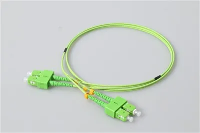
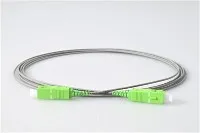
SC Pigtails: SC connectors use a push-pull coupling mechanism and a 2.5 mm ferrule. They are widely used in telecommunications, FTTH, CATV, distribution frames, and other applications where a relatively robust connector interface is required. The installed adapter and required UPC or APC polish should be confirmed before ordering.
LC Pigtails: LC connectors use a compact 1.25 mm ferrule and are commonly selected for high-density patch panels, data centers, telecommunications equipment, and other installations where port density is important.
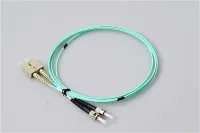
FC and ST Pigtails: FC connectors use a threaded coupling mechanism and remain useful in some industrial, instrumentation, laboratory, and measurement systems where a secure connection is required. ST connectors use a bayonet-style coupling mechanism and are still encountered in legacy LAN, industrial, sensor, and equipment installations. Existing equipment compatibility should be checked before specifying either interface for a new project.
Fiber Mode Variations:
Single-mode fiber pigtails are commonly specified with OS2 fiber for telecommunications, FTTX, backbone, and longer-distance transmission. Current projects may use ITU-T G.652 fiber or bend-insensitive G.657 fiber. G.657 categories are particularly useful where fibers must be routed through compact trays, wall boxes, or other locations with tighter bending conditions, but bend-insensitive fiber should still be selected according to the actual routing geometry rather than treated as a universal upgrade.
Multimode pigtails are available in OM1, OM2, OM3, OM4, and OM5 configurations. OM3 and OM4 are commonly used with short-reach high-speed optical links in buildings and data centers. The pigtail fiber grade should match the installed multimode cabling because mixing fiber categories can make link performance and acceptance testing more difficult to control.
Application-Specific Variations:
Armored Pigtails: Armored versions incorporate additional mechanical protection, often including a metal protective layer or stainless steel tube around the fiber. They can be useful where the pigtail may be exposed to crushing, repeated handling, rodents, or other mechanical risks, but the additional diameter and reduced flexibility must also fit the intended splice tray or enclosure.
Waterproof Pigtails: Outdoor and FTTX installations may require pigtails designed for moisture exposure, sealed enclosures, or harsh environmental conditions. "Waterproof" should not be treated as a complete specification by itself; buyers should confirm the cable construction, sealing method, connector configuration, installation environment, and enclosure requirements before placing an order.
For OEM or bulk orders, optical acceptance criteria should also be written into the RFQ. A statement such as "low insertion loss" does not define how the product will be accepted. IEC 61300-3-4:2023 covers attenuation measurement methods for fiber optic interconnecting devices and passive components, while IEC 61300-3-35:2022 provides procedures and criteria for connector end-face inspection. Connector interfaces are covered by the IEC 61754 series, while current single-mode fiber requirements can reference the applicable ITU-T G.652 or G.657 category.
Two suppliers can therefore quote pigtails with the same connector and nominal insertion-loss limit while supplying materially different products if the fiber category, polish, buffer diameter, test method, end-face acceptance criteria, or length tolerance has not been defined. For custom, OEM, or bulk purchasing, these requirements should be confirmed before comparing price or lead time. See our detailed guide to fiber optic pigtail specifications for the RFQ parameters that should be defined before ordering.
Conclusion
The name "pigtail" has traveled through several meanings. It was recorded in the 17th century for twisted tobacco, was applied to braided hair by the 18th century, and was later adopted by engineers for short tail-like electrical and optical connections. That history explains why the same word can refer to a hairstyle, a short electrical conductor, or a fiber optic component without those meanings having the same technical origin.
For fiber engineers and buyers, the important distinction is simple: a fiber optic pigtail has a connector on one end and splice-ready fiber on the other. Once it is fusion-spliced into an ODF, terminal box, or other fiber distribution system, its connector interface, fiber specification, polish, construction, and test criteria directly affect the reliability of the finished optical link.