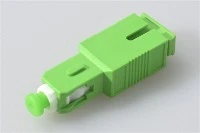
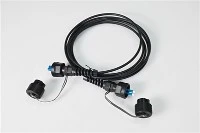
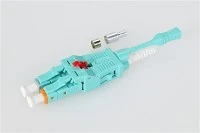
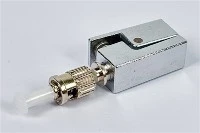
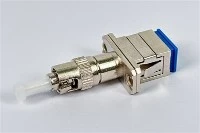
A fiber pigtail is essentially a short, pre-prepared piece of optical fiber-typically 1 to 3 meters in length-with a high-quality, factory-terminated and polished connector on one end (common types include SC, LC, FC, ST, or emerging VSFF like MDC/SN/CS) and bare fiber on the other end. The bare end is designed to be fusion spliced (permanently welded using an electric arc) to a longer backbone cable, distribution cable, drop cable, or feeder fiber in the field. This hybrid approach combines the precision and consistency of factory polishing with the reliability of field fusion splicing, eliminating the need for on-site connector termination, which is often prone to variability and higher loss.
In essence, pigtails serve as the "quick-connect tail" that bridges factory-controlled quality to field-deployed networks. Their core purpose is to deliver the cleanest, lowest-loss, most stable, and longest-lasting optical connections possible-especially in high-stakes environments like FTTH rollouts, data center interconnects (DCI), 5G/FTTR fronthaul, and AI-driven hyperscale fabrics.

Why Fusion Splicing + Pigtails Remains the Preferred Method in 2026
Fusion splicing with pigtails continues to dominate for permanent links because it creates a true glass-to-glass joint. Here's a detailed breakdown of the advantages, updated with 2025–2026 industry data and trends:
Ultra-Low Insertion and Return Loss: Modern core-alignment fusion splices routinely achieve 0.02–0.05 dB insertion loss (average ~0.03 dB in OTDR/OLTS field tests), far superior to mechanical splices (typically 0.2–0.5 dB or higher in real deployments) or field-terminated connectors (0.15–0.3 dB average). Return loss with APC (angled physical contact) polish often exceeds -65 dB, virtually eliminating back-reflections that cause ghost signals, coherent optics instability, or BER spikes in 400G/800G/1.6T systems.
|
Key Decision Factor |
Pre-Terminated Fiber Assemblies |
Fusion Splicing or Splice-on Connectors |
Mechanical Splice Connectors |
Traditional Epoxy/Polish Connectors |
|
Loss/Performance |
GOOD |
GOOD |
MEDIUM |
LOW |
|
Termination Time |
FAST |
SLOW |
MEDIUM |
SLOW |
|
Planning and Lead Time |
SLOW |
FAST |
FAST |
FAST |
|
Equipment and Consumable Cost |
LOW |
HIGH |
MEDIUM |
MEDIUM |
|
Material Cost |
HIGH |
LOW |
LOW |
LOW |
|
Skill Level |
LOW |
MEDIUM |
MEDIUM |
HIGH |
|
Risk of Contamination |
LOW |
LOW |
MEDIUM |
HIGH |
|
MPO Application |
YES |
YES |
NO |
NO |
Link Budget Savings and Extended Reach: Each low-loss splice saves 0.1–0.4 dB compared to alternatives. In large-scale networks, this stacks up: 0.5–1.5 dB total savings across 10–20 splice points can extend passive spans by kilometers, reduce or eliminate amplifiers/repeaters, and cut CapEx significantly. Real-world examples from 2025 FTTH projects show 15–30% backbone cost reductions; in hyperscale DCI, it provides critical headroom for AI traffic surges without immediate upgrades.
High-Speed and Coherent Optics Compatibility: For 100G to 1.6T+ Ethernet and coherent DWDM, low loss + high return loss keeps bit error rate (BER) - the fraction of bits in error - below 10^-12 or better without FEC overload. It also minimizes polarization mode dispersion (PMD) (signal distortion from fiber birefringence), which is critical in PAM4 modulation at high baud rates. Bend-insensitive OS2 pigtails further reduce PMD penalties in tight 100–500m runs.
Exceptional Long-Term Reliability and Durability: The glass-to-glass fusion creates a permanent bond-no index-matching gel to dry out, contaminate, migrate, or degrade over time (a common mechanical splice failure mode after 5–10 years of thermal cycling or humidity exposure). Fusion splices meet or exceed Telcordia GR-20/GR-326 (optical performance) and GR-63 (vibration/shock in central office/outside plant environments), surviving -40°C to +85°C, high humidity, and decades of service with near-zero maintenance. Field track records show 30+ years of stability, slashing Opex compared to mechanical alternatives that can drift 0.1–0.2 dB.
Field Efficiency, Speed, and Error Reduction: With modern core-alignment splicers (Fujikura 90S series, Sumitomo Z2C/Q102, INNO View series), a trained tech can complete a 12-fiber splice tray in under 30 minutes. This cuts provisioning time 40–60% versus field termination or mechanical methods. Rework rates drop from 2–5% to <0.5% thanks to active V-grooves, auto-cleave detection, and factory-consistent pigtail ferrules. Fewer truck rolls mean faster turn-up and quicker revenue in FTTH.
Standards Compliance and Funding Eligibility: Pigtails + fusion align with ITU-T G.652/G.657 (bend-insensitive single-mode), G.671 (transmission), and IEC 61300/61753 specs (max splice attenuation ~0.1 dB, real averages much lower). In the U.S., this supports BEAD (Broadband Equity, Access, and Deployment) funding eligibility-$42.45B program rolling out in 2026-by proving scalable, low-loss, gigabit+ networks that minimize future upgrades.
Scalability for AI/Data Center and Future Upgrades: Pre-terminated pigtails (especially LC/APC or VSFF like MDC/SN/CS) simplify MPO breakouts for 800G/1.6T without full re-splicing. Bend-insensitive fibers handle micro-bends in dense trays, essential as AI clusters push fiber counts per rack higher.
Sustainability Advantages: Lower loss reduces active repeaters/amplifiers, cutting power draw and carbon footprint-aligning with ESG reporting, data center PUE (Power Usage Effectiveness) targets (lower number = better efficiency), and 2026 green optics mandates.

Potential Drawbacks and Real-World Risks of Fusion Splicing + Pigtails
No method is perfect-here are the honest downsides, based on field experience and 2025–2026 reports:
High Initial Investment: A quality core-alignment splicer costs $5,000–$15,000+ (e.g., Fujikura 90S ~$10k–$12k, Sumitomo Q102 ~$9k–$11k, INNO View 5 ~$3.6k–$4k entry-level), plus cleavers, batteries, and accessories. For small crews or low-volume jobs, this can be prohibitive.
Training and Skill Dependency: Operators need hands-on certification (e.g., FOA CFOT or vendor-specific training) and practice for consistent low-loss results. Poor cleaves, dirty fibers, or misalignment cause high-loss splices (>0.1 dB) or outright failures. Contamination (dust, oil, moisture) during prep is the #1 cause of bad splices.
Common Failure Modes and Statistics:
Contamination: Dust/debris on ends or V-grooves leads to offsets and high loss; preventable with isopropyl alcohol wipes and inspection scopes.
Vibration/Mechanical Stress: In harsh OSP (outside plant) like cell sites or rail, unprotected splices can degrade over time (though fusion is far more resilient than mechanical). Studies show vibration can cause intermittent loss if ferrules pivot or debris enters.
Other Issues: Arc calibration drift, poor heat shrink protection, or environmental extremes (e.g., extreme cold affecting arc stability). Field stats: rework from contamination ~1–3% in well-managed crews, higher in rushed/remote jobs.
Rare but costly: splice failure requiring re-trenching or tower climbs.
For low-volume, emergency repairs, or unskilled teams, mechanical splices remain faster/cheaper upfront, though they risk higher long-term loss drift.

2025–2026 Developments in Mechanical and Advanced Connectors
Fusion + pigtails lead for permanent, high-performance links, but alternatives evolve:
Mechanical Splicing: Quick (no power/arc needed), lower skill barrier, loss now 0.1–0.3 dB in premium models with better gels/alignment. Still drifts from gel aging/thermal cycling; best for temporary fixes, drop cables, or rapid repairs.
VSFF (Very Small Form Factor) Connectors (MDC, SN, CS, MMC): Exploding in 2025–2026 for 800G/1.6T data centers. SN (Senko) offers highest density (3x LC), MDC (US Conec) widest ecosystem support (Cisco, Corning), CS for long-reach. Expanded Beam Optical (EBO, e.g., 3M) reduces contamination sensitivity via non-contact coupling. These enable direct patching in modular setups, sometimes reducing pigtail fusion needs in controlled environments, but fusion still wins for backbone reliability.
Choose hybrid: fusion for core/permanent, VSFF/mechanical for edges/high-density patching.

Common Application Scenarios with Real-World Impact
Optical Distribution Frames (ODF): Backbone spliced to pigtails in protected rear trays; front connectors patch flexibly. TIA-598 color coding (blue=1, orange=2, etc.) cuts troubleshooting 70–80%.
|
Metric |
Mechanical/Field-Term |
Pigtail Fusion |
Improvement |
|
Avg. Per-Core Loss (dB) |
0.25–0.35 |
0.03–0.08 |
75–85% lower |
|
Fault Isolation Time (min/event) |
90–150 |
20–35 |
70–80% faster |
|
Annual Opex per 1,000 Cores (USD) |
$1,200–$1,800 |
$300–$500 |
65–75% savings |
FTTH/FTTx Last-Mile: Pigtails in pedestals/boxes reduce activation time 40–60%, loss by 0.7–1.2 dB. U.S. hit 98.3M FTTH passings in 2025 (11.8M added), on track for 80%+ households by 2028; BEAD 2026 rollout accelerates rural.
Data Center High-Density: APC pigtails in MPO-LC breakouts for spine-leaf; VSFF emerging for 800G+.
Other: OTDR testing launches, armored for harsh (cell sites/industrial), APC for CATV reflection control.

This chart or table illustrates metric comparisons, such as average loss, fault isolation time, and Opex savings, between mechanical/field-term methods and pigtail fusion splicing.
Selection Guidelines for 2026 Projects
Polish: UPC (-50 dB RL) short/multimode; APC (≥-60 dB) single-mode/high-speed/long-haul.
Fiber: OS2 yellow single-mode long-distance/low-loss; OM3/OM4 aqua multimode short-reach.
Quality: Vendors with consistent ferrule geometry; batch-test for uniformity.

This guide image outlines selection criteria for fiber pigtails, including polish types (UPC vs. APC), fiber types (OS2, OM3/OM4), and quality considerations for 2026 projects.
The Strategic Business Case in 2026
In a world of exploding AI traffic, 5G/FTTR expansion, and BEAD-fueled builds, fiber pigtails with disciplined fusion splicing remain one of the highest-ROI choices: lower TCO through speed, low loss, minimal maintenance, and scalability to 1.6T+. Balance upfront costs/training with long-term gains, and consider hybrids where mechanical/VSFF fit. This approach ensures reliable, future-proof networks that deliver gigabit+ experiences while controlling costs and supporting sustainability goals.