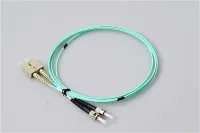
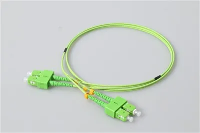
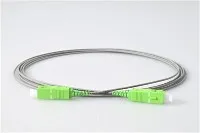
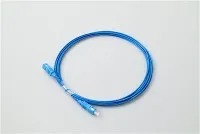
1.SC Optical Fiber Jumper: Developed by NTT Corporation of Japan, the structure and size of its pin and coupling sleeve are exactly the same as those of FC type. The large square jumper is the SC type optical fiber jumper, which is the optical fiber jumper with square SC connectors at both ends. Originally used for Gigabit Ethernet networks, the large square patch cord was standardized in 1991 as the telecommunications specification TIA-568-A, and has gradually become widely used as manufacturing costs have fallen. Square jumpers are generally used in data communications and telecommunications, including point-to-point and passive optical networks.
The large square jumper adopts a standard square joint, plugging and unplugging pin latch fastening method, which does not need to be rotated, the plugging and unplugging operation is very convenient, and the intervention loss fluctuation is small, and it has the advantages of strong compression resistance and high installation density. The connector commonly used as a GBIC optical module is often used in routers, and has the characteristics of low price and small fluctuation of access loss. When telecom companies pull optical fibers at home, they generally splice the pigtail of the SC interface, which is used with the SC socket on the optical modem, and this kind of plug is generally used on the optical fiber transceiver.

2. LC fiber optic patch cord: developed by BELL Research Institute, the joint is similar to SC and smaller than SC. The small square jumper is the LC type fiber optic jumper, which is the optical fiber jumper with small square LC connectors at both ends. The small square jumper adopts an easy-to-operate modular jack latch, and the size of the pin and sleeve is 1.25mm, which is half the size used in ordinary SC and FC. Plug and play, is the most popular small fiber optic patch cord, which can effectively reduce the use of space and is suitable for high-density connections. Connecting SFP optical modules, which are often used in routers, can improve the density of optical fiber connectors in optical fiber distribution frames to a certain extent.

3.FC Fiber Optic Patch Cord: Originally developed by NTT in Japan, FC is the abbreviation of English Ferrule Connector, the external protective sleeve is a metal sleeve, and the fastening method is a screw buckle. Generally, it is used on the ODF side, and it is most used on the patch panel. It has the advantages of strong fastening and dustproof. The round head jumper is the FC type fiber optic jumper, which is the fiber optic jumper with circular FC connectors at both ends. The round jumper adopts the fastening method of screw buckle, and the outside of the round jumper connector is reinforced with a metal sleeve, which is more firm after inserting the equipment, and the connector is not easy to fall off, which can be used in high vibration environments, and is also commonly used in optical fiber distribution frames.

4.ST fiber patch cord: the shell is round, the fastening method is a screw buckle, the fiber core is exposed, and the plug is rotated half a week after insertion and there is a bayonet to fix. It is often used as a 10BASE-F connector and is mostly used in optical fiber distribution frames.

5. MPO (Multi-fiber Push On) fiber optic patch cord connector is one of the MT series connectors, and the two 0.7mm diameter guide holes on the left and right sides of the ferrule end face are precisely connected with the guide pin (also known as PIN pin). MPO connectors and optical fiber cables can be processed to produce various forms of MPO patch cords. Molded in MT pins using precision molds for high-density applications.