Hey there! As a supplier of Fiber Optic LC Pigtails, I often get asked about the fiber material used in these little wonders. So, I thought I'd take a moment to break it down for you and give you the lowdown on what makes these pigtails tick.


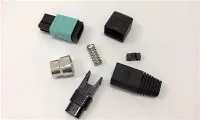
First things first, let's talk about what a Fiber Optic LC Pigtail actually is. In a nutshell, it's a short, single - length fiber optic cable with an LC connector on one end and a bare fiber on the other. These pigtails are super handy for splicing into larger fiber optic networks, and they're used in a whole bunch of applications, from data centers to telecommunications.
Now, onto the fiber material. The most common fiber material used in Fiber Optic LC Pigtails is silica glass. Silica, which is basically silicon dioxide (SiO₂), is the go - to choice for a bunch of good reasons.
One of the main advantages of silica glass is its low attenuation. Attenuation is just a fancy word for the loss of signal strength as light travels through the fiber. With silica glass, the attenuation is really low, especially in the infrared wavelengths that are commonly used in fiber optic communication. This means that the light signal can travel longer distances without losing too much strength, which is crucial for long - haul and high - speed data transmission.
Another great thing about silica glass is its high transparency. It allows light to pass through it with very little scattering. Scattering can cause the light signal to get distorted, and that's a big no - no when you're trying to send accurate data. The high transparency of silica glass ensures that the light signal remains clear and strong, resulting in reliable communication.
Silica glass also has excellent mechanical properties. It's strong enough to withstand the rigors of installation and day - to - day use. It can handle bending and pulling to a certain extent without breaking or losing its performance. Of course, there are limits to how much you can bend or stretch it, but overall, it's a pretty tough material.
There are different types of silica - based fibers used in Fiber Optic LC Pigtails. Single - mode fiber (SMF) and multi - mode fiber (MMF) are the two main categories.
Single - mode fiber is designed to carry a single mode of light. It has a very small core diameter, usually around 9 microns. Because of this small core, single - mode fiber can support extremely high - speed and long - distance communication. It's often used in applications like long - haul telecommunications, backbone networks in data centers, and high - definition video transmission. If you're looking for a Lc Simplex Fiber Patch Cord for a high - performance, long - distance setup, chances are it'll be made with single - mode silica fiber.
On the other hand, multi - mode fiber has a larger core diameter, typically 50 or 62.5 microns. It can carry multiple modes of light simultaneously. Multi - mode fiber is more suitable for shorter - distance applications, such as local area networks (LANs) within a building or campus. It's also generally less expensive than single - mode fiber, which makes it a popular choice for cost - sensitive projects.
But silica glass isn't the only game in town. There are also other fiber materials that can be used in Fiber Optic LC Pigtails.
Plastic optical fiber (POF) is one alternative. POF is made from polymers, which are basically large molecules made up of repeating units. POF has a much larger core diameter than silica fiber, usually around 1 millimeter. This makes it easier to work with, especially for DIY or small - scale installations. It's also more flexible and less brittle than silica glass.
However, POF has some limitations. Its attenuation is higher than that of silica glass, which means the signal can't travel as far. It's also not suitable for high - speed, long - distance communication. But for short - range applications like home networks or automotive communication systems, POF can be a cost - effective and easy - to - install option.
Another option is fluoride glass fiber. Fluoride glass has even lower attenuation than silica glass in some wavelength ranges. It can potentially support even longer - distance and higher - speed communication. However, fluoride glass is more difficult and expensive to manufacture, which limits its widespread use.
When choosing the fiber material for your Fiber Optic LC Pigtails, you need to consider your specific application requirements. If you're setting up a large - scale data center with high - speed, long - distance connections, single - mode silica fiber is probably your best bet. For a small office LAN or a home network, multi - mode silica fiber or even POF might be sufficient.
We also offer other types of pigtails, like Fiber Optic E2000 Pigtail and Fiber Optic St Pigtails, which are made with similar high - quality fiber materials to ensure reliable performance.
If you're in the market for Fiber Optic LC Pigtails or any of our other fiber optic products, I'd love to have a chat with you. Whether you're a network engineer, a system integrator, or just someone looking to set up a small network at home, we can help you find the right fiber material and product for your needs. Don't hesitate to reach out for a quote or to discuss your project requirements. We're here to make sure you get the best fiber optic solutions for your specific situation.
References:
- "Fiber Optic Communication Systems" by Govind P. Agrawal
- "Optical Fiber Technology: Principles and Applications" by R. Ramaswami, K. N. Sivarajan, and G. Sasaki