Hey there! As a fiber optic pigtail supplier, I often get asked about the difference between low - loss and standard fiber optic pigtails. So, let's dive right into it and break down these two types of pigtails.
What Are Fiber Optic Pigtails?
First off, for those who might not know, fiber optic pigtails are short, single - ended fiber optic cables with a connector pre - installed on one end. They're used to terminate fiber optic cables, allowing for easy connection to other fiber optic equipment. We offer a variety of them, like the Fiber Optic E2000 Pigtail and Fiber Optic Lc Pigtails.
Standard Fiber Optic Pigtails
Standard fiber optic pigtails are the workhorses of the fiber optic world. They're widely used in many different applications because they're cost - effective and reliable for most common scenarios.
Construction and Materials
These pigtails are typically made with standard optical fibers, like single - mode or multi - mode fibers. The connectors are usually made of materials like ceramic, which is a good balance between cost and performance. The cable jacket is often made of PVC or LSZH (Low - Smoke Zero - Halogen) materials, depending on the installation environment.
Performance
In terms of performance, standard pigtails have a certain level of insertion loss. Insertion loss is the amount of light that is lost when the signal travels through the pigtail and the connector. For standard pigtails, the insertion loss can range from about 0.3 dB to 0.5 dB. This is acceptable for many applications, such as local area networks (LANs) in small to medium - sized businesses, where the distances are relatively short and the data rates aren't extremely high.
Applications
Standard pigtails are great for general - purpose applications. For example, they're commonly used in enterprise networks for connecting servers, switches, and routers. They're also used in CCTV systems for transmitting video signals over short distances. Another application is in fiber - to - the - home (FTTH) installations, where they connect the optical network terminal (ONT) to the in - home equipment.
Low - Loss Fiber Optic Pigtails
Now, let's talk about low - loss fiber optic pigtails. These are designed for more demanding applications where minimizing signal loss is crucial.

Construction and Materials
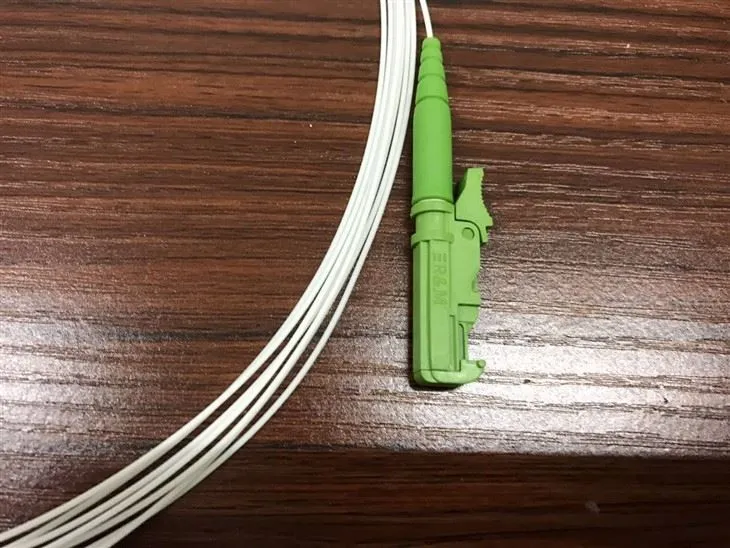
Low - loss pigtails use high - quality optical fibers with better light - guiding properties. The connectors are often made of high - precision ceramic or other advanced materials. The manufacturing process is also more precise, with tighter tolerances to ensure a better connection and less signal loss. For example, the end - face of the connector is polished to a very high level of smoothness to reduce reflection and scattering of light.
Performance
The key feature of low - loss pigtails is their significantly lower insertion loss. They can achieve insertion losses as low as 0.1 dB or even lower. This means that more light is able to pass through the pigtail and the connector, resulting in a stronger and clearer signal. This is especially important for long - distance transmissions and high - speed data networks.
Applications
Low - loss pigtails are used in applications where signal quality is of the utmost importance. In long - haul telecommunications networks, where signals need to travel hundreds or even thousands of kilometers, low - loss pigtails are essential to maintain the integrity of the signal. They're also used in data centers for high - speed interconnects, such as 100G, 400G, or even higher - speed networks. Another application is in high - definition video transmission, like in broadcast studios or large - scale digital signage systems.
Why Choose Low - Loss Over Standard?
You might be wondering, if low - loss pigtails are better, why not just use them all the time? Well, it comes down to cost and application requirements.
Cost
Low - loss pigtails are more expensive than standard pigtails. The high - quality materials and the more precise manufacturing process drive up the cost. So, if your application doesn't require extremely low signal loss, it might not be worth the extra expense.
Application Requirements
As mentioned earlier, standard pigtails are sufficient for most common applications. But if you're dealing with long - distance transmissions, high - speed data rates, or applications where signal quality is critical, then low - loss pigtails are the way to go. For example, if you're building a data center that needs to support 400G Ethernet connections, using low - loss pigtails will ensure better performance and less data retransmissions.
Our Offerings
As a fiber optic pigtail supplier, we understand the needs of different customers. That's why we offer both standard and low - loss fiber optic pigtails. Our Fiber Optic Lc Pigtails and Lc Simplex Fiber Patch Cord come in both standard and low - loss options. Whether you're a small business looking for a cost - effective solution or a large enterprise in need of high - performance pigtails, we've got you covered.
Contact Us for Procurement
If you're in the market for fiber optic pigtails and need to figure out whether standard or low - loss is right for your application, don't hesitate to reach out. We have a team of experts who can help you make the best choice based on your specific requirements. Whether you need a small quantity for a one - time project or a large - scale supply for a long - term installation, we're here to assist you.
References
- "Fiber Optic Communication Systems" by Govind P. Agrawal
- "Optical Fiber Technology: Principles and Applications" by Wayne C. Young
- Industry whitepapers on fiber optic pigtail performance and applications.