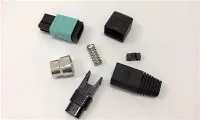
In the realm of fiber optic technology, the choice between bend - insensitive and standard Fiber Optic ST Pigtails can significantly impact the performance and reliability of your network. As a trusted supplier of Fiber Optic ST Pigtails, I am here to shed light on the differences between these two types, helping you make an informed decision for your specific needs.
Understanding Fiber Optic ST Pigtails
Before delving into the differences, let's briefly understand what Fiber Optic ST Pigtails are. An ST pigtail is a short length of fiber optic cable with an ST connector pre - installed at one end. The ST (Straight Tip) connector is a popular choice in fiber optic networks due to its simplicity and ease of use. It features a bayonet - style coupling mechanism, which allows for quick and secure connections. These pigtails are commonly used in various applications, including local area networks (LANs), data centers, and telecommunications systems.
Standard Fiber Optic ST Pigtails
Standard Fiber Optic ST Pigtails have been the workhorse of the fiber optic industry for many years. They are designed to meet the basic requirements of most fiber optic networks.
Construction and Design
Standard pigtails are typically made of single - mode or multi - mode fiber. Single - mode fiber is used for long - distance transmissions, while multi - mode fiber is suitable for shorter distances, such as within a building or campus. The fiber core in standard pigtails is surrounded by a cladding layer, which helps to keep the light signals within the core. The outer jacket provides protection against physical damage and environmental factors.
Performance Characteristics
In terms of performance, standard Fiber Optic ST Pigtails offer good signal transmission capabilities. They have relatively low attenuation, which means that the light signals can travel a certain distance without significant loss. However, they are sensitive to bending. When a standard pigtail is bent beyond its recommended radius, the light signals can leak out of the core, resulting in increased attenuation and signal loss. This can lead to degraded network performance, such as slower data transfer speeds and higher error rates.
Applications
Standard pigtails are well - suited for applications where the fiber optic cables are installed in a relatively straight and unobstructed environment. For example, in a well - organized data center, where the cables are neatly routed through cable trays and racks, standard pigtails can provide reliable performance. They are also commonly used in traditional LANs, where the network layout is relatively simple.
Bend - Insensitive Fiber Optic ST Pigtails
With the increasing complexity of modern fiber optic networks, bend - insensitive Fiber Optic ST Pigtails have emerged as a solution to address the limitations of standard pigtails.
Construction and Design
Bend - insensitive pigtails are designed with a special fiber structure that allows them to withstand tight bends without significant signal loss. They use a technology called bend - insensitive fiber (BIF), which has a modified refractive index profile in the fiber core and cladding. This design helps to keep the light signals confined within the core, even when the fiber is bent. The outer jacket of bend - insensitive pigtails is also designed to provide additional protection against bending and other physical stresses.


Performance Characteristics
The main advantage of bend - insensitive Fiber Optic ST Pigtails is their ability to maintain low attenuation even when bent. They can tolerate much smaller bend radii compared to standard pigtails. For example, a standard pigtail may require a minimum bend radius of 30 mm, while a bend - insensitive pigtail can tolerate a bend radius as small as 7.5 mm. This makes them ideal for applications where the fiber optic cables need to be routed around corners, through tight spaces, or in areas with limited installation space.
Applications
Bend - insensitive pigtails are widely used in applications where the fiber optic cables are likely to be bent or twisted. In residential and commercial buildings, where the cables may need to be routed through walls, ceilings, and floors, bend - insensitive pigtails can ensure reliable signal transmission. They are also commonly used in fiber - to - the - home (FTTH) networks, where the cables are often installed in a more challenging environment.
Key Differences between Bend - Insensitive and Standard Fiber Optic ST Pigtails
Bend Tolerance
As mentioned earlier, the most significant difference between bend - insensitive and standard pigtails is their bend tolerance. Standard pigtails are more susceptible to bending, which can lead to signal loss. Bend - insensitive pigtails, on the other hand, can withstand tight bends without significant attenuation, making them more suitable for complex installation environments.
Installation Flexibility
Bend - insensitive pigtails offer greater installation flexibility. They can be routed around obstacles and through tight spaces more easily than standard pigtails. This can reduce the installation time and cost, especially in applications where the cable routing is complex. For example, in a retrofit project where the existing building structure limits the cable installation options, bend - insensitive pigtails can be a game - changer.
Cost
In general, bend - insensitive Fiber Optic ST Pigtails are more expensive than standard pigtails. The special fiber technology and additional design features required to make them bend - insensitive contribute to the higher cost. However, the cost difference may be offset by the savings in installation time and the improved network reliability.
Making the Right Choice
When choosing between bend - insensitive and standard Fiber Optic ST Pigtails, several factors need to be considered.
Network Requirements
If your network requires high - speed data transmission over long distances and the cables will be installed in a relatively straight environment, standard pigtails may be sufficient. However, if your network is subject to tight bends and complex cable routing, bend - insensitive pigtails are recommended to ensure reliable performance.
Installation Environment
The installation environment plays a crucial role in the choice of pigtails. In a new building with well - planned cable management systems, standard pigtails may work well. But in an old building or a retrofit project where space is limited and the cables need to be routed around existing structures, bend - insensitive pigtails are a better option.
Budget
Budget is always a consideration. If cost is a major concern and the network requirements can be met with standard pigtails, then they may be the more economical choice. However, if the long - term reliability and performance of the network are more important, investing in bend - insensitive pigtails may be worth the extra cost.
Our Product Offerings
As a leading supplier of Fiber Optic ST Pigtails, we offer a wide range of both standard and bend - insensitive options. Our products are manufactured to the highest quality standards, ensuring reliable performance and long - term durability. In addition to ST pigtails, we also provide other types of fiber optic products, such as Fiber Optic Sc Pigtail, Fiber Optic E2000 Pigtail, and Lc Simplex Fiber Patch Cord.
Contact Us for Procurement
If you are in the market for Fiber Optic ST Pigtails or any other fiber optic products, we invite you to contact us for a detailed discussion. Our team of experts can help you determine the best solution for your specific needs and provide you with a competitive quote. Whether you need a small quantity for a home network or a large - scale deployment for a data center, we have the products and expertise to meet your requirements.
References
- "Fiber Optic Communications Technology" by John M. Senior
- "Optical Fiber Telecommunications V" edited by Ivan P. Kaminow and Tingye Li
- Industry whitepapers on fiber optic cable design and performance.