Hey there! As a supplier of Fiber Optic ST Pigtails, I often get asked about the connector types of these pigtails. So, I thought I'd write this blog to share some insights and clear up any confusion.
First off, let's understand what a Fiber Optic ST Pigtail is. It's a short, single - fiber cable with an ST connector pre - installed at one end and a bare fiber at the other. These pigtails are used in fiber optic networks for various purposes like splicing to other fibers or connecting to equipment.
The ST Connector
The ST connector is one of the most common types of fiber optic connectors out there. It was developed by AT&T back in the 1980s. The "ST" stands for Straight - Tip. One of the key features of the ST connector is its bayonet - style coupling mechanism. This means it has a twist - lock design, similar to what you'd find on some camera lenses. You simply insert the connector into the receptacle and give it a quarter - turn to lock it in place. This makes it quick and easy to install and remove, which is great for field installations and maintenance.
The ST connector uses a 2.5mm ferrule to hold the fiber in place. The ferrule is a small, precision - made tube that aligns the fiber cores accurately. This alignment is crucial because even a tiny misalignment can cause significant signal loss. The end - face of the ferrule is polished to a high degree of smoothness to ensure good optical performance.
Other Connector Types in Comparison
While the ST connector is popular, there are other connector types in the fiber optic world that are worth mentioning.
LC Simplex Fiber Patch Cord
The Lc Simplex Fiber Patch Cord uses the LC connector. The LC connector is a small - form - factor connector. It's about half the size of the ST connector. This makes it ideal for high - density applications where space is limited, like in data centers. The LC connector uses a 1.25mm ferrule, which is smaller than the ST's 2.5mm ferrule. It has a push - pull locking mechanism, so you just push it in to connect and pull it out to disconnect. It offers low insertion loss and high return loss, which means it can transmit signals with less loss and less reflection.
Fiber Optic Lc Pigtails
Fiber Optic Lc Pigtails also use the LC connector. They are similar to ST pigtails in that they have a pre - installed connector at one end and a bare fiber at the other. The main difference is the connector type. The LC pigtails are often used in telecommunications equipment and high - speed network connections. Because of their small size, you can fit more LC connectors in a given area compared to ST connectors.
Fiber Optic Fc Pigtail
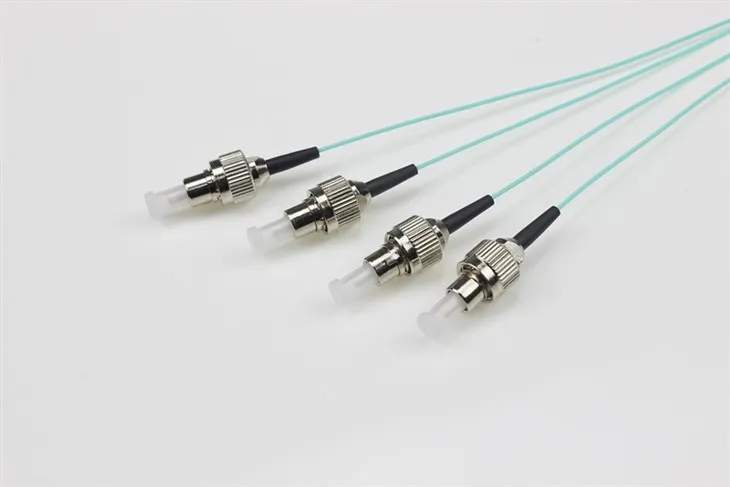
The Fiber Optic Fc Pigtail uses the FC connector. The FC connector has a threaded coupling mechanism. You screw the connector into the receptacle, which provides a very secure connection. It's often used in applications where vibration or movement could be an issue, like in some industrial settings. The FC connector also uses a 2.5mm ferrule, similar to the ST connector. However, the installation process is a bit more time - consuming compared to the ST's bayonet - style or the LC's push - pull design.
Advantages of Fiber Optic ST Pigtails
One of the big advantages of Fiber Optic ST Pigtails is their durability. The bayonet - style locking mechanism is robust and can withstand repeated insertions and removals without getting loose. This makes them suitable for environments where there might be a lot of handling, like in some telecommunication closets.
Another advantage is their wide availability. The ST connector has been around for a long time, so there are a lot of compatible devices and equipment in the market. If you're upgrading or expanding an existing fiber optic network that already uses ST connectors, it's easy to integrate new ST pigtails.
They also offer good optical performance. With proper installation and alignment, ST pigtails can provide low insertion loss and acceptable return loss. This means that the signal can travel through the fiber with relatively little degradation.
Applications of Fiber Optic ST Pigtails
Fiber Optic ST Pigtails are used in a variety of applications. In local area networks (LANs), they are often used to connect network switches, routers, and servers. They can also be used in telecommunications networks for connecting fiber optic cables to telephone exchanges or central offices.
In the industrial sector, ST pigtails can be used for monitoring and control systems. For example, in a manufacturing plant, they can be used to connect sensors and other devices to a central control unit via fiber optic cables.
Quality and Testing
As a supplier, we take quality very seriously. All our Fiber Optic ST Pigtails go through a series of tests before they are shipped out. We test for insertion loss, return loss, and visual inspection of the connector end - faces. Insertion loss is the amount of signal power that is lost when the pigtail is connected to the network. Return loss is the amount of signal that is reflected back from the connector. We make sure that these values are within the industry - standard limits.
We also use high - quality materials for our pigtails. The fibers are made from high - purity silica glass, which has excellent optical properties. The connectors are made from durable materials that can withstand environmental factors like temperature changes and humidity.
Why Choose Our Fiber Optic ST Pigtails
If you're in the market for Fiber Optic ST Pigtails, there are a few reasons why you should choose us. First, we have a wide range of pigtails available. Whether you need single - mode or multi - mode pigtails, we've got you covered. Single - mode pigtails are used for long - distance transmissions, while multi - mode pigtails are better for shorter distances.
Second, our prices are competitive. We understand that cost is an important factor for our customers, so we work hard to keep our prices down without compromising on quality.

Finally, we offer excellent customer service. Our team of experts is always ready to answer your questions and help you choose the right pigtails for your specific needs.
Contact Us for Purchase
If you're interested in purchasing our Fiber Optic ST Pigtails or have any questions about them, don't hesitate to reach out. We're here to help you find the best fiber optic solutions for your network. Whether you're a small business looking to upgrade your LAN or a large corporation in need of a high - performance telecommunications network, we can provide the right products and support.
References
- "Fiber Optic Network Design and Implementation" by a well - known author in the field.
- Industry standards documents from organizations like the Telecommunications Industry Association (TIA) and the International Electrotechnical Commission (IEC).