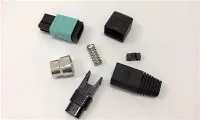
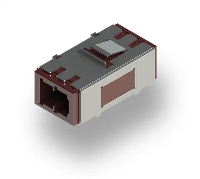
Hey there! As a supplier of Fiber Optic MPO Adapters, I often get asked about how these nifty devices handle signal attenuation. Signal attenuation is like the bad guy in the world of fiber - optic communication. It's the reduction in the strength of a signal as it travels through a fiber - optic cable. And let me tell you, it can really mess up your data transmission if not dealt with properly.
So, what exactly are Fiber Optic MPO Adapters? MPO stands for Multi - Fiber Push - On. These adapters are designed to connect multiple fiber - optic cables at once, which is super handy in high - density applications like data centers. They can hold anywhere from 4 to 72 fibers in a single connector, making them a real space - saver.
Now, let's dig into how they handle signal attenuation. First off, the design of the MPO adapter plays a huge role. The connectors are precision - engineered to ensure a tight and accurate fit between the fibers. When the fibers are properly aligned, the light signal can pass through with minimal loss. Think of it like trying to pour water through two straws. If the straws are lined up perfectly, the water flows smoothly. But if they're misaligned, some water will spill out. In the same way, misaligned fibers in an MPO adapter can cause the light signal to leak out, leading to signal attenuation.
Another factor is the quality of the materials used. High - quality MPO adapters are made from materials that have low optical loss. For example, the ferrules, which hold the fibers in place, are often made from zirconia. Zirconia is a great material because it's very hard and has a smooth surface. This smooth surface helps to reduce the scattering of light as it passes through the fibers, thus minimizing signal attenuation.
The polishing process of the fibers is also crucial. A well - polished fiber end - face will have a flat and smooth surface, which allows the light to pass through more efficiently. When the end - face is rough or has scratches, the light can bounce around in unpredictable ways, causing signal loss. Our MPO adapters go through a rigorous polishing process to ensure that the fiber end - faces are as perfect as possible.


Now, let's talk about some of the other types of fiber - optic adapters out there. If you're looking for something a bit different, you might be interested in Fiber Optic Lc Adapters. LC adapters are single - fiber connectors that are commonly used in telecommunications and data networking. They're smaller than MPO adapters and are great for applications where space is limited.
If you're into FTTH (Fiber to the Home) networking, Factory Price Ftth Networking Lc - lc Duplex Fiber Adapter could be a good choice. These duplex adapters are designed to connect two fibers at once, which is useful for applications like internet and TV services in homes.
And then there's the Fiber Optic St Coupler. ST couplers are another type of single - fiber connector. They use a bayonet - style locking mechanism, which makes them easy to install and remove. They're often used in older networking systems.
But back to MPO adapters. In addition to the design, material, and polishing, environmental factors can also affect signal attenuation. Temperature, humidity, and vibration can all have an impact on the performance of MPO adapters. For example, extreme temperatures can cause the materials in the adapter to expand or contract, which can lead to misalignment of the fibers. That's why it's important to choose MPO adapters that are designed to withstand a wide range of environmental conditions.
We also offer MPO adapters with different types of coatings. These coatings can help to protect the fibers from damage and reduce the effects of environmental factors. For example, some coatings are designed to be resistant to moisture, which can prevent corrosion of the fibers.
When it comes to testing, we don't just rely on visual inspections. We use advanced testing equipment to measure the signal attenuation of our MPO adapters. This allows us to ensure that each adapter meets our high standards of quality. We test for things like insertion loss, which is a measure of how much the signal is weakened when it passes through the adapter. We also test for return loss, which is a measure of how much of the signal is reflected back towards the source.
So, if you're in the market for high - quality MPO adapters that can effectively handle signal attenuation, look no further. We've got a wide range of MPO adapters to suit your needs, whether you're working on a small - scale project or a large - scale data center. And if you have any questions about which adapter is right for you, our team of experts is always here to help.
If you're interested in purchasing our Fiber Optic MPO Adapters or want to learn more about how they can benefit your project, don't hesitate to reach out. We're eager to have a chat with you and discuss your specific requirements. Whether you're a small - time contractor or a big - name corporation, we're committed to providing you with the best products and services. Let's start a conversation and see how we can work together to make your fiber - optic communication systems run smoothly.
References
- "Fiber Optic Communication Systems" by Govind P. Agrawal
- "Optical Fiber Technology: Principles and Applications" by R. Ramaswami and K. N. Sivarajan