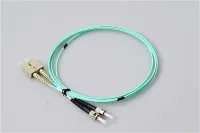
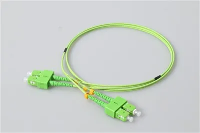
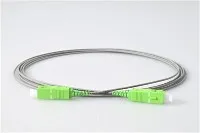
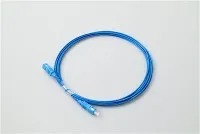
Fiber optic pigtails and fiber optic jumpers, as two commonly used network connection devices in fiber optic networks, have many similarities, so many people may be confused and often confuse them. In fact, the most intuitive difference between fiber optic pigtails and fiber optic jumpers is that only one end of the pigtail has a connector, while fiber optic jumpers have connectors at both ends.
Fiber optic jumper: also known as fiber optic connector, with connectors at both ends. It is similar to coaxial cable except that there is no mesh shielding layer. It is used as a Patch cable from the equipment to the optical fiber cabling link. Generally used for the connection between optical terminals and terminal boxes.
The commonly used fiber optic jumpers in current network engineering include:
1. FC type fiber optic jumper: The external reinforcement method is to use a metal sleeve, and the fastening method is to use a screw buckle. Usually used on the ODF side. (Most used on distribution frames)
2. SC type optical fiber jumper: It is a connector connecting GBIC Optical module. Its shell is rectangular, and its fastening method is plug and pull pin latch type, without rotation. (Most used on router switches)
3. ST type fiber optic patch cord: commonly used in fiber optic distribution frames, with a circular shell and a screw buckle fastening method. (commonly used in fiber optic distribution frames)
4. LC type fiber optic patch cord: A connector for connecting SFP modules, made using a modular jack (RJ) latch mechanism for easy operation. (commonly used in routers)
Fiber optic tail fiber: also known as pigtail wire, one end is a connector, and the other end is a broken end of the fiber optic cable core. Mainly used to connect optical cables to fiber optic transceivers (couplers, jumpers, etc. are also used between them). It usually appears inside the fiber optic terminal box and is connected to other fiber optic cable cores through fusion, which can simplify the installation and maintenance of the cable system.
Tail fibers are generally divided into single mode tail fibers and multimode tail fibers. The single mode tail fiber has wavelengths of 1310nm and 1550nm, with transmission distances of 10km and 40km, respectively; The multimode tail fiber has a wavelength of 850nm and a transmission distance of 500m, used for short distance interconnection. The high-speed (FS) tail fibers all use precision ceramic inserts, with strong anti pressure and anti drag performance, and comply with Telcordia and EIA/TIA standards.