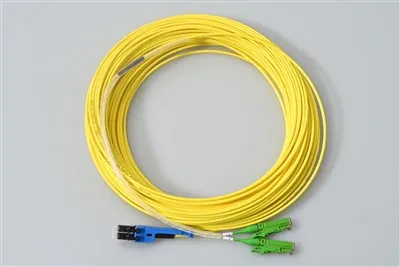
What is LC FC patch cable?
LC-FC fiber patch cable with two LC fiber connectors terminated at both ends is the most commonly used fiber optic cable type in the industry. Compared with other common fiber optic cables, FC fiber cables offer high density and reliable performance in most applications
Our cables are 100% optically inspected and tested for insertion loss.
Specification
| Connector Type | LC UPC to LC UPC | Fiber Mode | Yellow 9/125μm |
| Fiber Grade | G657A/G652D | Wavelength | 1310/1550nm |
| Insertion Loss | ≤0.3dB | Return Loss | ≥50dB |
| Min. Bend Radius(Fiber Core) | 10mm | Min. Bend Radius(Fiber Cable) | 10/5D (Dynamic/Static) |
| Fiber Count | Duplex | Cable Jacket | LSZH |
| Operating Temperature | -20~70°C | Storage Temperature | -40~80°C |
The classification methods of optical cables
Optical fiber cable is a communication line that uses optical fibers meeting optical performance requirements as the transmission medium to achieve optical signal transmission. It consists of components such as the cable core, reinforcement elements, and sheath, and may also include additional elements like waterproof layers, buffer layers, insulation layers, and armor layers as needed.
The classification methods of optical cables mainly include the following:
By transmission medium: categorized into single-mode fiber optic cables and multimode fiber optic cables.
According to the cable core structure: it is divided into stranded optical cable, skeletal optical cable, central tube optical cable, ribbon optical cable, and flat optical cable.
Reinforced components: categorized into non-metallic optical cables, standard optical cables, and reinforced component optical cables.
By installation method: divided into duct optical cable, overhead optical cable, direct-buried optical cable, and submarine optical cable.
Based on the usage environment, they are categorized into indoor optical cables and outdoor optical cables.
Applications
Data Center Cabling
Widely used for interconnection between patch panels, switches, transceivers, and network devices in data centers, helping ensure high-speed and stable data transmission.
Telecom Networks
Suitable for telecommunications rooms, central offices, and optical distribution systems where dependable duplex fiber connectivity is required.
Local Area Networks (LAN)
Ideal for enterprise LAN backbones and fiber-to-device connections, supporting efficient communication between network equipment.
Fiber Optic Patch Panels and Distribution Frames
Commonly used to connect fiber patch panels, ODF systems, and distribution boxes, allowing convenient routing, management, and maintenance of optical links.
FTTH and Premise Networks
Suitable for indoor fiber wiring applications such as FTTH, office networks, building backbone links, and other structured cabling systems.
CATV and Multimedia Transmission
Applicable to CATV systems and other multimedia optical transmission networks that require reliable duplex fiber connections.
FAQ
Q: 1. What is an LC UPC to LC UPC duplex patch cable?
A: It is a fiber optic patch cable terminated with LC UPC connectors on both ends, using a duplex structure for bidirectional optical signal transmission.
Q: 2. What does "duplex" mean?
A: Duplex means the cable contains two fibers, allowing one fiber to transmit and the other to receive signals at the same time.
Q: 3. What does UPC mean?
A: UPC stands for Ultra Physical Contact. It refers to the connector end-face polish type, which helps reduce insertion loss and improve signal performance.
Q: 4. What is this patch cable mainly used for?
A: It is mainly used for connections between fiber optic transceivers, patch panels, switches, routers, ODF systems, and other network equipment.
Q: 5. Is this cable suitable for single mode or multimode applications?
A: LC UPC to LC UPC duplex patch cables can be made in single mode or multimode versions. The correct type should be selected according to your network system requirements.
Q: 6. What is the difference between single mode and multimode patch cables?
A: Single mode fiber is typically used for long-distance transmission, while multimode fiber is more commonly used for short-distance, high-bandwidth indoor networks.
Q: 7. Can this cable be used in data centers?
A: Yes. It is commonly used in data centers for equipment interconnection, patching, and high-density fiber management.
Q: 8. How do I choose the right cable length?
A: The cable length should be selected based on the actual installation distance, while allowing enough slack for cable routing and maintenance.
Q: 9. Is this cable suitable for indoor use?
A: Yes. Most LC to LC duplex patch cables are designed for indoor applications such as server rooms, telecom rooms, office wiring, and structured cabling systems.
Q: 10. Can the cable be customized?
A: In many cases, custom options such as fiber type, cable length, jacket material, polish type, and color are available depending on project requirements.
Q: 11. What jacket types are commonly available?
A: Common jacket types include PVC, LSZH, and OFNR, depending on installation environment and fire safety requirements.
Q: 12. Is factory testing available?
A: Yes. High-quality fiber patch cables are usually factory terminated and tested before shipment to ensure consistent optical performance.
13. How should I clean the connectors before use?
Use a professional fiber optic cleaning tool to clean the connector end face before installation. Dust or contamination may cause signal loss or connection failure.
Q: 14. What should I confirm before ordering?
A: Before ordering, please confirm:
Connector type
Polish type
Fiber mode
Duplex or simplex structure
Cable length
Jacket material
Application environment
Hot Tags: fiber optic lc upc to lc upc patch cable duplex, China fiber optic lc upc to lc upc patch cable duplex manufacturers, suppliers, factory, fiber optic patch cord for media producers, fiber optic patch cord for passive optical network pon , fiber optic patch cord retail, singlemode fiber optic patch cord, economical fiber optic patch cord, fiber connecting cord