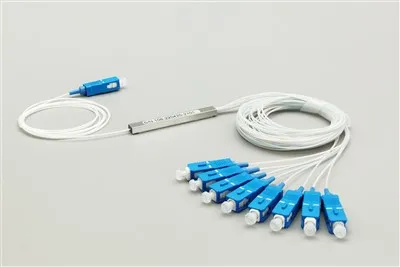
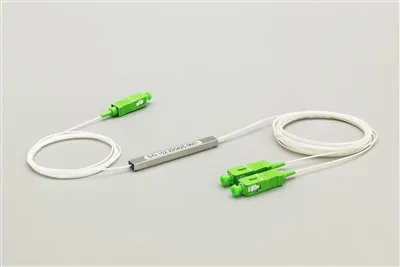
What is 1X16 PLC Fiber Splitter?
EVOLUX 1X16 PLC Fiber Splitter, Steel Tube, Bare Fiber 250μm, Singlemode is designed to meet the evolving demands of the global telecommunications industry. This passive optical device connects OLT (Optical Line Terminal) and ONU (Optical Network Unit) by splitting one or two fibers into multiple fibers, enabling the connection of multiple branch optical fibers. With a wide range of split ratios (1:2, 1:4, 1:8, 1:16, 1:32, and 1:64) and various encapsulation options, our PLC Fiber Splitter is perfect for indoor, outdoor, and indoor/outdoor applications.

Environmental Performance Requirements
|
No. |
Test item |
Test method |
Criterion |
|
|
Insertion loss variation |
Appearance change after test |
|||
|
a |
High temperature |
85 ℃ (±2 ℃ ),duration time 96h,on-line test |
≤0.4 dB |
No mechanical damage in |
|
b |
Low temperature |
-40 ℃ (±2 ℃ ),duration time 96h,on-line test |
≤0.5 dB |
appearance, such as |
|
c |
dampness-heat |
75 ℃ (±2 ℃ ),95%(±5%)RH, duration time 96h,on-line test |
≤0.5 dB |
deformation , cracks, |
|
d |
Temperature cycling |
( -40 ℃ ~ + 85 ℃ ),one circulation 8h, 21 times circulation, on-line test |
≤0.5 dB |
loose. No fiber fracture, |
|
e |
Water soaking |
Room temperature, tap-water, duration time 168h |
≤0.3 dB |
fiber pull-out, fiber |
|
f |
Salt fog |
Saline solution: 5% NaCl, 6.5 |
≤0.3 dB |
endpoint fault and cable seal damage etc. |
|
Temperature : 35°C |
||||
|
duration time : 96 hours |
||||
|
Note 1 : Temperature circulation test will be the conversion curve shown as below, one circulation takes 8h,21 times. |
||||
Features
- High-quality PLC design with a protective metal casing
- PLC splitting mechanism divides input signal into equal parts across all output fibers
- 900µm loose tube fiber for easy stripping, splicing, or terminating
- Operating and storage temperature range: -40°C to 85°C
- Wavelength: 1260nm / 1650nm
Applications

FTTH/FTTX - Residential Broadband
- GPON/EPON distribution networks
- Fiber splice closure integration
- Multi-dwelling unit (MDU) deployments
- Drop cable distribution points
- Last-mile fiber distribution

Telecom - Central Office & PON
- OLT port splitting for subscriber lines
- Passive optical network nodes
- High-density ODN cabinet installation
- Signal distribution in CO facilities
- Redundant path configurations

Enterprise - LAN & CATV
- Campus fiber backbone splitting
- CATV signal distribution
- Surveillance system fiber feeds
- Data center interconnection
- Test & measurement setups
FAQ
Q: Why choose a bare fiber splitter instead of one with connectors?
A: Great question - this really depends on your installation scenario. Bare fiber splitters are perfect when you're doing permanent, fixed installations like splice closures or terminal boxes. Since there's no connector, you fusion splice it directly to your fiber cables. The big wins here? Lower cost per unit, more compact size that fits tight spaces, and actually slightly better optical performance since there's no connector loss to worry about. We see a lot of FTTH contractors prefer this for large-scale rollouts where they're splicing everything anyway.
Q: What's the typical insertion loss I should expect from a 1x16 splitter?
A: For a 1x16 PLC splitter, you're looking at around 12-14 dB insertion loss - that's just the physics of splitting one signal into 16 equal parts. Our splitters typically come in at the lower end of that range. The good news is PLC technology gives you very uniform loss across all 16 output ports (usually within 1.2 dB), which is way better than older FBT splitters. This uniformity matters a lot when you're trying to balance your power budget across multiple ONUs.
Q: Can I use this splitter outdoors?
A: The steel tube package itself is pretty robust, but here's the thing - bare fiber ends need protection from the environment. So you wouldn't mount this exposed outside. What works great is installing it inside a weatherproof splice closure or outdoor cabinet. The splitter handles the temperature swings no problem (-40°C to +85°C), it's really about protecting those bare fiber ends from moisture and physical damage. We've got customers running these in everything from desert heat to Scandinavian winters - inside proper enclosures, of course.
Q: What's the difference between 250μm and 900μm bare fiber options?
A: The 250μm is the raw fiber with just the primary coating - super compact, ideal for tight spaces like cassette trays or small splice boxes. The 900μm has an additional tight buffer that makes it easier to handle and more durable during installation - better choice if your techs are working in the field under less-than-ideal conditions. Performance-wise, they're identical. Most of our FTTH customers go with 250μm for density, while test labs and enterprise installs often prefer 900μm for the easier handling.
Q: How does a 1x16 splitter compare to using two 1x8 splitters in cascade?
A: Good thinking on the architecture! A single 1x16 gives you lower total insertion loss compared to cascading two 1x8s (you'd add the losses together in cascade). It's also simpler - one splice point instead of multiple. However, cascading can make sense for distributed architectures where you want to split at different locations along your route. We help customers model their specific power budgets all the time - just send us your network layout and we'll recommend the best approach.
Q: What wavelengths does this splitter support?
A: This is one of the big advantages of PLC technology - it's wavelength-independent across the entire 1260nm to 1650nm range. That covers all your PON wavelengths: 1310nm upstream, 1490nm downstream for GPON, 1550nm for video overlay or CATV, and even the newer wavelengths for XGS-PON and NG-PON2. So you're future-proofed - no need to swap out splitters when you upgrade your PON equipment down the road.
Hot Tags: 1x16 plc fiber splitter without connector, China 1x16 PLC fiber splitter without connector manufacturers, suppliers, factory, fiber optic plc splitter tuv certification, fiber optic plc splitter fcc certification, feature of fiber optic plc splitter, precision fiber optic plc splitter, miniature fiber optic plc splitter, advertising of fiber optic plc splitter