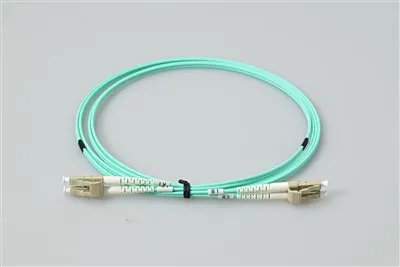
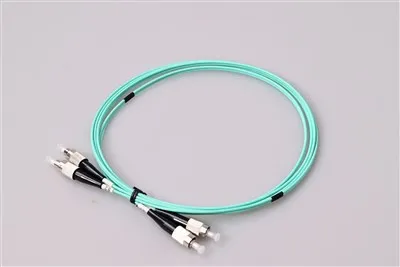
What is SC FC patch cable?
SC-FC fiber patch cable with two SC fiber connectors terminated at both ends is the most commonly used fiber optic cable type in the industry. Compared with other common fiber optic cables, FC fiber cables offer high density and reliable performance in most applications
Our cables are 100% optically inspected and tested for insertion loss.

The LSZH cables make little smoke and no halogen, suited for horizontal structural cabling areas.
Specification
| Connector Type | SC UPC to FC UPC | Fiber Mode | Yellow 9/125μm |
| Fiber Grade | G657A/G652D | Wavelength | 1310/1550nm |
| Insertion Loss | ≤0.3dB | Return Loss | ≥50dB |
| Min. Bend Radius(Fiber Core) | 10mm | Min. Bend Radius(Fiber Cable) | 10/5D (Dynamic/Static) |
| Fiber Count | Duplex | Cable Jacket | LSZH |
| Operating Temperature | -20~70°C | Storage Temperature | -40~80°C |
The classification methods of optical cables
Optical fiber cable is a communication line that uses optical fibers meeting optical performance requirements as the transmission medium to achieve optical signal transmission. It consists of components such as the cable core, reinforcement elements, and sheath, and may also include additional elements like waterproof layers, buffer layers, insulation layers, and armor layers as needed.
The classification methods of optical cables mainly include the following:
By transmission medium: categorized into single-mode fiber optic cables and multimode fiber optic cables.
According to the cable core structure: it is divided into stranded optical cable, skeletal optical cable, central tube optical cable, ribbon optical cable, and flat optical cable.
Reinforced components: categorized into non-metallic optical cables, standard optical cables, and reinforced component optical cables.
By installation method: divided into duct optical cable, overhead optical cable, direct-buried optical cable, and submarine optical cable.
Based on the usage environment, they are categorized into indoor optical cables and outdoor optical cables.
Application

FTTH/FTTX Networks
- OLT to ODF connections in central offices
- PON network equipment interconnection
- Optical distribution frame patching
- Mixed APC/UPC equipment bridging

Data Centers & Enterprise Networks
- SFP/SFP+ transceiver module connections
- High-density patch panel cross-connects
- Server-to-switch fiber interconnections
- 1G/10G/25G/40G/100G Ethernet links

Telecommunications
- DWDM/CWDM equipment cross-connections
- Long-haul transmission systems
- Carrier-grade network infrastructure
- Wireless base station backhaul

Testing & Measurement
- OTDR and optical power meter connections
- Lab testing and R&D environments
- Network troubleshooting and diagnostics
- Reference cable for loss measurements
FAQ
Q: What's the difference between the APC and UPC connectors on this patch cord?
A: Good question – this is one of the most common things people ask about! The APC (Angled Physical Contact) end has an 8-degree angled polish on the ferrule, which gives you excellent return loss of ≥60dB by directing reflected light away from the fiber core. The UPC (Ultra Physical Contact) end has a flat, dome-shaped polish with return loss ≥50dB. We designed this hybrid cable specifically for situations where you need to bridge equipment with different connector types – like connecting an APC-terminated OLT to a UPC patch panel. The green connector is your APC side, blue is UPC – color-coded so you won't mix them up in the field.
Q: Can I connect an APC connector to a UPC port, or vice versa?
A: I'll be honest – this is something we strongly advise against. Here's why: the APC ferrule has that 8-degree angle, so if you plug it into a flat UPC adapter, the ferrules won't mate properly. You'll get an air gap, which means massive insertion loss (we're talking 2-3dB or more) and potential damage to both ferrule end-faces. That's exactly why we make these hybrid cables – so you can properly connect APC equipment to UPC equipment without forcing incompatible connectors together. Always match APC to APC adapters and UPC to UPC adapters at each end.
Q: Why is the cable jacket yellow? Does color matter?
A: Yellow is the industry standard color for singlemode fiber cables – it's not just for looks! Following TIA-598 color coding helps technicians instantly identify fiber type in the field. When you're working in a cabinet with hundreds of patch cords, being able to spot singlemode (yellow) versus multimode (orange for OM1/OM2, aqua for OM3/OM4) at a glance saves time and prevents costly mistakes. We stick to these standards across all our products, so your installation stays organized and compliant with industry best practices.
Q: What's the typical insertion loss I should expect?
A: Our LC APC to LC UPC patch cords are spec'd at ≤0.3dB insertion loss, but honestly, most units we ship come in around 0.15-0.2dB – we test every single cable before it leaves our facility. For the APC end, you're getting return loss ≥60dB, and the UPC end delivers ≥50dB. These numbers matter for your link budget calculations, especially in long-haul or high-speed applications. If you need test reports for a specific batch, just ask – we keep records and can provide individual test data.
Q: What does "duplex" mean? Do I need simplex or duplex?
A: Duplex means you've got two fibers in one cable – one for transmit, one for receive. Most network equipment uses duplex connections because data flows both ways simultaneously. The two LC connectors on each end are clipped together with a duplex clip, making installation clean and organized. If you're connecting a standard SFP transceiver to a patch panel, duplex is what you need. We do offer simplex (single fiber) versions too – those are typically used for specific applications like bidirectional transceivers or when you're just adding a monitoring tap.
Q: How should I clean the connectors, and how often?
A: Connector cleanliness is huge – we see more issues caused by dirty ferrules than anything else. Clean both ends before every insertion using lint-free wipes or a click-style cleaner designed for LC connectors. Even a tiny dust particle can cause 0.5dB or more of loss. Our connectors come with protective dust caps – keep those on whenever the cable isn't plugged in. For the APC end especially, contamination is more critical because of the angled surface. A quick clean takes 10 seconds and can save you hours of troubleshooting.
Q: What's the bend radius I need to maintain during installation?
A: We use G.657.A1 bend-insensitive fiber in these cables, which is much more forgiving than traditional G.652.D fiber. The minimum bend radius under load is 10mm – that's about the diameter of a pencil. For static installations (cable at rest), you can go even tighter. This matters a lot in high-density environments like patch panels where space is tight. That said, don't go crazy – tighter bends still increase attenuation slightly. Give your cables some slack and use proper cable management, and you'll have zero issues.
Q: Can this cable support 10G or higher speeds?
A: Absolutely – OS2 singlemode fiber can handle pretty much any speed you throw at it, from 1G all the way up to 400G and beyond. The bandwidth isn't limited by the fiber itself; it's determined by your transceivers. This cable works perfectly with 10GBASE-LR, 25GBASE-LR, 40GBASE-LR4, 100GBASE-LR4 – you name it. For long-distance runs, singlemode at 1310nm can reach 10km, and at 1550nm you're looking at 40km+. If you're building out infrastructure, singlemode is future-proof for whatever comes next.
Hot Tags: fiber optic sc fc patch cable mm dx, China fiber optic sc fc patch cable mm dx manufacturers, suppliers, factory, fiber optic patch cord with fc connector, cheap fiber optic patch cord, fiber optic patch cord for stadium optical network, fiber optic patch cord for underground optical network, fiber optic patch cord for machine learning, fiber optic patch cord with mpo connector